

Thursday morning, June 4, 2026. Lia Ofri Malka, 35, from Rishon Lezion, sets out as usual to drive her 2-year-old daughter to preschool. She has no idea that for long minutes, the person operating the explosive device planted in her car has been following her, patiently waiting until she drops off the child and says goodbye to her with kisses at the entrance to the preschool.
From there, Malka continues on her routine drive to work at an accounting office in Tel Aviv. Then, on Highway 20, the Ayalon Highway, near the Holon Interchange, with the press of a button from a distance, the ground around her shakes. A powerful explosive device weighing about 1 kilogram, which had been attached to her car, explodes, ripping the vehicle’s frame apart and leaving her no chance of survival.
Gallery
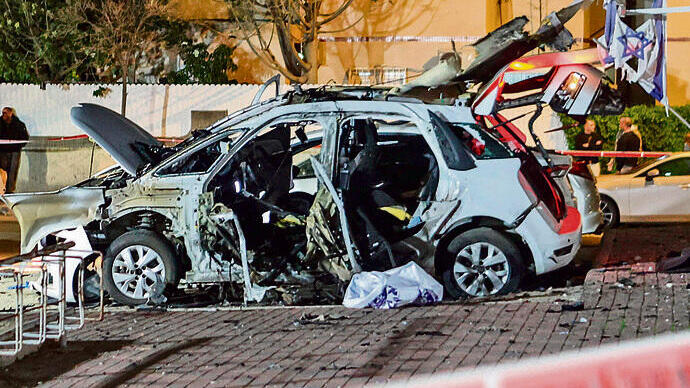
Explosion in Kiryat Yam in February of this year, which killed Guy Ben Simon and injured a 13-year-old boy
What initially seemed to police officers who rushed to the scene like another familiar underworld assassination turned out, according to suspicion, to be an act of domestic violence. Chen Cohen, Malka’s estranged partner, was immediately arrested on suspicion of carrying out the act, but in the absence of forensic or direct evidence physically tying him to the detonation, he was released. Prosecutors filed an alternative indictment against him for sending dozens of explicit threats to Malka’s father — chilling recordings and messages that police had even before the fatal explosion, but that failed to prevent the murder, whose warning signs were written on the wall in blood.
It was a tragic and unusual incident, but it also became part of the statistics of a wave of assassinations using explosive devices that has escalated over the past year. June, for example, became a deadly show of force by crime organizations, with no fewer than eight vehicles exploding across Israel and eight people losing their lives. Among the cases, in addition to Malka’s murder, were the explosive device that detonated at the Goral Junction in the Negev, killing two people and defined as a criminal accident, and additional assassinations in Jaffa, Holon, Musheirifa, Kiryat Gat and Kiryat Haim.
Alongside all of these, June also brought intelligence successes for police, including the thwarting of an attempt to assassinate southern crime boss Eyal Nagar, in which a powerful explosive device was located and neutralized in Ashdod moments before it was activated.
Police point to a decline in the number of criminal explosive devices. According to data provided to ynet this week, from the beginning of the year through June 30, 125 explosive devices were used, compared with 175 during the same period last year — a decline of about 30%. Police also said that of the 125 devices, 46 were monitored before they exploded, about 36%.
Still, despite police investigators’ success in neutralizing devices at the last moment and despite the arrests of some of those who planted them, the bottom line remains stubborn: So far, none of the assassinations carried out this year by planting explosives has been fully solved. No suspects have been arrested and no indictments have been filed against the perpetrators. The main production line of the engineers of death, serving the criminal underworld, continues to operate undisturbed.
This is how it works on the ground:
1. The devices: Spillover from the IDF
The escalation in violence among crime organizations, mainly in the Arab sector, and the bloodbath sweeping the streets are creating growing demand for sophisticated weapons and powerful explosive devices intended to eliminate rivals.
Recently, however, it has become clear that the devices are no longer intended only for assassinations of senior crime figures. A review of this year’s explosions shows that some have adopted explosives as a routine method used for threats, debt collection and allegedly domestic violence.
The explosives used in criminal devices come from two sources. The first and main source is military, and its effect is correspondingly far stronger. If criminals once had to improvise and hope for the best, today they have access to standard, high-grade explosives, which explains the climbing “success rate” in the field.
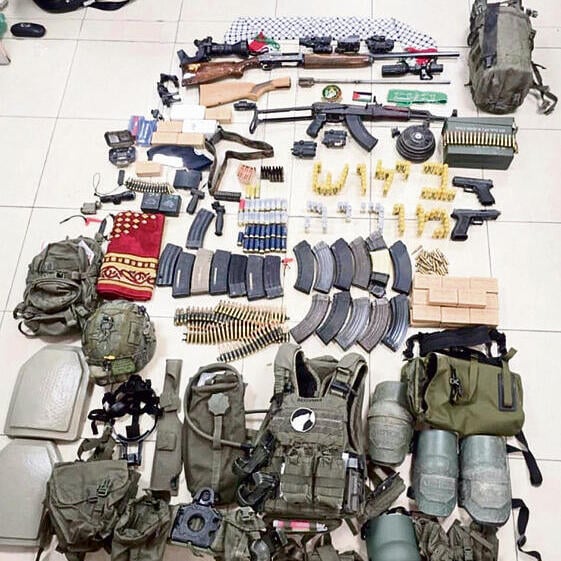
The weapons seized in the Jerusalem apartment of a discharged IDF soldier
“Most of the weapons circulating in the country since 2024 — fragmentation grenades, demolition blocks and more — are a result of the war,” says Chief Superintendent Yaniv Fadida, head of the Israel Police bomb laboratory division. “We are seeing direct spillover from it into the criminal market.”
“Since October 7, there is greater access to explosive materials,” also emphasizes Chief Inspector Liron Koren, head of the drugs and weapons unit in the Intelligence Division. “Most of the devices seized were originally military-grade high explosives, meaning standard explosives that come from the army and cause far more significant damage,” she says.
The second source, Fadida explains, is firecrackers and fireworks, which can easily be turned into improvised pipe bombs. Hundreds of tons of them are imported into Israel legally for private events. A source familiar with the fireworks market explains that “this is accessible, available, cheap raw material that is easy to buy without supervision and sold under the guise of a toy.”
From there, Fadida continues, it easily leaks into the criminal market, which is estimated at about 40,000 items a year. Here and there, he says, there are still incidents involving improvised devices based on homemade explosive materials, such as chemical fertilizer.
Police stress that while most pipe bombs made from fireworks are identified during the preparation stages and thwarted, in the criminal assassinations carried out in the streets over the past year, the main materials used were standard military-grade explosives stolen from the IDF.
“Firework-based devices are more common in the West Bank, where there are no standard explosives,” Fadida says.
This division draws a clear class distinction within Israel’s criminal pyramid. Local gangs and smaller organizations use improvised devices for extortion and intimidation. The top-tier organizations, by contrast, have access to military-grade standard explosives, such as demolition blocks that arrive as raw material from the defense industries, and cyclonite, an explosive more powerful than TNT, stolen from IDF bases. Magnetic devices attached to vehicles, known as limpet charges and remotely activated with deadly precision, have become the game-changing weapon in turf wars between crime organizations.
Weapons seizures over the past month attest to the high availability of military-grade explosives
In the first stage at an explosives scene, Fadida explains, investigators try to understand what they are dealing with: what type of device was planted, what explosive material was used and what activation system it includes. “Each device has different characteristics. You can see whether the device exploded in the field or whether it was neutralized and thwarted by bomb technicians,” he says.
Weapons seizures over the past month attest to the high availability of military-grade explosives. In early July, police and the Military Police Criminal Investigation Division, who came to arrest a deserter at his apartment in Jerusalem’s Ramat Sharett neighborhood, found a cache of weapons stolen from the IDF that was allegedly intended for criminal use. Officers seized standard demolition blocks, components for assembling explosive devices and 36 grenades. The suspect, a discharged combat soldier in his 20s who had been abroad, was arrested when he landed at Ben Gurion Airport, and his detention was extended for questioning.
Four days later, in police raids on the homes of crime organization members in Lod and towns in the Triangle region, officers seized demolition blocks stolen from the IDF, along with firearms and ammunition intended for the underworld.
In early July, acting on intelligence, Jerusalem District police and Border Police officers conducted a rare operation deep inside the Palestinian city of Hebron in the southern West Bank, intercepting thousands of fireworks allegedly bound for East Jerusalem for use in criminal and terrorist activity.
2. The price: Up to 15,000 shekels
A review of court protocols and conversations with criminal sources shows that to evade police wiretaps, crime organizations regularly use code names to disguise references to explosive devices. Raw explosive material, for example, is sometimes called “cake.”
Small or medium devices are called “the child” or “the baby.”
A fully assembled device awaiting activation, with magnets for attachment, receives the evocative nickname “the bride is ready.”
Large and powerful devices are called “a pot” or “a pressure cooker.”
Browsing Telegram and social media reveals an active market for purchasing the auxiliary components used to install explosive devices. These usually include small and advanced electronic components, such as smartwatches, which include an independent SIM card, built-in battery and timer, and are repurposed into delay or remote activation systems.
Raw explosive material, for example, is sometimes called 'cake.' Small or medium devices are called 'the child' or 'the baby.' A fully assembled device awaiting activation, with magnets for attachment, receives the evocative nickname 'the bride is ready'
The weight of the devices, Fadida says, is determined according to their purpose. Improvised devices, sometimes intended only for threats and extortion, are usually composed of a block of explosives weighing between 1.5 kilograms and 5 kilograms. A standard device, by contrast, usually weighs between 2 kilograms and 40 kilograms or more, including the casing and activation components.
“There is no doubt that, in recent months, we are talking about lethal weights,” Fadida says.
As for the price, Koren says that according to police intelligence, the cost of a standard military-grade explosive device ranges from 5,000 shekels to 15,000 shekels. The price varies according to the device’s size, the amount of explosive material it contains, the quality of the explosive and other factors.
When it comes to improvised devices, Koren explains, prices are significantly lower. Pipe bombs, for example, cost between 2,000 shekels and 4,500 shekels.
3. The engineers: A one-way ticket
To use explosive devices, crime organizations depend on professionals known in the underworld as “bomb engineers.” This is skilled and experienced manpower that is generally not found by browsing LinkedIn.
“These organizations have a closed list of professionals who know how to assemble or conceal explosive devices,” Koren says.
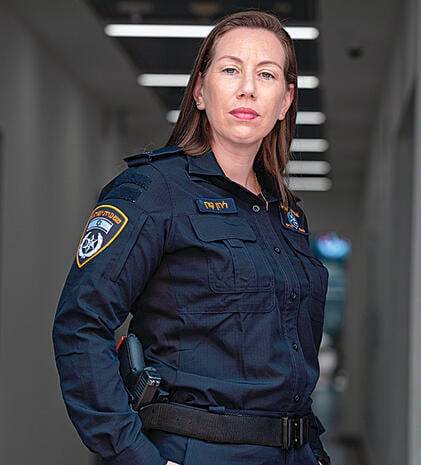
Chief Inspector Liron Koren, head of the drugs and weapons unit in the Intelligence Division
(Photo: Yuval Chen)
That narrow list is effectively the critical link in the assassination chain. Here too, the IDF plays a central role in providing prior knowledge that becomes highly useful in the criminal sphere.
“The engineers may have military training or may be civilian engineers who expanded their knowledge on various networks, such as the darknet. They also do not have to be part of the organization. They work for money and can sometimes move from one organization to another.”
Still, she clarifies, this is usually a one-way entry ticket into the criminal underworld. “To assemble an explosive device, you have to understand the field. This is expertise you don’t buy on the street, and whoever prepares them has to take that into account.”
Meaning what?
“A bomb engineer is too valuable an asset for an organization to release. Once you enter the loop, the organization keeps you on a short leash under constant threats, and the only choice left to you is to keep assembling devices for payment, or become the victim of one yourself.”
A former prisoner explains that some bomb builders go through “courses” and “advanced training” in prison — in other words, they acquire the knowledge from other inmates.
“Any auto electrician or installer of car audio and security systems can, with a little help, retrain professionally,” Fadida says.
And the high demand also creates alternatives. Last week, investigators from Lahav 433’s national serious crimes unit arrested an instructor at a boarding school for at-risk youth on suspicion that he served as the bomb engineer for several of Israel’s leading and largest crime organizations. The suspect is a 24-year-old from a normative family in the Arab town of Qalansawe.
The instructor was arrested after his fingerprint was found on a powerful explosive device seized in the Triangle area. Investigators are now examining suspicions that he was also involved in producing additional devices used in the latest wave of assassinations.
The suspect, whose name is barred from publication under a gag order, denied all allegations against him through his attorney, Dror Shalom. Rishon Lezion Magistrate’s Court Judge Guy Maimon, who reviewed the investigative materials, thought otherwise and extended his detention on suspicion of weapons production and attempted sabotage using explosives. The investigation is ongoing.
“The normative appearance of an educated person who works like anyone else is revealed in this case as a cover for criminal activity at the highest level of preparing explosive devices and considerable knowledge in this field,” the judge wrote in his decision extending the suspect’s detention.
4. The unique signature: Creative work
Fadida says police have ways to identify an engineer’s “signature” or working method in devices he assembled, as was demonstrated in the arrest of the suspected instructor.
“Without addressing the case in question, over the years there have been bomb builders whose patterns of action and assembly methods we have managed to learn,” he says.
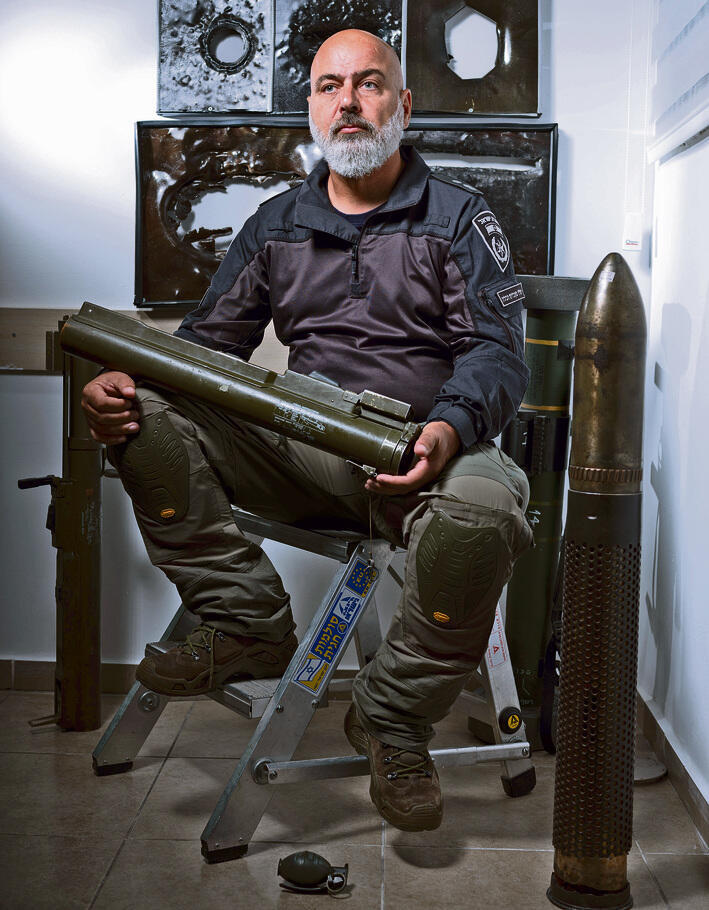
'Learning the patterns of action.' Chief Superintendent Yaniv Fadida
(Photo: Yuval Chen)
For example?
“These are usually creative people. It is like hearing a song and immediately knowing it is the style of a specific singer. Many times, they build devices in a unique style. We identify them by the way certain elements in the device are connected, by the arrangement of the layers of material or by the combination of a specific type of explosive with the activation system. There were quite a few cases in which my people arrived at a scene and said: Apparently, X has been released from prison, because we recognize the pattern of his devices. There was one such engineer from the Pardes Hanna area who would go into prison for three or four years, be released, and each time we again saw devices he had assembled. We would catch him and put him back in prison until he was released again. He also built devices for several crime organizations.”
What has happened recently, given that none of the assassinations have been solved?
“We are constantly working to identify those who manufacture these devices, including members of Arab criminal organizations. Even when an explosive device has already detonated, we are often able to recover forensic evidence linking it to those responsible — and even more so if it is discovered before it explodes. But it is important to understand that when a device detonates, especially if it causes a fire, much of the evidence is destroyed. The larger the explosion and the more extensive the damage, the less evidence remains.”
5. The production chain: Complete compartmentalization
The real advantage of the large organizations lies not in the quality of the explosives they obtain, but in the hierarchical structure. Police explain that the production chain is built so that each link knows only the person working directly with it. The head of the organization passes along an instruction and a budget — sometimes hundreds of thousands of shekels — through intermediaries so that his name is never linked to the operation.
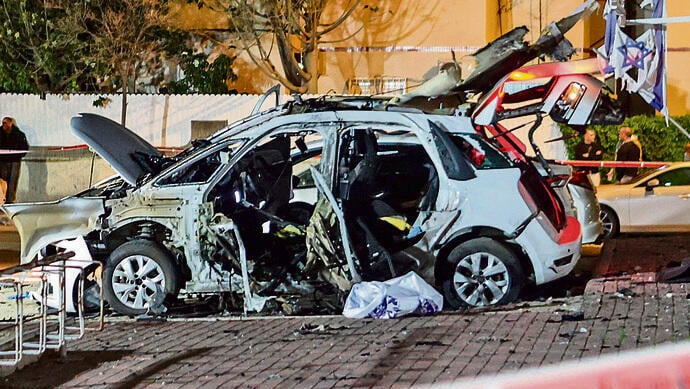
A bomb explosion in Kiryat Yam in February of this year, which killed Guy Ben Simon and injured a 13-year-old boy
He is the customer who transfers the money to the intermediary. The intermediary then purchases a neutralized device from the engineer, who passes it to a courier who transports it, while the low-level foot soldier who attaches it to the vehicle receives the target through an encrypted app or a disposable phone. Even if he is caught in the act, he has nothing that will lead investigators backward. And so the heads of the pyramid remain in the shadows, far from the defendants’ bench.
That was also the case in the arrest in May of two criminals: a bomb engineer and the person who assembled the devices. Both worked as freelancers, meaning they were not affiliated with a specific crime organization. The indictment, which accuses them of placing devices in two incidents, does not state what their motive was or who was behind the selection of the targets.
Both remained silent under questioning, but in the detention cell, in front of an undercover informant, D., 34, from Bat Yam, opened up and described himself as the “execution contractor.”
D. told the informant that he was paid to assemble, place and activate explosive devices against targets provided to him by M., 38, from Tel Aviv. Among other things, he said he had previously activated devices in Ashdod and Ashkelon, the kind in which “doors flew off,” and even revealed the safety rules of the person who sent him: At their meetings, M. demanded that the cellphones be left aside.
What D. did not know was that every word he said was being recorded.
The indictment obtained by ynet's parent newspaper Yedioth Ahronoth accuses the two of detonating a pipe bomb in a woman’s car in Holon in April and placing an explosive device in March 2025 near a man’s apartment in Ashdod, where it did not explode. Both are charged with conspiracy to commit a felony, joint weapons production, joint possession and carrying of weapons, causing damage with explosives and attempting to cause damage with explosives.
Prosecutors, who describe M. as “the crime generator and the driving force,” asked to keep the two in custody until the end of the legal proceedings against them. This, incidentally, is the only case fully solved this year — but even in this case, the breakthrough ended only with damage, without fatalities.
6. The clients: Senior crime figures
Crime organizations’ use of explosive devices also exposes a big change in the underworld’s assassination map. If once they beat, stabbed, shot or threw fragmentation grenades, today explosives have become the preferred strategic tool, certainly when it comes to assassinating senior figures.
Tuesday, June 30, was marked as an earthquake in the criminal world and the closing stamp on one of its bloodiest months. At midday, in the heart of a busy street in Kiryat Haim, Rabia Abu Haikal, 49, the No. 2 man to crime boss Nasser Hariri, was killed in an explosion in his vehicle. Police bomb technicians who rushed to the scene found that it was an explosive device weighing about 1.5 kilograms, activated by remote control, leaving Abu Haikal no chance of survival.

Rabia Abu Haikal
Abu Haikal, a senior underworld figure, served as Hariri’s finance, logistics and operations chief, as well as his right-hand man and close confidant. His killing is seen in criminal circles as a complete collapse of the old rules: No one is untouchable. Police also believe the assassination will not go unanswered and that retaliation is likely.
In another case, only a few weeks earlier, on June 12, police managed to thwart an assassination using an explosive device planted in the car of Eyal Nagar, head of a major crime syndicate in southern Israel.
“We received intelligence about a suspected explosive device planted in Nagar’s car, but it was not known by whom,” Koren says. “And this is where our greatest fear comes in.”
Why?
“Because there is no waiting time, and police treatment has to be immediate. Sappers went there immediately to thwart the incident. The team contacted Nagar, who was completely unaware that his life was in danger. They began inspecting the vehicle until they located the explosive device, which was already ready for activation. It was a wireless device attached under his vehicle with standard explosive material, which the bomb technicians managed to dismantle and neutralize.”
Do we know who wanted to kill him?
“He was questioned about it and did not speak. The officers saved his life. He did not even say thank you.”
Sometimes, survival comes down to luck.
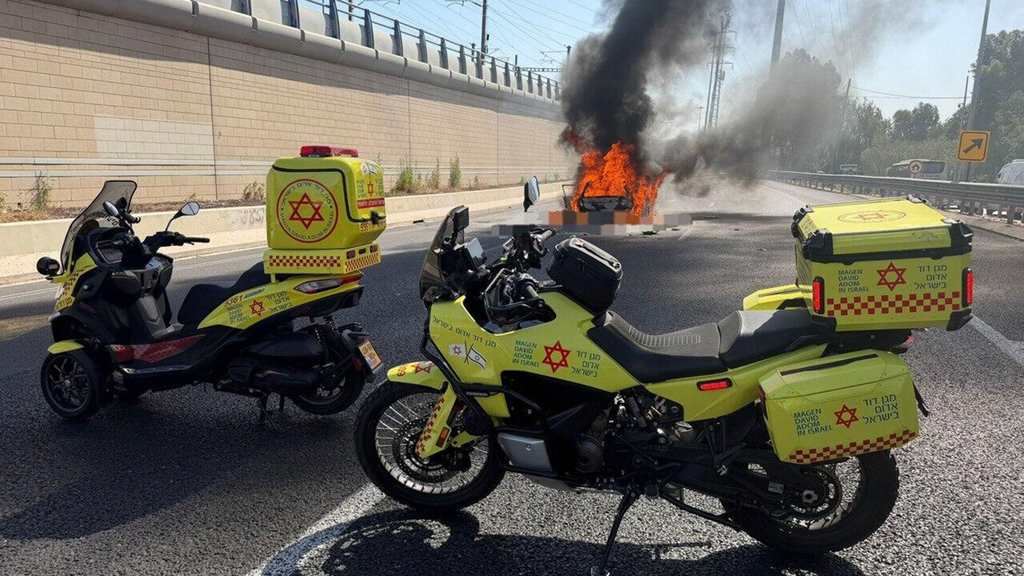
On Wednesday, July 1, Ashdod crime figure Adam Dapas — a police intelligence target who was also believed to be the target of an assassination attempt — was driving along Hazayit Street in the city's Quarter A neighborhood, unaware his life was in danger.
At about 5 p.m., a powerful explosion shattered the quiet of the residential street. Large numbers of police officers rushed to the scene and, after determining there were no casualties, initially believed the blast had been caused by a fragmentation grenade.
(Photo: MDA)
The investigation took a turn only two days later, after security camera footage was uploaded to social media. It then became clear that, while the vehicle was moving, an explosive device that had apparently been attached carelessly under Dapas’ car fell off and exploded.
Police initially arrested Dapas on suspicion that the blast was the result of a botched criminal operation. After court proceedings indicated that he had been the target of an assassination attempt, investigators sought to keep him in custody on suspicion of conspiracy to commit a crime and obstruction of justice.
His attorney, Ness Ben Natan, told ynet this week: “We got him released from custody after proving he had no connection to the device. Dapas received an order barring him from the city for a month, out of concern that he would go out to avenge himself against his rivals.”
The use of explosives by untrained criminals also increases the risk of what police describe as “work accidents.” In the incident that opened a bloody June, two men from Be'er Sheva and Kiryat Gat were killed when a bomb exploded in their car at Goral Junction. Investigators suspect the blast was caused by a botched criminal operation.
Fadida says this is a fairly common occurrence.
“Work accidents happen from time to time. We encounter situations involving people, mainly amateurs, who try to build a device and it blows up in their hands.”
Where are devices usually hidden?
“Hiding explosive devices in a back seat or beneath the driver’s seat is relatively rare. Historically, we have seen only four or five such cases. It requires someone to enter the vehicle, plant the device and leave without being detected, which makes the operation more complicated.
“Most devices are attached to the outside of a vehicle, but they can be placed elsewhere. We have found explosives at the entrances to homes, on front doors, along walkways leading to houses and in other locations. Ultimately, it depends on how determined the person planting the device is.”
Do you cooperate with and try to help threatened criminals?
“I have encountered threatened criminals who came and told us: ‘We saw on the cameras someone approaching the vehicle,’ or ‘We saw someone tampering with it.’ It often happens that a crime family calls because of such a suspicion, and we always come there, at any time of day. We do not care whether the person is a criminal or not. In the end, it is about human life.”