

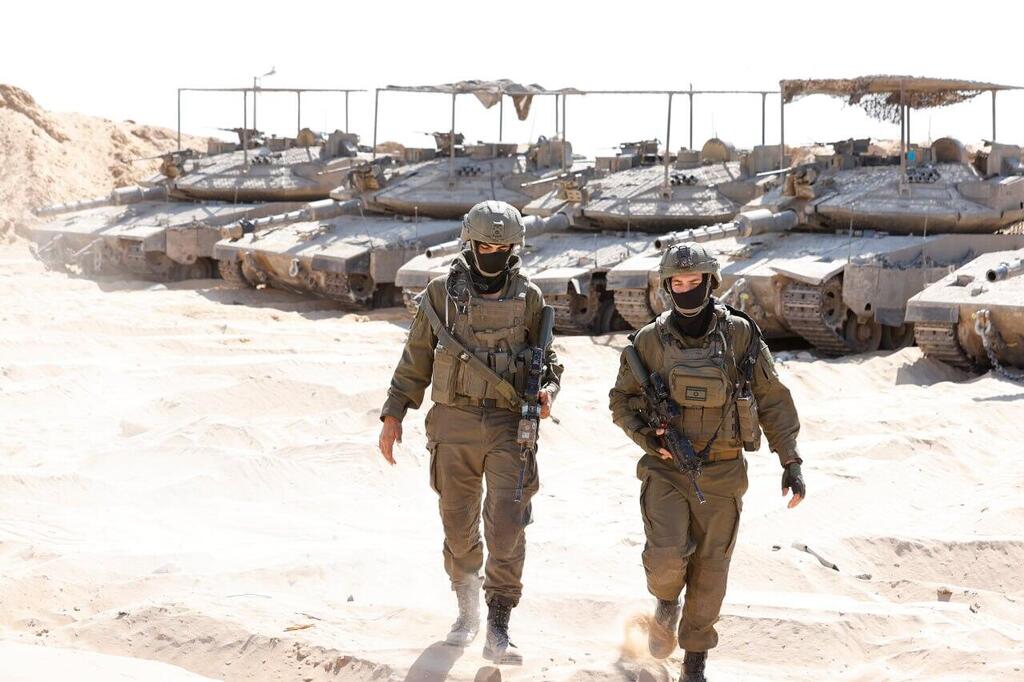
On Friday, October 13, 2023, we arrived at the staging areas of the 401st Armored Brigade near the Gaza border. Among the tanks, we met Eitan, a lone soldier from Australia who was preparing with his fellow troops for the ground offensive in Gaza. "War is complicated, and we understand that not everyone will come back," he said.
Eitan had a clear-eyed understanding of the reality. The 401st Brigade lost 58 soldiers during the ground operations in Gaza and Lebanon, including brigade commander Col. Ehsan Daxa and Battalion 52 commander Lt. Col. Dor Gedalia Ben Simhon. Many others were wounded in combat, including Daxa's successor, Col. Meir Biderman.
Gallery
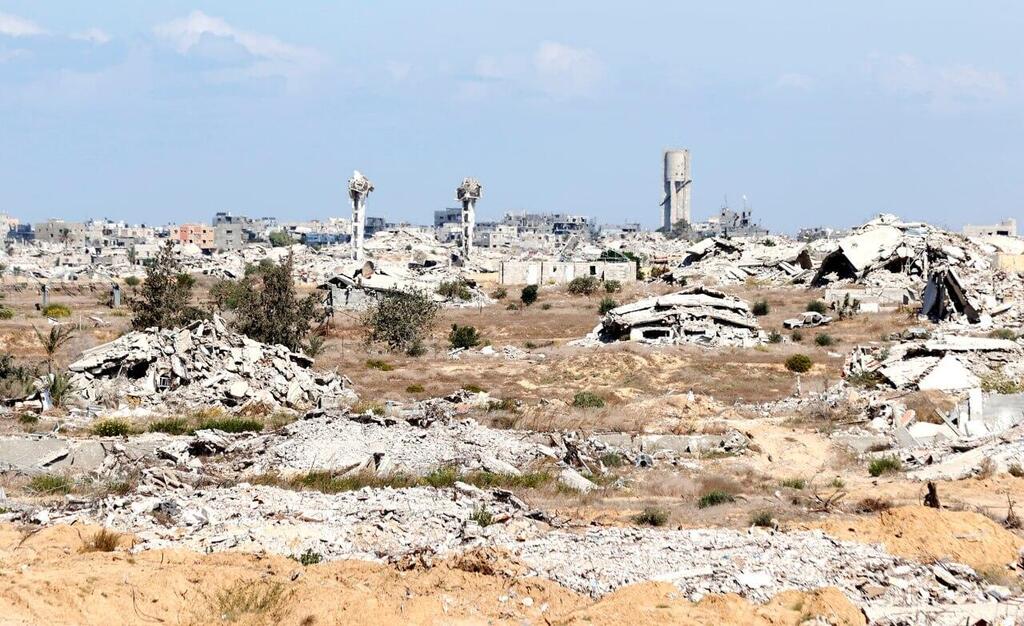
The Yellow Line, where the battalion operates. Troops continue to locate and destroy tunnels
(Photo: Gadi Kablo)
As we walked through the staging area, speaking with soldiers and commanders in the days following the devastating October 7 attack, R. was sitting at the forward command post of the 162nd Division, meticulously planning the ground offensive in Gaza. At the time, he was head of operational planning in the division's operations branch. Three years later, Lt. Col. R. commands Battalion 9 of the 401st Brigade, now deployed in the southern Gaza Strip.
His battalion combat team consists of a tank company, a reserve infantry company, a combat engineering company and a logistics support company. Today, the missions of tank and infantry battalion commanders are almost identical.
"The only difference between us is that I ride in a tank, while an infantry battalion commander rides in a Namer armored personnel carrier," Lt. Col. R. explains.
Active defense
We are standing on the earthen berm surrounding the Etzioni outpost, about five miles inside the Gaza Strip. In front of us is the Yellow Line, marked by concrete blocks that also serve as a physical barrier. Battalion 9 controls the Morag Corridor, which separates Rafah from Khan Younis. Anyone attempting to travel between the two cities will encounter IDF forces.
The 401st Brigade, including Battalion 9, was the first to enter Gaza at the start of the ground offensive exactly three years ago. After two years of fighting in the Gaza Strip, the brigade moved to Lebanon and took part in the ground offensive conducted as part of Operation Roaring Lion. R., who has held his current position for about three months, assumed command of the battalion in Ras al-Bayada, a village in southern Lebanon near the Israeli border.
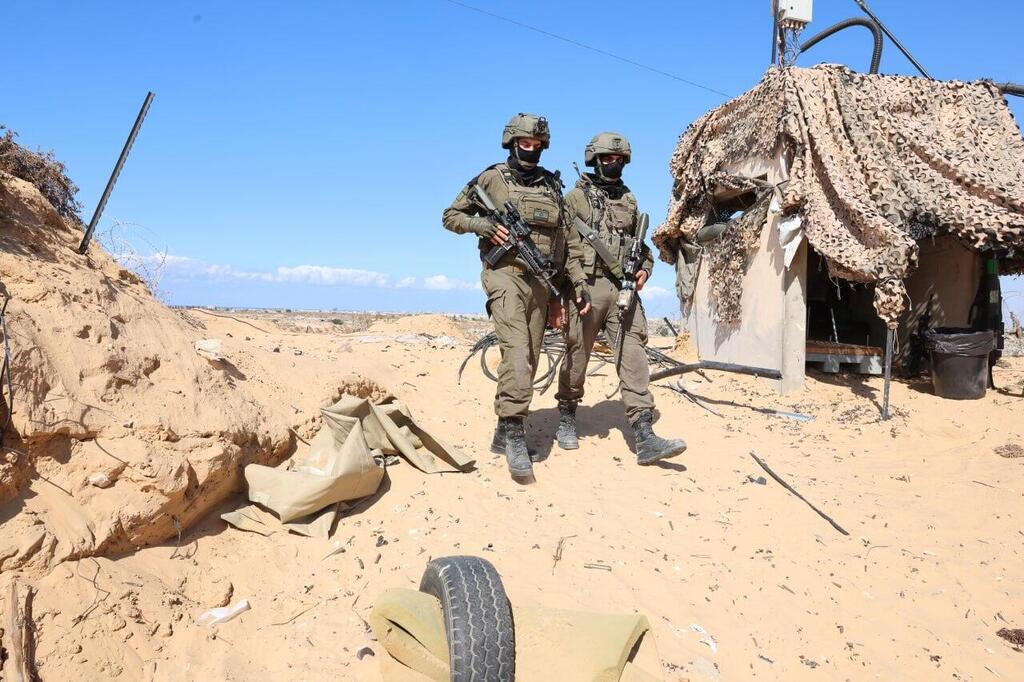
Capt. A. and Lt. Col. R. 'We take risks, and sometimes we pay the price'
(Photo: Gadi Kablo)
R., 34, lives in the central Israeli city of Rosh Ha'ayin. He is married to Lt. Col. M., also a career IDF officer, and they have two sons: Alon, 4, and Sahar, 2, who was born during the war. "I managed to make it to the delivery," R. says.
About two months ago, the brigade returned to the southern Gaza Strip, where it has remained ever since.
"Our mission is to defend the area from the Yellow Line to the border, creating a buffer zone between the enemy and the communities in the southern Gaza border region," R. explains. "Because the IDF is here, well inside the Gaza Strip, residents can return to their homes, celebrate the holidays safely and cultivate their land right up to the last furrow. I find that deeply moving."
For him, these are not empty slogans. The battalion commander's sister recently moved with her family to Kibbutz Magen in the northwestern Negev desert, where her husband grew up.
Standing with us on the berm is Capt. A., commander of Battalion 9's Lahav Company. He is 25, from Rehovot and recently married. A. was wounded by fragments from an RPG during the ground offensive in Gaza and returned to combat three weeks later.
"When you work so hard and see the results, when people feel safe returning to their homes, you feel a sense of satisfaction that you've done a good job," he says.
Not everyone has returned, it must be said. Many residents of the Gaza border communities, particularly those that suffered the heaviest losses, remain displaced. Some will never return.
The company commander emphasizes that defense involves more than simply remaining at fortified positions.
"We maintain a presence throughout the area, go out with the tanks, patrol near the Yellow Line and conduct firing operations," he says.
The battalion is also working to locate and destroy tunnels that still exist in the area.
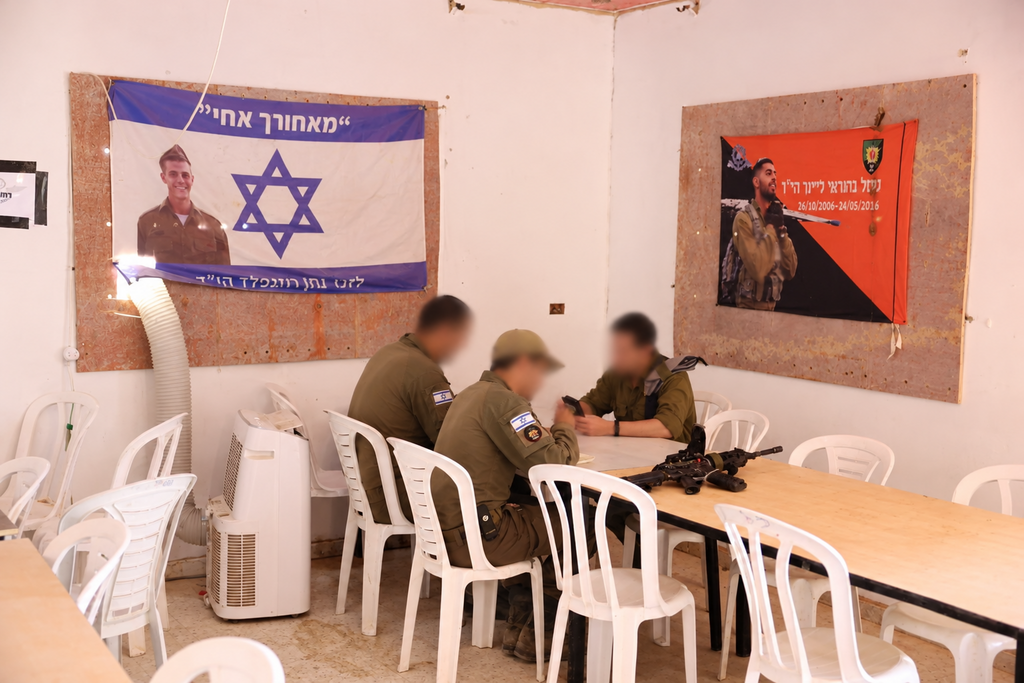
The dining hall, with photographs of fallen soldiers
(Photo: Gadi Kablo)
What is absent here are Palestinian homes and residents. The Morag Corridor is deserted, and almost all the houses that once stood in the area have been destroyed. Nearby Rafah has also been completely devastated.
Anyone crossing the Yellow Line is regarded by the troops as an enemy, unless the person is a woman or a child.
"We don't shoot at women and children," the battalion commander stresses, stating what should be obvious.
The Etzioni outpost is undergoing extensive construction and preparations for winter. Cranes are unloading prefabricated structures from trucks. The IDF is becoming increasingly established in the area, and it appears to be there for the long term.
"Even a dentist comes here to treat the soldiers, and God willing, we'll have a physical therapist as well," Capt. A. says.
At a nearby observation post stands a reservist from the infantry company. He does not recognize the battalion commander, who is probably younger than he is.
"If you're finished talking, get down from the berm," the reservist says. "You're exposed to the enemy. God forbid someone should shoot at you."
"We're not finished yet, thank you," the battalion commander replies.
He then assures us: "If there were any real danger, I wouldn't have brought you up here."
On our way back toward the border, we pass through the Regavim outpost, where a combat engineering company from Battalion 601 is stationed under the command of Battalion 9.
Hanging on the dining hall wall are flags bearing photographs of two battalion soldiers killed in the war: Sgt. Nehorai Leizer of Eilat, who was killed in Lebanon, and Sgt. Yisrael Natan Rosenfeld of Ra'anana, who was killed in Jabalia.
Helping farmers
We climb with the battalion commander to the roof of the outpost, which is actually a residential building that remains standing. He points east, toward the Israeli communities along the Gaza border visible on the horizon.
"On the Israeli side of the border, you can see the communities of Sufa, Holit, Kerem Shalom and Nir Oz. It's a reminder to my soldiers of why they're here," he says.
(Photo: Gadi Kablo)
The Battalion 9 commander places great importance on maintaining ties with residents of the Gaza border communities, from working meetings with local security coordinators to volunteer activities in the communities.
"Before a platoon goes home on leave, the soldiers volunteer to help farmers in the Gaza border area with work in their fields and orchards. That, too, helps them understand the 'why.'"
Lt. Col. R. and Capt. A. know the cost of war all too well. Both have lost friends, commanders and soldiers who served under them.
"When Ehsan was killed, I wasn't far from there," A. recalls. "We gathered the company and told the soldiers: 'The brigade commander has been killed, a replacement has been appointed and we are continuing our missions in the spirit of his leadership.'
"When soldiers understand that their commanders are out front, taking risks and sometimes paying the price to accomplish the mission, they understand that they're not alone."
Lt. Col. R. saw another example of that commitment when Ben Simhon was killed in Lebanon, as R. was preparing to take command of the battalion.
"Dor embodied exactly that kind of leadership: leading from the front, standing alongside his soldiers in direct confrontations with the enemy, in the toughest moments, when a commander is needed to make decisions," he says.
When your wife hears that a fellow battalion commander has been killed and knows that you're also on the front lines, what does she say?
"She understands the risks very well and what could happen. She's fully aware of them, and we take that into account.
"All I can tell you is what I always tell my soldiers: 'It's not enough to love this country. You must also take responsibility for its fate.'"