


The IDF pushed back Friday against a report by the UN-backed Integrated Food Security Phase Classification (IPC), which warned of an impending "famine" in Gaza and is expected to lead the UN to formally declare a “famine emergency” in Gaza City.
In a detailed rebuttal, Israel’s Coordinator of Government Activities in the Territories (COGAT) dismissed the IPC findings as “false and biased,” accusing the organization of relying on “partial and manipulated data supplied by Hamas.”
Food supplies across the Gaza Strip
(Video: COGAT)



According to COGAT, hundreds of thousands of tons of humanitarian aid — including food, water and medicine — have entered Gaza since the war in Gaza began, undermining claims of widespread starvation.
IDF accuses IPC of methodological flaws
COGAT said the IPC report contained “severe methodological and factual gaps,” citing reliance on Hamas-linked sources, misrepresentation of key indicators and a “deliberate lowering of thresholds” to enable a famine declaration.
According to COGAT, IPC cut the required percentage of severely food-insecure households from 30% to 15% “for this report alone” and ignored mortality rates entirely — changes Israel called “deeply unprofessional and politically motivated.”
The Foreign Ministry echoed the criticism, describing the IPC’s findings as “fabricated and tailored to fit Hamas’s false propaganda campaign.” A senior ministry official accused the organization of “whitewashing Hamas’s lies” and warned that the report “serves a political agenda rather than presenting reality.”
Israel cites large-scale humanitarian aid
COGAT presented data claiming extensive humanitarian access to Gaza. Since the war began, Israel reported that more than 100,000 aid trucks have entered the Palestinian enclave, about 80% of them carrying food.

(Photo: COGAT)
Between January 19 and Friday— as part of a hostage-release deal — Israel allowed 25,200 trucks loaded with food, water, medicine and shelter supplies crossed into Gaza. In May alone, over 10,000 trucks delivered aid and COGAT reported a “sharp drop in food prices” in local markets since then.
According to COGAT, Gaza currently receives an average of 4,400 calories per person per day, well above the threshold for famine. Israel also highlighted deliveries of baby formula, therapeutic foods for malnourished children and special high-calorie products.
Additionally, more than 90 community kitchens are reportedly operating across the Strip, serving over 600,000 meals daily and 2.2 million weekly food packages have been distributed since May.
While Israel disputes the findings, top UN officials argue that Gaza faces a severe humanitarian crisis. UN High Commissioner for Human Rights Volker Turk said starvation in northern Gaza is a “direct consequence of Israeli government actions” and warned that deaths caused by hunger “may constitute war crimes.”
UN Secretary-General Antonio Guterres described the situation as a “man-made catastrophe,” urging that “it must not be allowed to continue unchecked.”

וולקר טורק
(צילום: AFP )
COGAT reported that 18 hospitals and medical centers remain operational in Gaza, supported by 12 active field hospitals. Since June 2024, nearly 4,000 patients and caregivers have left Gaza for treatment in Jordan, the UAE and European Union countries.
Israel added it has also facilitated 48,000 tons of medical supplies entering Gaza and expanded access to water through pipelines from Israel, desalination plants and emergency infrastructure funded by the UAE. More than 2,300 humanitarian aid packages have been air-dropped in coordination with 12 countries.
Criticism of IPC’s reliance on Hamas-linked sources
COGAT accused IPC of basing its conclusions partly on unpublished phone surveys, UNRWA assessments involving Hamas-affiliated staff and data from “local organizations with vested interests.”
The response claims IPC ignored recent improvements in aid delivery and presented “alarmist projections” despite what Israel calls a “significant positive trend” in food availability.
Israel also criticized the IPC for linking aid access to a permanent ceasefire, calling it “an overtly political stance, not an objective assessment.”
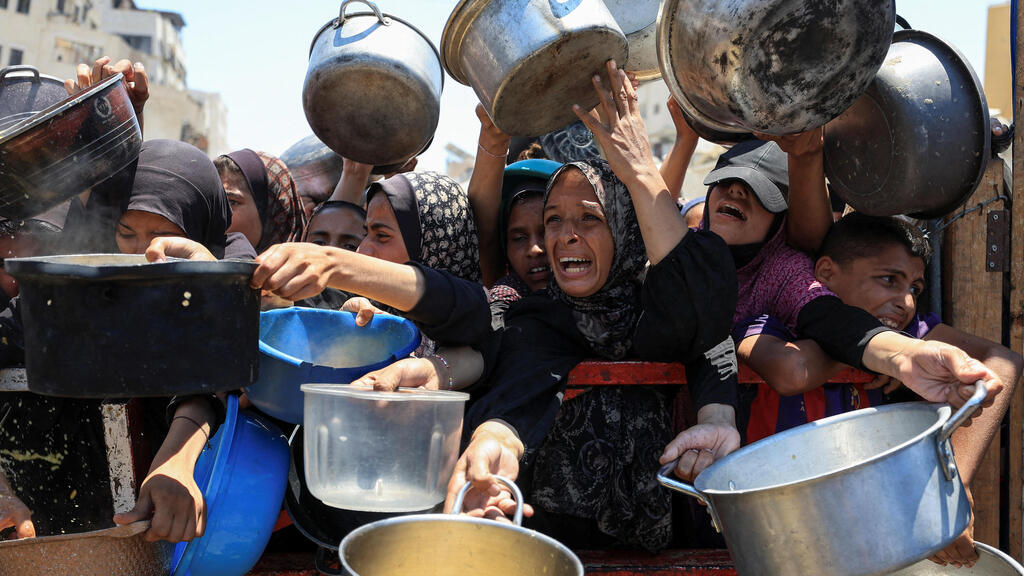
Aid delivery in Gaza
(Photo: REUTERS/Dawoud Abu Alkas)
“The IPC’s report represents yet another example of an international institution abandoning its mandate in favor of politicization, effectively serving Hamas’s propaganda campaign,” COGAT’s statement read.
Israel’s Coordinator of Government Activities in the Territories, Maj. Gen. Ghassan Alian, said: “The IPC report is based on partial and unreliable sources, many linked to Hamas, and ignores Israel’s extensive humanitarian efforts. We expect the international community to examine the full data before echoing false claims.”