

For more than a week, Israel pressured Abu Dhabi to deny a report alleging that Mohammed bin Zayed, or MBZ, gave Prime Minister Benjamin Netanyahu an explicit warning before October 7 that Yahya Sinwar was planning an “earthquake.” On Saturday night, The National, the English-language newspaper based in Abu Dhabi, published a statement from an Emirati source saying: “The UAE discusses security issues with other countries through the relevant bodies and does not discuss details of this kind at the level of national leaders.”
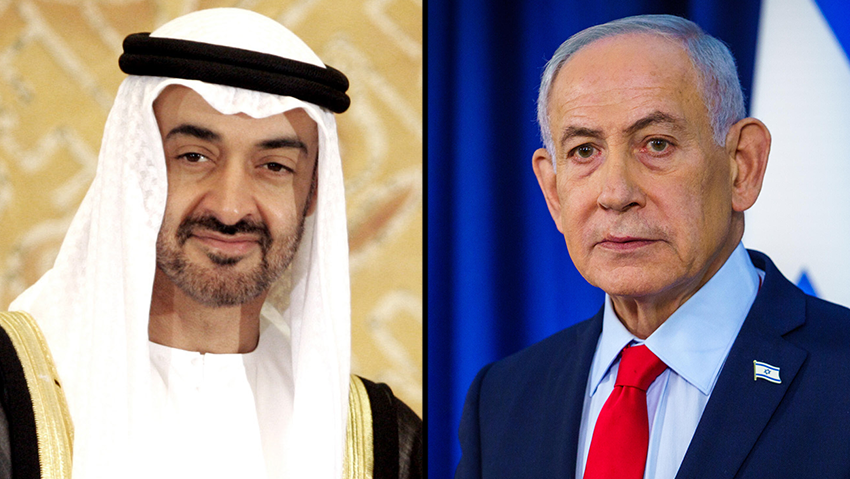
In other words, even after pressure from Israel, the source did not explicitly deny that a conversation between bin Zayed and Netanyahu took place, did not say the report was false and did not rule out that Israel had received a warning. The National’s report said the source was responding to the allegations because they had become “a major issue for politicians campaigning on security.”
The investigation — and the UAE’s initial response
Already on Sept. 8, the day the investigation was published, Israel pressed the United Arab Emirates to issue an official clarification denying the report. The UAE, however, preferred not to engage with the details and released an official statement saying it would not comment on them.
“The Ministry of Foreign Affairs confirms that the UAE government does not comment on media reports or speculation regarding conversations,” the statement said. “Since October 7, the UAE’s efforts have focused on de-escalation, promoting regional stability and reducing violence.”
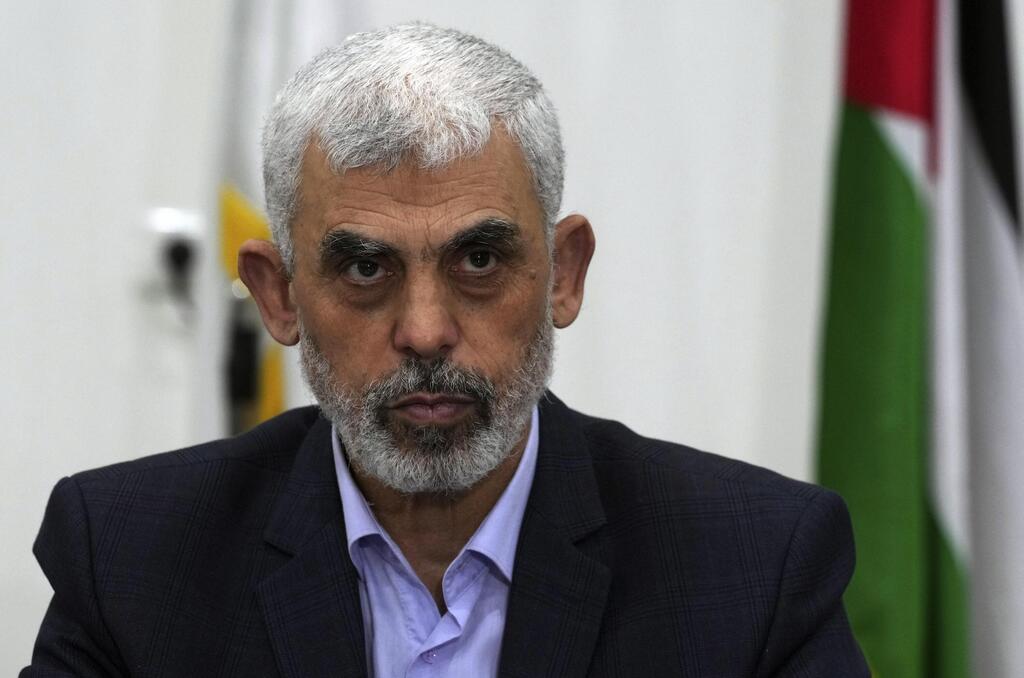
Yahya Sinwar
(Photo: Adel Hana/AP)
The UAE Foreign Ministry also said that since diplomatic relations with Israel were established more than five years ago, “government bodies in both countries have maintained open and direct channels of communication. When necessary, all relevant intelligence information is shared and continues to be shared between the relevant parties.”
At the time the report was published, speculation arose that the person who passed along the information was Mohammed Dahlan, a former senior figure in the Palestinian Preventive Security Force in the Gaza Strip, who for years was regarded as a senior Fatah official, a major rival of Palestinian Authority President Mahmoud Abbas and a possible candidate to lead Gaza in a post-Hamas era.
Dahlan, however, has remained silent amid the controversy surrounding October 7 and the alleged conversation with bin Zayed — but he has not denied it.
The report about the conversation appeared in a new book by journalists Shlomi Eldar and Ruth Yuval, Hostages: 843 Days of Abandonment.
According to the investigation, bin Zayed called Netanyahu after receiving information that Sinwar was planning an “earthquake” in Israel.
“They have conversations that are conducted in a unique way. There is a special application developed by the Emiratis. A representative from the embassy arrives with the application and a phone, and they hold a conversation that lasts 45 minutes,” Eldar said.
According to the investigation, Netanyahu tried to reassure bin Zayed during the conversation and told him: “We are prepared in Gaza.” He also reportedly assessed that if there were a problem, it would be in the West Bank.
After that conversation, Netanyahu did not update then-IDF Chief of Staff Herzi Halevi, then-Shin Bet chief Ronen Bar or then-Mossad chief David Barnea.
Palestinian politician: ‘I am the source who passed message from Sinwar’
On Wednesday, Palestinian politician Dr. Sufian Abu Zaida, a Fatah and PLO member and former Palestinian Authority minister for prisoner affairs, revealed in a video posted to Facebook that he was the source referred to as “Coal Eyes,” who passed along a warning in mid-September that Sinwar was planning an attack on Israel.
He said that “in the coming days” he would elaborate on the message he received from Sinwar, as well as on mediation efforts in contacts between Israel and Hamas.

Sufian Abu Zaida, the ex-PA official who says he relayed Sinwar’s pre-Oct. 7 warning to Israel
The story was first revealed in the book by Eldar and Yuval, who wrote that Abu Zaida — whose name was withheld in the book out of concern for his safety — received the message from Sinwar in the course of contacts between Israel and Hamas over the return of the bodies of Hadar Goldin and Oron Shaul, as well as the two captives Hisham al-Sayed and Avera Mengistu.
According to Eldar, at some point in early September, when the talks had stalled, Sinwar dropped off the Shin Bet’s radar. He then summoned Abu Zaida and told him: “Tell the Israelis that I am planning a big surprise for them if they do not make progress.”
According to Eldar, Sinwar used the word “zilzal” — earthquake — for the first time.
Eldar said Abu Zaida left the conversation frightened and passed the message to an associate who now serves as an adviser to UAE President Mohammed bin Zayed.
That adviser emphasized that Abu Zaida initially did not pass the message to the Shin Bet because he feared being accused of collaborating with Sinwar. But after the adviser updated bin Zayed on the matter, bin Zayed asked him to determine whether Sinwar truly meant war.
Abu Zaida was therefore sent to speak with Sinwar again and, during that conversation, told him that he had not passed the message to Israel as requested.
According to the account, Sinwar then clarified to Abu Zaida: “Tell them that I am preparing a surprise for them from the land of surprises. A terrifying operation. Something extraordinary,” and repeated the word “zilzal” for a second time.
He demanded: “Please pass on to the Israelis what I am saying, word for word.”
Abu Zaida then called the Emirati president’s adviser again and, on September 15, also passed the warning to the Shin Bet.
Following that, then-Shin Bet chief Ronen Bar spoke with Netanyahu, and security discussions were held in which he recommended taking action to neutralize the threat or implementing “strong defensive efforts” in the Gaza Strip.
At that time, the mistaken assessment was that Sinwar intended to seize Elizabeth Tsurkov, the Israeli researcher who had been abducted and held in Iraq.