


An Israeli defense technology company that began with childhood experimentation in a family home has grown into a supplier poised to play a role in the future battlefield of the United States.
Xtend, an Israeli drone and robotics software company founded in 2018, has sold more than 10,000 systems to militaries and security forces in more than 30 countries and recently entered a strategic partnership with U.S. defense giant Lockheed Martin. The collaboration integrates Xtend’s operating system, known as XOS, into Lockheed Martin’s multi-domain command-and-control architecture, a step that could position the company as a contributor to U.S. military modernization.
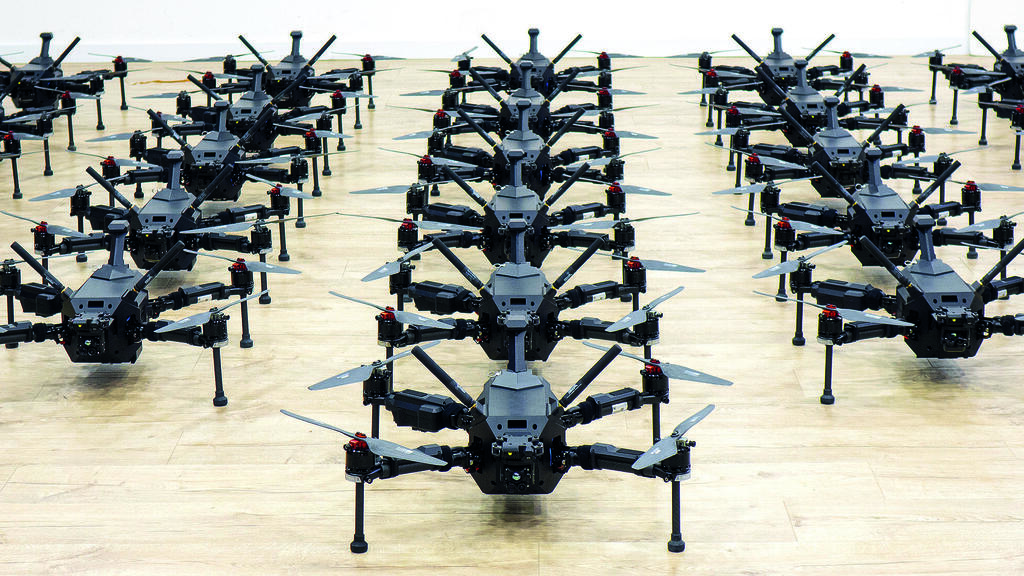
The partnership aligns Xtend with the Pentagon’s Replicator initiative, a flagship program designed to reshape U.S. military preparedness for a potential future conflict with China. The initiative emphasizes deploying large numbers of low-cost, autonomous systems — including aerial drones, ground robots and unmanned maritime platforms — rather than relying on fewer, more expensive aircraft and ships.
The concept is built around saturating the battlefield with swarms of autonomous systems, forcing adversary defenses to expend costly interceptors on comparatively inexpensive targets. Artificial intelligence and reduced reliance on human operators are central to the approach.
Xtend’s technology is designed to meet those requirements. The company develops software that allows a single operator, assisted by AI, to control multiple drones or robotic systems simultaneously. Its systems are built to operate in contested environments where GPS signals are blocked and communications are disrupted — conditions increasingly common in modern warfare.
Xtend has established a drone manufacturing facility in Florida, meeting a key requirement of Replicator for domestic production. Over the past year, the company was selected as a supplier for the initiative, winning tenders against U.S. manufacturers.
The partnership with Lockheed Martin marks another significant step. Under the agreement, Xtend’s XOS will be integrated into Lockheed Martin’s MDCX platform, which is intended to serve as a unified command-and-control system across all branches of the U.S. military. Development is being led by Lockheed Martin’s Skunk Works division, its secretive advanced projects unit known for producing some of the most advanced military aircraft in history.
Engineers at Skunk Works have cited Xtend’s battlefield experience as a key factor in the collaboration. Xtend’s systems have been used operationally in Gaza and Lebanon, as well as in defensive missions in Ukraine, giving the company real-world data from environments marked by heavy electronic warfare and GPS denial.
In November 2025, the two companies demonstrated a so-called “marsupial” mission, in which a large “mother” drone deploys multiple smaller drones at a target area. The demonstration showed how a single operator could manage the entire operation rather than handing control between multiple operators. Defense analysts say the approach represents a leading edge in drone warfare concepts.
Xtend was founded by four Israeli entrepreneurs: brothers Aviv and Mateu Shapira, along with Robby Liani and Adir Tubi. The Shapira brothers grew up in Rishon LeZion before spending part of their childhood in the United States after their father relocated for work at Amdocs. Aviv Shapira, the company’s chief executive, studied aerospace engineering and specialized in rocket propulsion. Mateu Shapira, his older brother, leads artificial intelligence innovation at the company and has a background in computer graphics.
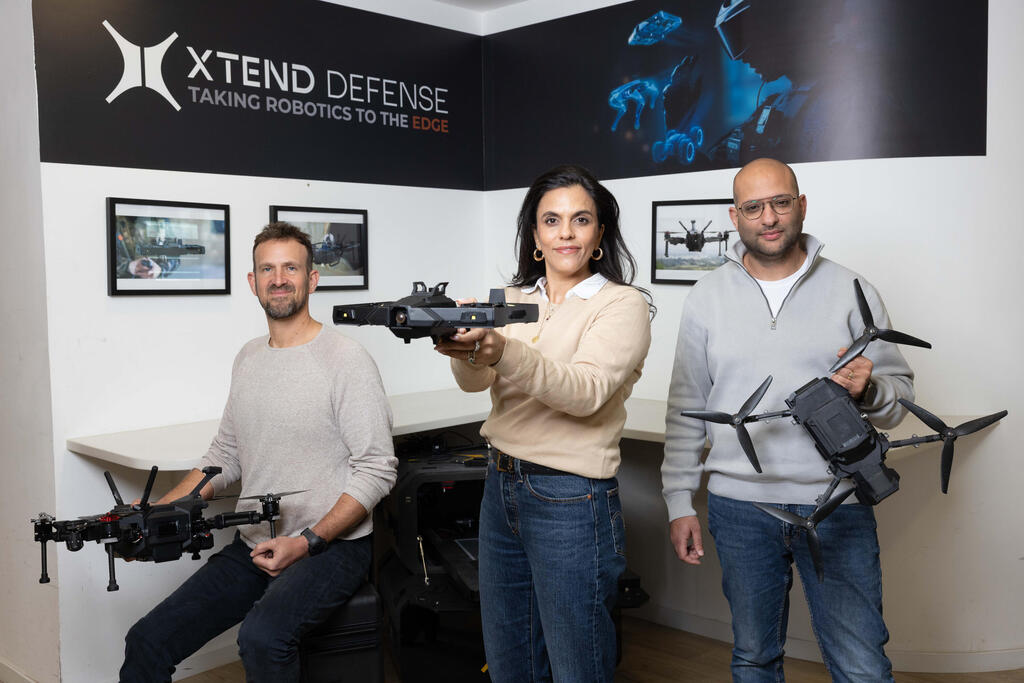
From right: Robby Liani, CEO Chen Haim and Mateu Shapira
(Photo: Oz Moalem)
The brothers previously co-founded Replay, an Israeli startup that developed immersive 360-degree sports broadcasting technology using arrays of high-resolution cameras. Replay was sold to Intel in 2016 for $175 million, though Intel later shut down the operation.
Concepts developed at Replay helped shape Xtend’s direction. The company initially focused on high-speed gaming drones operated through virtual reality headsets, requiring intuitive human-machine interfaces that allowed operators to fly without direct line of sight.
That technology found new relevance in 2019, as security forces sought ways to counter airborne threats near the Gaza border. Xtend adapted its systems for military use, leading to its first contracts with the Defense Ministry. The company worked closely with military research and development officials and combat engineering units to refine its capabilities, including indoor navigation and reconnaissance.
Since then, Xtend’s role has expanded rapidly. The company supplies drones and software to ground forces, special units and allied militaries worldwide. In the United States, its subsidiary won Pentagon contracts worth tens of millions of dollars, including an $8.8 million deal for urban combat drones and additional contracts supplying systems to the Army, Marine Corps and Navy.
Xtend’s technology has also been deployed in Ukraine, primarily as software installed on third-party drones, where it has been used for reconnaissance in areas with heavy electronic interference.
The company says its software-driven approach distinguishes it from competitors. “We are not a drone company — we are a software company,” Shapira said. “Our goal is not to build the best drone, but to keep human operators out of harm’s way.”
Xtend continues to maintain a civilian business line, providing robotic control systems for law enforcement, rescue services and industrial customers. One of its systems is installed on Boston Dynamics’ robotic dog, Spot.

(Photo: Xtend)
The company employs about 150 people, with operations in Tel Aviv, the United States, Singapore, Britain and Europe. It plans to expand to 250 employees by the end of the year.
Financially, Xtend reported a 113% increase in revenue last year and said its order backlog stands at about $50 million. The company expects to surpass $100 million in annual revenue this year. It completed a $30 million funding round in July 2025, adding to an earlier $40 million raise and bringing total funding to more than $106 million. Its valuation is estimated at between $200 million and $300 million.
Defense analysts say the Lockheed Martin partnership could significantly boost Xtend’s prospects. While direct payments from Lockheed Martin are relatively modest, the strategic value lies in potential follow-on contracts if the integrated system is adopted by the U.S. military. In that scenario, Xtend could secure deals worth hundreds of millions of dollars and potentially reach unicorn status.
Risks remain. A significant share of the company’s revenue still comes from hardware sales, a market facing intense competition and price pressure, particularly from Chinese manufacturers. The company aims to shift toward recurring software revenue. Long-term growth also depends on sustained defense spending, which could fluctuate with geopolitical developments.
For now, Xtend is riding a surge of interest in autonomous warfare. As militaries draw lessons from conflicts in Ukraine, Gaza and Lebanon, the Israeli company’s combination of battlefield experience, software expertise and partnerships with major defense contractors has positioned it among a new generation of defense technology players shaping modern warfare.