

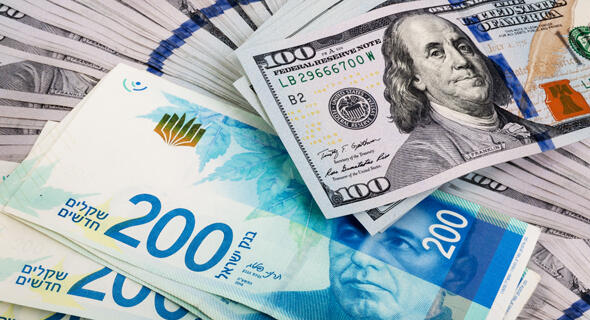
Despite the Bank of Israel’s first interest rate cut in about five months, and contrary to economic logic, the shekel continued to strengthen sharply against the dollar and the euro on Tuesday.
The representative dollar exchange rate fell to a new low not seen in more than 30 years, settling at 2.859 shekels, down 1.65%. The representative euro rate dropped 1.57% to 3.3263 shekels. Later in trading, the dollar fell even further to 2.84 shekels.
The shekel is continuing to strengthen sharply against the dollar
(Photo: Shutterstock)
The relatively surprising market reaction to the rate cut followed the declared position of Bank of Israel Governor Prof. Amir Yaron, who hinted on Monday after the rate decision that another cut is not expected soon. He also refrained this time from making a larger 0.5% reduction, reinforcing the view that the central bank remains concerned about possible inflationary pressures amid an unclear geopolitical situation.
Meanwhile, participants in the foreign exchange market, led by investment houses and institutional players, concluded that despite the sharp decline in the dollar’s value, the Bank of Israel is unlikely to intervene in currency trading by purchasing dollars to support the exchange rate.
The steep fall in the dollar, amounting to roughly 8% over the past three months, has reduced the cost of importing raw materials and many foreign goods. It has also lowered expenses for Israelis traveling abroad, including airfare, hotel stays, car rentals and shopping purchases.
Still, many Israelis rushed to buy dollars in advance for summer vacations when the shekel was trading just above 3 shekels to the dollar. It is now becoming clear that what some viewed as a clever money-saving move produced the opposite result, as the dollar has since dropped by about another 5%.
The decline in the dollar’s exchange rate, together with some easing in global oil prices, is expected to bring the first reduction in domestic gas prices on Sunday since the start of the war with Iran and the closure of the Strait of Hormuz. The dollar exchange rate accounts for roughly 50% of the Energy Ministry’s gas price calculation, while the remaining 50% is driven by fluctuations in the global oil market.