

Nvidia became the first company to reach a $4 trillion market valuation, with shares rising 2.7% on Wednesday, continuing a weeks-long surge that has cemented its dominance in the artificial intelligence sector.
Over the past four years, Nvidia’s stock has increased eightfold, driven largely by the global AI revolution. The company holds more than 80% of the AI chip market, making its systems a must-have for any firm seeking to seriously compete in AI development.
The company faced a temporary setback in April following two significant blows: U.S. President Donald Trump’s announcement of sanctions and export restrictions on China, one of Nvidia’s key markets, and the release of a new AI model by Chinese firm DeepSeek. The model demonstrated that advanced AI could be developed using older Nvidia chips, undermining Nvidia’s technological lead. As a result, the company issued a profit warning, projected a $5.5 billion loss on Chinese exports and saw its stock value drop by $600 billion.
Since then, investor confidence has rebounded, buoyed by Nvidia’s strong earnings and anticipated purchases from tech giants such as Microsoft, Google and Amazon. The company’s stock has not only recovered but surpassed Microsoft’s, which briefly held the title of the most valuable company in the world.
Get the Ynetnews app on your smartphone: Google Play: https://bit.ly/4eJ37pE | Apple App Store: https://bit.ly/3ZL7iNv
Nvidia’s strength lies not just in its AI chips and data center infrastructure, but also in its visionary leadership under CEO Jensen Huang. Beyond hardware, Nvidia is expanding into AI operating systems, digital twin technology, robotics, drones and autonomous vehicles—what it calls “physical AI.”
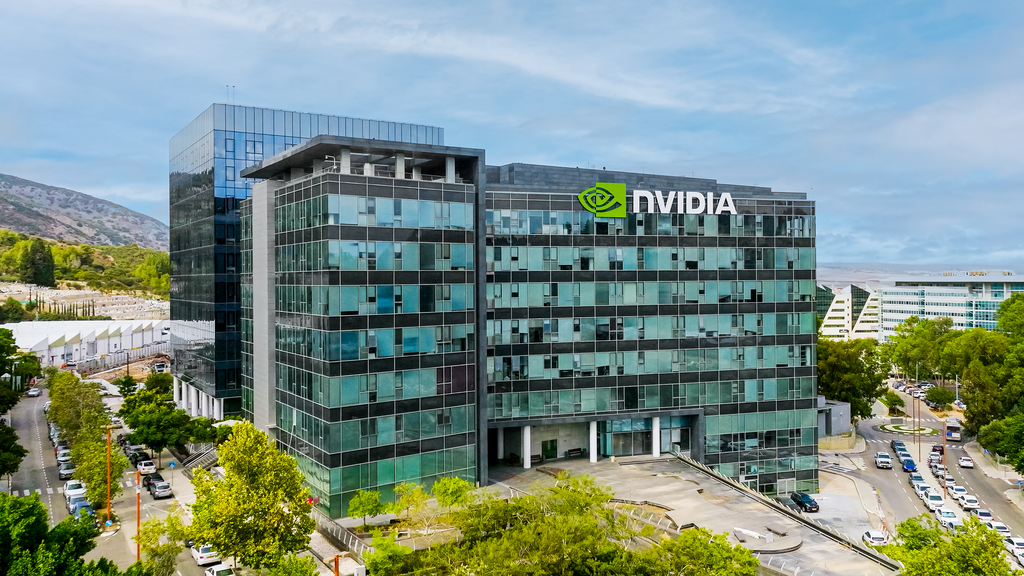
Nvidia offices in Yokneam, northern Israel
(Photo: Courtesy of NVIDIA)
Nvidia is planning a dramatic expansion in Israel, with preparations underway to build a massive new campus on a plot of land measuring between 70 and 120 dunams (roughly 17 to 30 acres). The planned construction spans 80,000 to 180,000 square meters—far exceeding the size of Microsoft’s large Herzliya campus (46,000 square meters) and Intel’s new building in Petah Tikva (34,000 square meters).
Nvidia’s Israeli development center is already its second-largest worldwide after the United States, employing more than 5,000 people. The scale of the new campus suggests that the company intends to double or even triple its local workforce in the coming years.
The campus will be built in northern Israel, not far from Nvidia’s offices in Yokneam, formerly the headquarters of Mellanox Technologies, which Nvidia acquired in 2019 for $6.9 billion.