

As she does every year, Noa Tishby underwent a mammogram and breast ultrasound this October. Once again, she chose to share the process with her hundreds of thousands of followers because the subject is close to her heart. Her grandmother died of breast cancer, and her mother battled the disease three times, surviving in part thanks to a double mastectomy. Her younger half-sister on her father's side is also a breast cancer survivor. Tishby herself has been undergoing regular screenings since she was 26.
"My sisters and I don't carry the BRCA mutation, just like my mother, but we're considered high-risk because of our family history," she explains. "I've been getting tested every October for 25 years and, since social media came along, I've been filming and posting about it, too. It's not a pleasant test. Clearly, it was invented by a man, not a woman. But you hold your breath for a few minutes, and it's over."
Noa Tishby interview


Why is it important for you to share this with your followers?
"Because you can recover from breast cancer if it's caught early. There are women who live with it for years, like a chronic illness. You don't have to die from it."
In May, Tishby's mother, Yael Artzi Tishby, died in her sleep at the age of 85. Noa traveled to Israel for a brief, painful visit to sit shiva. She recently returned for another two-week visit with her son, Ari, staying with her close friend, fashion producer Motty Reif, while tackling a difficult task: clearing out her mother's apartment.
Gallery

Noa Tishby has been screened regularly for breast cancer since the age of 26
(Photography: Alon Shefransky, Styling: Reuven Cohen)
In 2018, Yael Artzi Tishby gave an interview to LaIsha magazine in which she recounted her eventful life. Her first husband, pilot Aki Artzi, disappeared with his aircraft over the Gulf of Suez in 1967, leaving her with two young daughters, Mira and Michal. She later married architect Daniel Tishby and built a new life.
Noa, 51, is the youngest of her three daughters. She also has two half-sisters from her late father Daniel, Iris and Tom.
"My mother didn't carry the gene, and yet she got sick again and again and beat it every time," Tishby says. "She was always a fighter."
Business as usual, without the drama
Yael Artzi Tishby was first diagnosed with breast cancer in 1993. Both of her grandmothers and two of her aunts had died of the disease. Four years before her diagnosis, her mother, Noa's grandmother, died after battling breast cancer for several years.
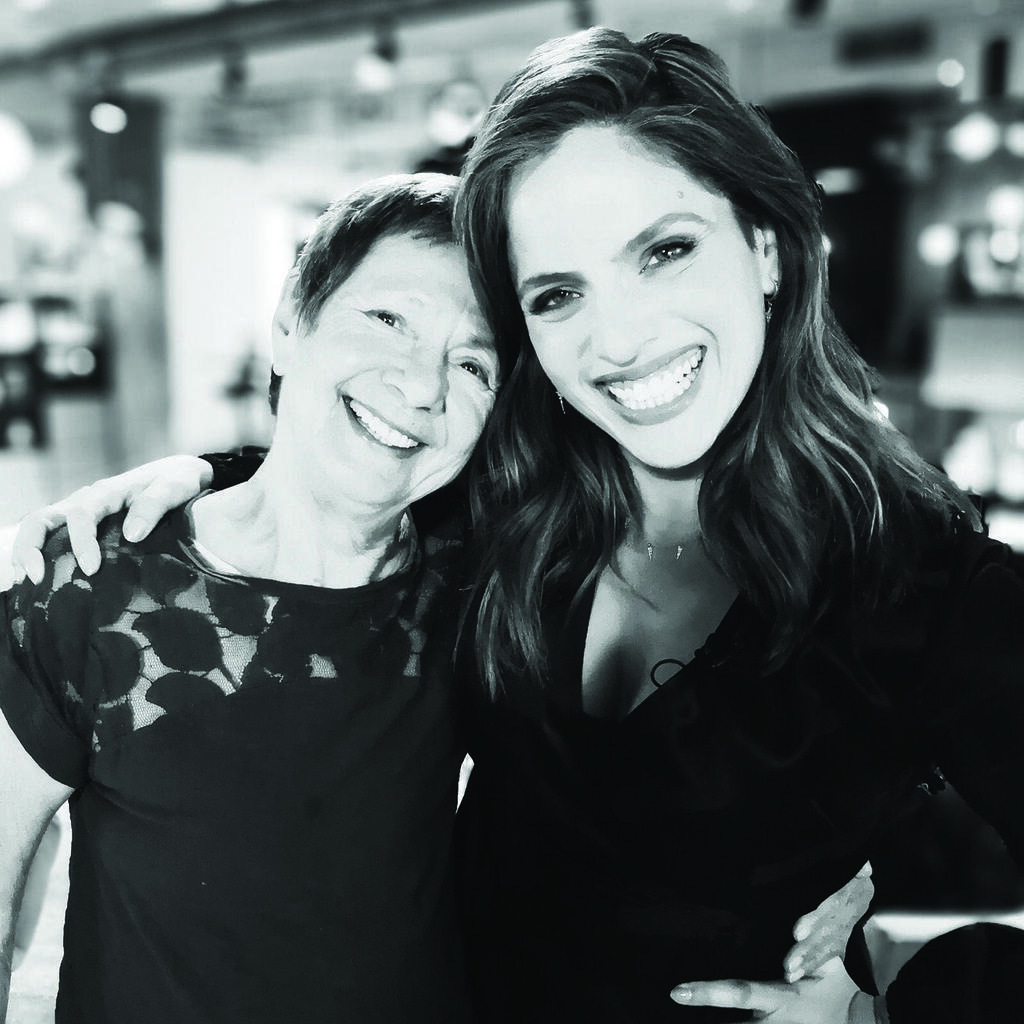
Noa Tishby with her mom, Yael Artzi Tishby
(Photo: Private album)
"My grandmother neglected her health and didn't get herself checked," Tishby recalls, "until it was too late and the cancer had spread."
In Yael's case, the tumor was detected early. She underwent surgery to remove it and remained under medical surveillance. Noa was 18 at the time.
"I remember the day my mother told me, 'They found a tumor,'" she says. "She spoke about it almost dismissively and said, 'Everything will be fine.' She was composed and said you just do what needs to be done, without any drama."
Perhaps she was trying to spare you the fear.
"She wasn't a woman who frightened easily. I come from a family of strong women."
Twenty-one years later, in 2014, the breast cancer returned. Yael was 73.
"The second time, she asked for a complete double mastectomy and didn't want reconstruction. Then came treatments and radiation that weakened her, but she beat it. Cancer had picked a fight with the wrong person. We used to joke at home that Mom would kill the cancer, not the other way around. And that's what happened."
She decided not to undergo breast reconstruction, which is an unusual choice. How did your family react?
"What my mother conveyed to us was that you keep moving forward. Business as usual. You focus on getting things done. I don't remember there ever being any medical drama in our family. I was convinced she'd have the mastectomy and then undergo reconstruction, but she simply said, very firmly, 'Why should I put myself through another unnecessary operation?' I was surprised, but anyone who knew my mother knows how perfectly that suited her."
In 2019, the cancer returned for a third time, this time with metastases to her lungs. At that point, Yael decided she did not want to undergo any further treatment. Ultimately, she did not die of cancer but of chronic obstructive pulmonary disease (COPD).

Noa Tishby: 'I don't remember there ever being any medical drama in our family'
(Photography: Alon Shefransky, Style: Reuven Cohen)
"She wasn't interested in clothes, makeup or gossip," Noa recalls. "What interested her was fighting for differential VAT rates and food security, so that if the skies and ports were closed, we would be able to produce our own food. She was active in the Magen LaOref nonprofit organization, which pushed for the development of laser interception systems. Even 20 years ago, she said Iron Dome wouldn't provide complete protection and that one day cruise missiles and drones would come at us simultaneously, so we needed to develop lasers. Suddenly, it turns out she was right."
How did you and your sisters cope with her death?
"We knew it was coming, and we even somewhat hoped she would be released from her suffering. When she died, unfortunately, it was a relief. She always said she never wanted to reach a point where she needed nursing care, but in the end, she did. As long as her mind was functioning, she was at home, and the house was full of friends. When her mind was no longer there, she wouldn't have wanted to live like that.
"Of course, it's a tragedy and heartbreaking because she was one of the smartest women in the world. She went to sleep at night and simply didn't wake up. We couldn't have asked for anything different."
And then I texted Gwyneth
It took Tishby several years to make the transition from actress, singer and producer to a public diplomacy figure, almost a political personality, representing Israel around the world. But as the granddaughter of an ambassador and the daughter of a woman deeply devoted to Zionism and public life, the move came naturally.
She began her advocacy work 20 years ago. "The moment I moved to the United States, I realized Israel had an image problem, and I couldn't keep my mouth shut. I'm my mother's daughter. In 2011, I founded Act for Israel, the first organization to conduct Israeli advocacy online. Even before that, when I sold "In Treatment" to HBO, I saw it as something that would help Israel: It would support the Israeli industry and make people think of Israel as something other than wars and conflict."
After October 7, her advocacy work intensified. Tishby appeared on international news networks, speaking fluent English and presenting Israel's perspective. She filled a significant vacuum in Israeli public diplomacy.
In 2024, she founded Eighteen, a nonprofit organization that fights antisemitism, advocates for Israel and promotes Jewish pride. The organization has six staff members and operates on donations.
"Anti-Zionist progressives spent about 30 years pushing the message that we're an occupying, illegitimate state, European colonialists rather than indigenous people, and nobody in Israel was dealing with it.

Noa Tishby was appointed in 2022 as Israel's first special envoy for combating antisemitism and delegitimization
(Photography: Alon Shefransky, Style: Reuven Cohen)
"That changed when Yair Lapid, then foreign minister, appointed me in 2022 as Israel's first special envoy for combating antisemitism and delegitimization. When the government changed, they asked whether I wanted to continue. I thought about it for a bit and said, 'Yes, of course,' because fighting antisemitism is important even when I disagree with the government. Then, after I spoke out against the judicial overhaul, particularly the override clause, they decided in March 2023 to part ways with me."
On a scale of 1 to 10, how offended were you when you were fired?
"Zero. It was another problematic decision. Why get rid of a spokesperson who's actually doing the job? And in what world do you fire someone as talented as Eylon Levy when Israel needs every spokesperson it can get?
"But I didn't miss a beat. I just kept going, only without the title. I was working voluntarily anyway."
Why did you establish your own advocacy organization?
"Because I was falling apart from doing it alone. Since October 7, I'd been doing everything on my own, with tremendous passion, and I realized that if I didn't have a support system around me, I would collapse. We're a small team, everything is done over Zoom, our expenses are low, and we invest our entire budget in creating content and organizing events."
You recruited Gwyneth Paltrow, Carla Bruni and other celebrities to light Hanukkah candles.
"The Hanukkah project started two years ago as a pipe dream during a team conversation. What if we lit a candle with a celebrity every night? I aimed as high as possible. I texted Gwyneth, and she said yes in a second. That's when I realized we had a project.
"It's one of the things we do that gets the most attention. There were also plenty of people who said no because they're afraid, even though it's not political. Pink and Amy Schumer participated, along with non-Jewish friends like Cindy Crawford. My dream is to get Barbra Streisand and Jerry Seinfeld."
Are you managing to make a living as well?
"I make my living from my books, both of which are New York Times bestsellers, and from lectures around the world that have nothing to do with the organization. I turn down a lot of social media campaigns that aren't connected to the subjects I work in."
Menopause is wonderful
Tishby, the mother of 11-year-old Ari from her relationship with Ross Hinkle, has spent much of the past few years living out of a suitcase.
"When I'm traveling, Ari stays with his father. I couldn't manage this crazy schedule without the wonderful relationship I have with Ross. He was just in Israel with Ari. Sometimes we take vacations and spend Shabbat together. He really loves Israel, and his Hebrew has improved a lot."
Have you seen NAZA, the film by Yuval Abraham and Rachel Szor that won the Jury Prize at the Venice Film Festival?
"I haven't seen the film. But even Raviv Drucker, who watched it, wrote in Haaretz that the testimonies in it aren't supported by details that can be verified.
"There's something fundamentally wrong with a film about the IDF and the war in Gaza that doesn't mention October 7. It dishonors those who were murdered. I don't think people in Israel understand how serious the country's image problem is and how much it affects every Jew around the world. We went into our most justified war after October 7, and we conducted it unwisely. We failed to rally global public opinion and turned ourselves into the enemy of humanity."
What do you say to people who comment, 'That's all very nice, but you don't live in Israel'?
"First of all, I don't read comments. I understand people who say that, but right now I'm much more effective for Israel from abroad, and in English. Anyone who knows me understands that all my work is connected to the State of Israel and the Jewish people. I don't care what people say."
Is there a chance you'll move back to Israel one day?
"Absolutely. Ari would move here in a second, and Ross talks about coming for extended periods. A month ago, he suggested again that, before Ari moves on to his next school, we should come to Israel for six months. That's not going to happen right now."
Tishby is loving life. After splitting from her tech executive boyfriend in January, she is enjoying being single. At 51, she feels she is at her peak.
"Menopause is like the State of Israel," she says with a smile. "The most wonderful thing with the worst branding. I feel healthier and stronger than I've ever felt in my life. This is the most beautiful age for women, the most powerful, the most self-assured, and I'm enjoying it so much. And yes, I take hormones. Of course, I'm not recommending that every woman do what I do. I haven't had a single hot flash in my life, and my sex life is in a great place."
Makeup: Galit Wertheim; Hair: Liraz Agam; Production: Livnat Sulimani; Styling assistant: Lior Buchbut; Clothing: DES dress for Verner, Jack Kuba bra, Stella McCartney T-shirt for Factory 54, Jacquemus skirt for Factory 54, Mimosa shirt and pants; Jewelry: H. Stern, necklace and bracelet from a private collection. Photographed at the David Kempinski Hotel in Tel Aviv.