

Eyal Shani has earned praise, stars and plenty of criticism, yet even after four decades in the world of food and restaurants, there are still moments that surprise him. His New York restaurant Shmoné recently received a Michelin star for the third consecutive year.
The achievement comes at a time when direct attacks on Israel may have subsided, but political tensions remain and attitudes toward Israel are still highly charged. Shani and his team were convinced they would not receive a star this year. But amid that tension, where politics meets food, the unexpected happened and the invitation to the ceremony arrived.
“It was against all odds. We were sure we wouldn’t get a star,” Shani tells ynet. “The feeling in New York is that the media and everyone else don’t want to deal with anything Israeli, especially with the terrible accusations directed at Israel. So why should Michelin give a star to an Israeli restaurant? We also weren’t invited to the ceremony on time, and whoever is invited knows they won a star. Only two weeks before the ceremony did we receive an invitation, which is very late. It felt to me like they didn’t want to give us a star at first but then reconsidered and decided to invite us.”
If there is one thing Shani does not want, it is to become a “Michelin restaurateur.” In his eyes, Shmoné is a wild restaurant, with no table manners and no rules. Steak is served on paper with juices running onto the table, and dessert is served on a cloth napkin spread over the mess left from the meal. That wild format suits one star but not two or three, which require strict rules and entirely different standards.
Does Michelin help the business?
“I never aimed to get Michelin. I aim for the hearts of the people who dine with me. That is my goal, and for that I need absolute freedom and love, not a system of rules like Michelin has. At Shmoné I did everything the opposite way. It is my wildest restaurant. It is a crazy place. We may not have manners, but we have passion and love for what we do and a desire to serve people. Shmoné is similar to Abraxas in Tel Aviv. Diners at Shmoné get a raw experience, with no filters. They get the truth of the food story as I see it. There are no decorations.”
Is Michelin still relevant today?
“They are trying to protect the old model, but in recent years they have loosened up and award one star even to a street stall. Where do they preserve the past? With two and three stars. There you must follow their protocols exactly. The best Michelin restaurants are the one-star places because you do not have to fit any framework. With two and three stars, you need five forks set by every plate, white tablecloths and servers everywhere. A one-star place can even be a simple tavern. For me, a one-star rating signals great intention, passionate creativity and unique touch. Getting one star is delightful. I would never want two stars because that would put me into a mold of what is allowed and what is forbidden, and in the end, I would need to pour sauces from little pitchers onto plates. I do not want that.”
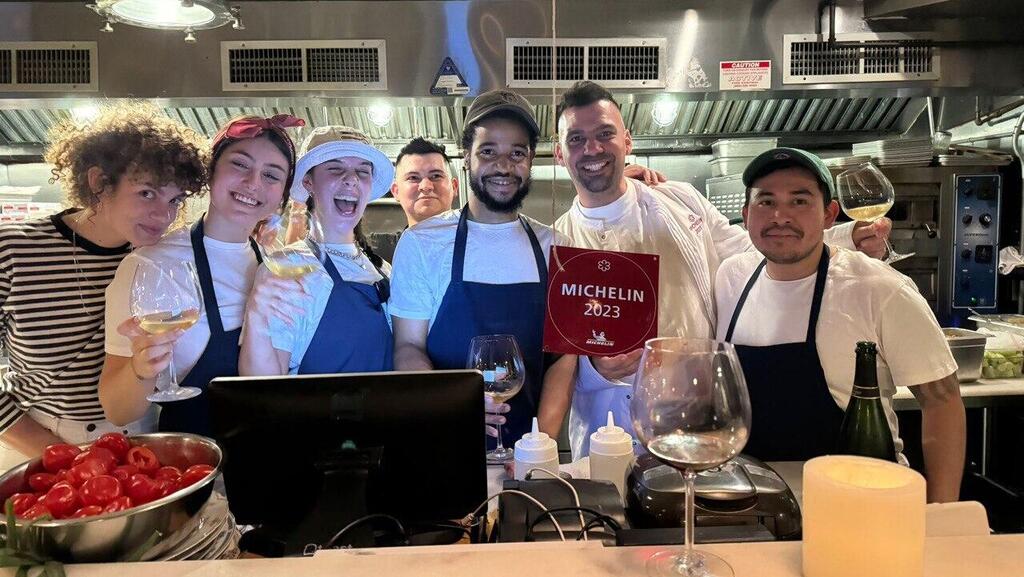
Shmoné Restaurant in New York
(Photo: PR)
You have restaurants around the world. Which one do you most enjoy being in?
“I love Seven North in Vienna, I love Shmoné in New York and I love Miznon in Chelsea Market, which was our first spot in the United States. Now I’ve also started loving Gila & Nancy in Berlin, there is something charming there. I like being in places we created without prior knowledge, in the untouched places. We built HaSalon in Tel Aviv the same way, with no idea what we were doing, just chaos and passion. HaSalon is now 18 years old, but when we opened it everyone said it wouldn’t survive more than two months. Today we know it will outlive us all. When we opened, we kept it secret for three months. Only a small circle of friends knew. It was like a secret cult that gathered on Wednesday and Thursday nights and we did amazing things there. We used to feed 24 people a night, and I remember wondering what would happen if 60 people came. Today HaSalon serves 200 people a night. It gives full expression to raw ingredients. Nothing is decorated. Today, there are so many unnecessary things in the restaurant world.”
Like what?
“Most things are unnecessary. For example, three hosts at the door, or when you sit down, they ask if you have allergies as if you arrived at an emergency room. That is not restaurant culture for me. I try not to have unnecessary things in my restaurants. I want honesty.”
Shmoné is in the heart of Greenwich Village in Manhattan. It has only 70 seats and a long waiting list. “Even before we received the star, Shmoné was full every evening,” Shani says. “It is not very expensive and that is the best style for an unpretentious Michelin restaurant. It is even cheaper than HaSalon because I want it to be accessible. Demand is high, and we only manage to seat 20 percent of the people who want to come. I think the success of a restaurant is measured by its waiting list. That shows desire and longing.”
The kitchen at Shmoné is led by chef Orianne Shapira, only 28, who grew up within the group’s kitchens. Shani speaks of her like an artistic discovery. “Orianne came to Shmoné from HaSalon in Tel Aviv. She doesn’t have much experience but she is talented, and I have always valued her talent. You cannot stop watching her work with her hands. I once saw her slicing sashimi. She has the hand movement of a dancer and an excellent Japanese knife. I looked at her and told myself that with those hands and that knife, I could conquer the city. She is 28, and before joining us, she never worked in any other kitchen. She grew up with me. When she receives a box of fresh red mullet, she gently strokes each fish and places it perfectly in the tray, really caressing its head. All my life, I have looked for cooks who don’t work like everyone else, by method, but cooks who have another way.”