

Most of us do not give it much thought at the supermarket. We simply add a familiar bag of potatoes, with red or white skin, to the cart and move on. But behind the most common root vegetable in our kitchen lies an entire world of dozens of varieties, each with its own aroma, texture and completely different culinary purpose.
Whether it is crispy fries, buttery mashed potatoes or oven-roasted potatoes, the secret to a winning dish begins with identifying the right variety. We set out to find which varieties are grown in Israel — far more than you might think — how to choose the right potato for your dish and what mistakes we make with them in the home kitchen.
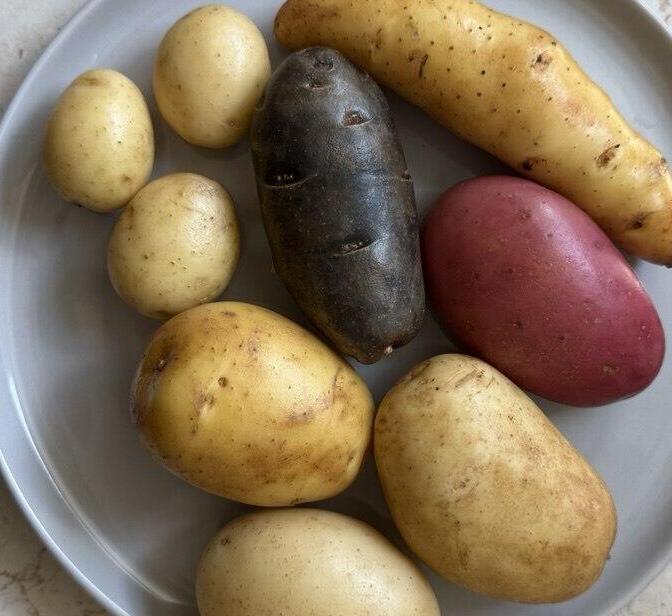
There are many varieties of potatoes
Contrary to what packing houses and supermarket chains have taught us, there is no real connection between the color of a potato’s skin and its cooking properties. In fact, white, yellow and red varieties can be found for every range of uses.
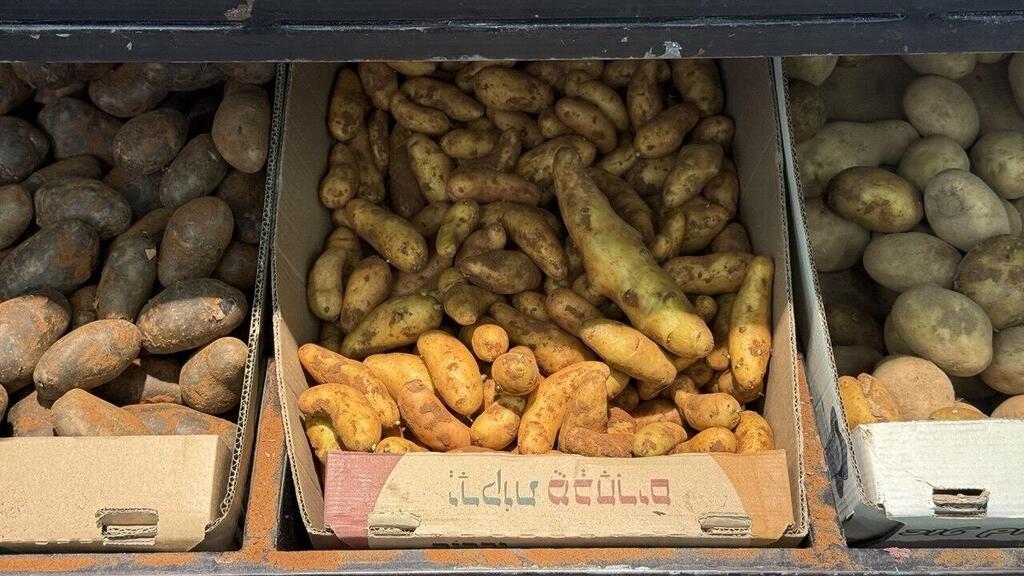
While supermarkets mainly sell five red varieties, such as Desiree and Mozart, and five white varieties, such as Sifra and Mondial, Israel actually grows between 60 and 80 different varieties, the vast majority of them intended for export. We checked at Carmela’s store in the Carmel Market which varieties stand out — and what the differences are.
Agria and Kingsman are Israel’s leading varieties for making fries. They ensure an especially crispy result on the outside and a soft interior. Ratte is the aristocrat of potatoes. It is a premium French variety, very dry and with a strong flavor, resembling a mouse in shape. It is the secret ingredient — half Ratte, half butter — in the famous mashed potatoes of chef Joël Robuchon.
Butter, as its name suggests, has a rich, buttery flavor and a yellowish color. It is high in starch and especially suitable for gnocchi, mashed potatoes or baking. Queen is a new white variety developed especially for frying. It has a low sugar level, so it does not caramelize, or darken, too quickly in deep oil.
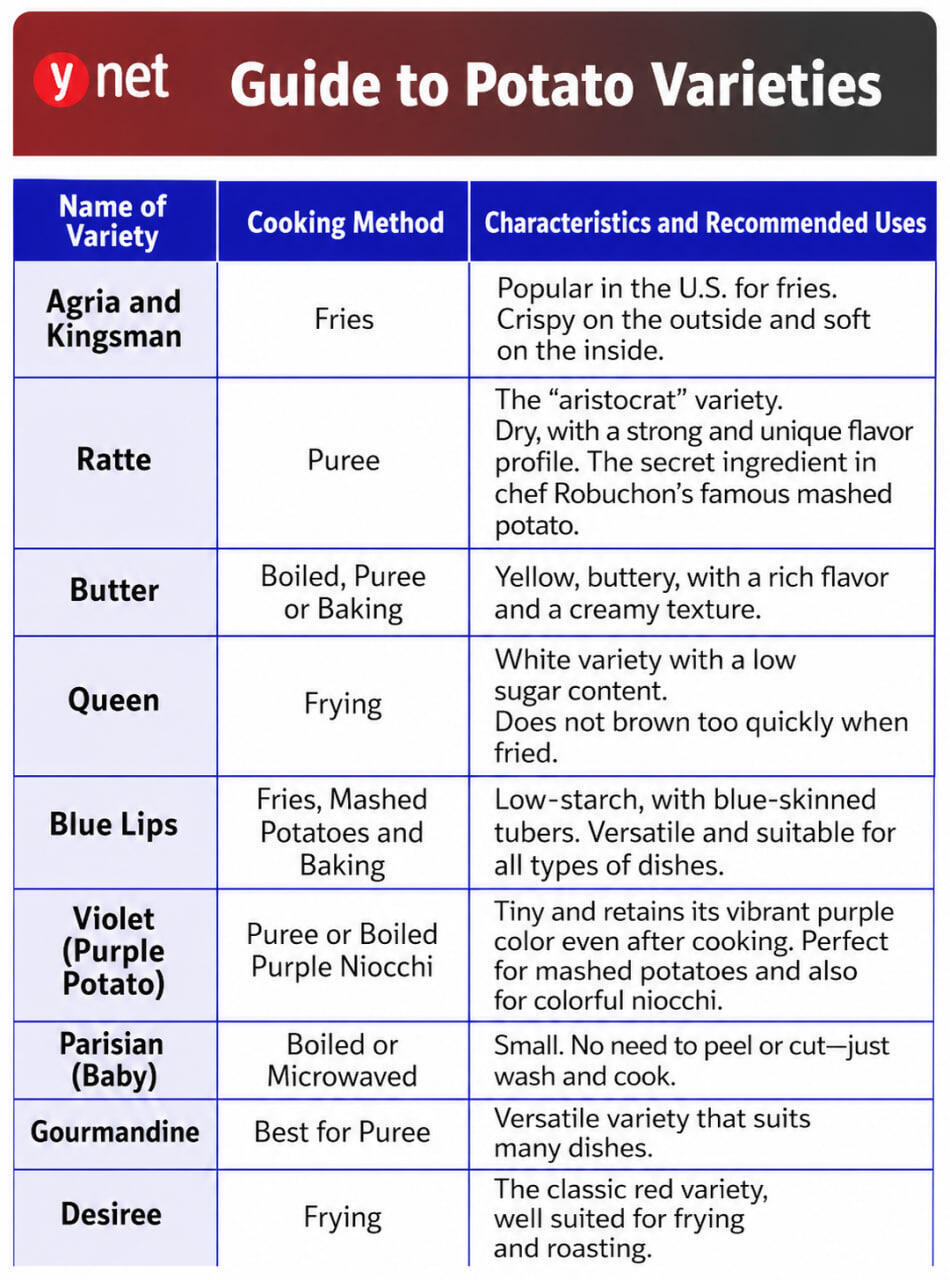
Blue Lips is easy to identify thanks to purple marks on the skin that resemble a kiss. It has a sweetish taste and is considered very versatile, suitable for fries, latkes and oven baking. Next on the list is Violet, a purple potato: small and impressive, it retains its deep purple color even after cooking. It is very dry and suitable for making surprising mashed potatoes for children or colorful gnocchi.
Parisian is the name for tiny baby potatoes. Their great advantage is that there is no need to peel or cut them. Simply wash and put them in the oven or microwave. Gourmandine is a particularly beloved variety that suits almost every need, but excels especially as a base for mashed potatoes. Last on the list is Desiree, the classic red variety familiar to us all, which is very suitable for frying.
Don't wash until you are ready to use
Many of us prefer buying washed potatoes to save work, but it turns out this harms their quality. Washing accelerates chemical and biological processes that cause potatoes to change their properties in a way that affects baking or cooking. Also remember that large potatoes keep longer than small ones.
Start cooking them in cold water
(Photo: Sapir Gordo)
To understand how to get the most out of potatoes at home, we turned to experts who know them up close and have prepared a practical cooking guide for us. We asked chef Snir Eng-Sela of the Gouje & Danielle restaurant what the most common mistake is when people cook potatoes at home.
“A potato cooks from the outside in, so you always need to start cooking it in cold water,” Eng-Sela explains. “When you start in cold water, the entire potato reaches an even temperature and cooks uniformly. If you throw it straight into boiling water, it will fall apart on the outside and remain raw inside. The same is true for baking. When the potato enters the oven cold, its temperature rises evenly and properly.”
Is there a preparation method or tip that can significantly upgrade a potato even in home cooking?
“When cooking potatoes in water, for mashed potatoes, gnocchi or fries, they must not be left in the liquid once they are ready. Once the potato is fully cooked, it begins absorbing water, and you have to handle it immediately. Another tip is that there is no waste in a potato — everything is usable. Do not throw away peels. If you have them left after making a salad, mix them with olive oil, roast them in the oven until crispy and add them as an upgrade to a salad.”
A complement to any meal
(Photo: Daniel Lila)
Do you have a professional trick for making perfect potatoes?
“In Israel, there are not enough specific potatoes that are good for classic fries year-round, only for about four months. So my trick is to take baby potatoes, first cook them in water, cool them, then smash and fry them. For seasoning, you can simply use salt and nothing else, or toss them in a gremolata of parsley, lemon zest, garlic and olive oil. It is an excellent combination for this.”
Do you have a particular approach to potatoes?
“I like them simple. A good ingredient should take center stage, and in mashed potatoes you should taste the potato, not just butter and cream. Today it is easy to get excellent varieties at home, like the Butter variety, which is available at greengrocers and is excellent for mashed potatoes, gnocchi or potato confit that undergoes an initial cooking in fat and then double frying.”
Do you have a favorite or surprising potato dish people must try?
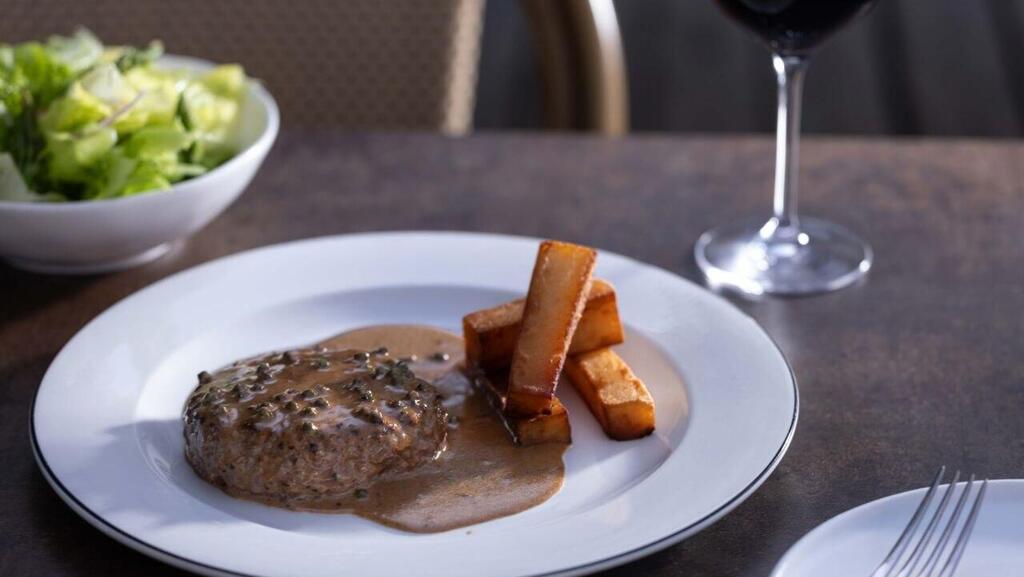
“My great loves are mashed potatoes and pommes Pont-Neuf, named after a bridge in Paris. You cut the potatoes into large, thick sticks, confit them in beef fat, cool them and then fry them. They come out crispy on the outside and super soft inside.”
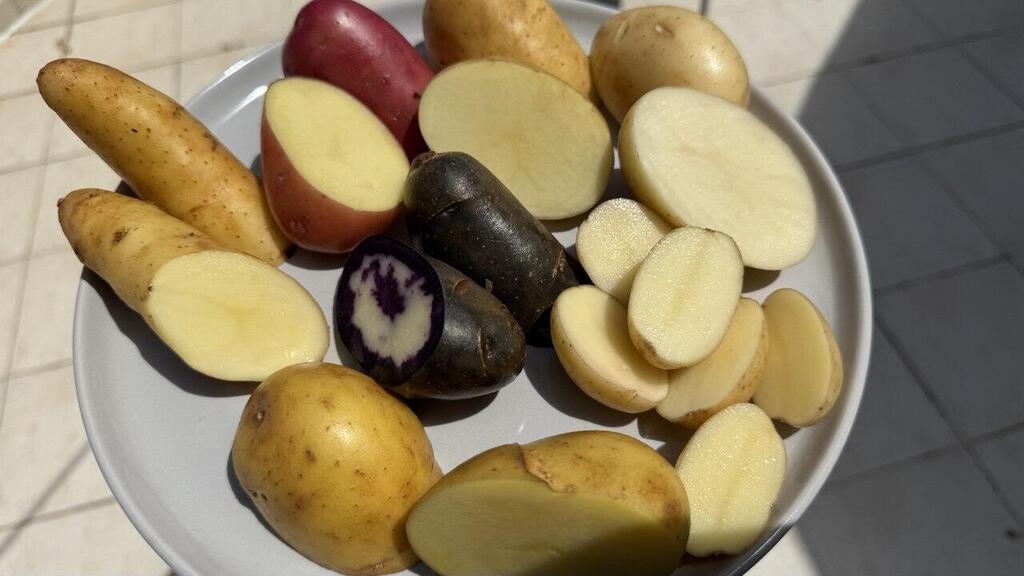
Potatoes are very rich in potassium,
(Photo: Sapir Gordo)
Beyond taste and texture, it is also important to know how to incorporate potatoes properly and in a balanced way into our daily diet. We asked Karen Ann Gaiman, a dietitian, fitness trainer and television presenter, about the main nutritional values of the popular vegetable.
“In 100 grams of potato, there are about 86 to 87 calories, about 20 grams of carbohydrates, about 1.7 to 1.9 grams of protein and only about 0.1 grams of fat. In addition to these values, potatoes are very rich in potassium,” she explains.
Is there a nutritional difference between the different varieties?
“In terms of nutritional values, there is not much difference between different potatoes. Per 100 grams, they are quite similar. Red or purple varieties, like those that come from Peru, contain anthocyanins in the skin, powerful antioxidants similar to those found in beets and blueberries, though in small concentrations. Since most people do not eat the skin, their health contribution is fairly negligible. The main difference is in texture: firm potatoes are better suited for fries, while softer potatoes are better for mashed potatoes.”
Does the preparation method significantly change its health value?
“In most preparation methods, a potato retains its components, except for frying, which adds many calories. Frying in oil that is not cold-pressed, or in oil that has already been used, increases its oxidation and can fill the potato with less healthy components.”
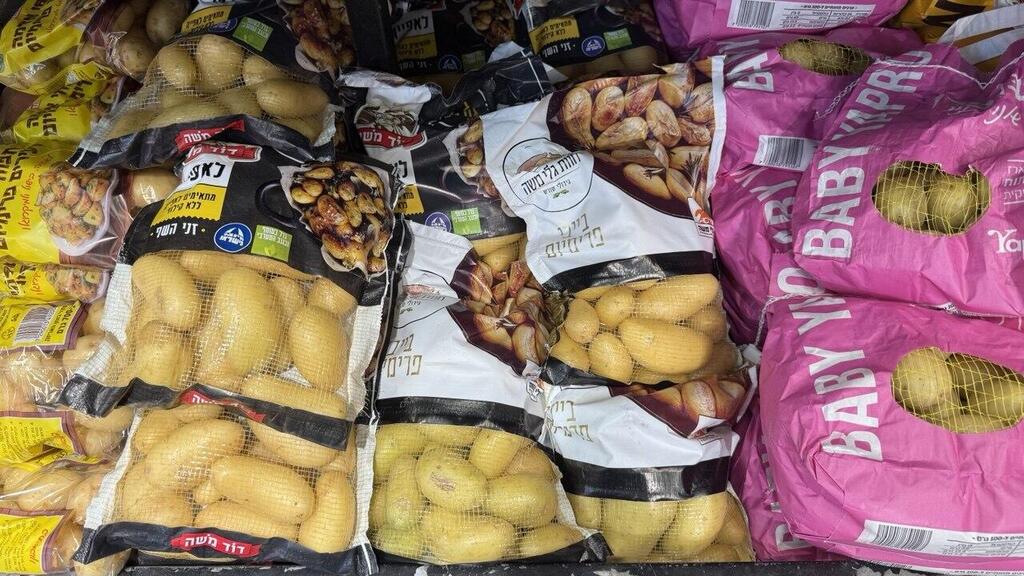
Leave the peel on
(Photo: Sapir Gordo)
Is a potato considered a less healthy carbohydrate?
“There is no such thing, universally, as a good or bad carbohydrate, except perhaps sugar and sweets. Potatoes have a fairly high glycemic value, meaning they break down quickly into sugar and raise blood sugar levels. On the other hand, we usually consume them alongside fat, such as olive oil or butter in mashed potatoes, or a little oil in baked fries, and that helps balance the glycemic index. As a dietitian, there are carbohydrates with greater added value, such as legumes, but potatoes are not a bad carbohydrate.”
What is the most common mistake people make when it comes to eating potatoes?
“The most common mistake is automatically peeling the potato. It is worth considering whether the dish is suitable for eating the skin, such as in a long-cooked stew or baked fries. Eating the skin preserves nutritional values such as fiber, and in colorful varieties, antioxidants as well. You just need to clean it well beforehand.”
How should potatoes be stored at home so they last a long time?
“Potatoes should be stored in a ventilated, shaded and relatively cool place. Storing them in a basket inside a cabinet is the right way. Make sure the potato does not accumulate moisture and remains at room temperature without heating up.”
When a potato starts sprouting or turns green, is it still safe to eat?
“It is preferable to eat the potato before it sprouts. As for the green color, if someone eats a little of it when it is slightly green, nothing will happen. A potato full of solanine will already be very green, and no one will eat it. There is no reason to create panic or unnecessary fear.”
First published: 12:45, 05.27.26