


When Jordan Goldberg was growing up in Chicago, he certainly never imagined that one day he would find the love of his life in a tiny community in Israel. He also never imagined that because of that love, he would make aliyah and move to Israel, just as the country was being attacked from two fronts simultaneously.
The love story of Jordan Goldberg and Noa Pink, both 29, who live together in Kibbutz Gonen in northern Israel, is not only charming and romantic. It also proves the power of love to completely change the course of our lives.
Gallery
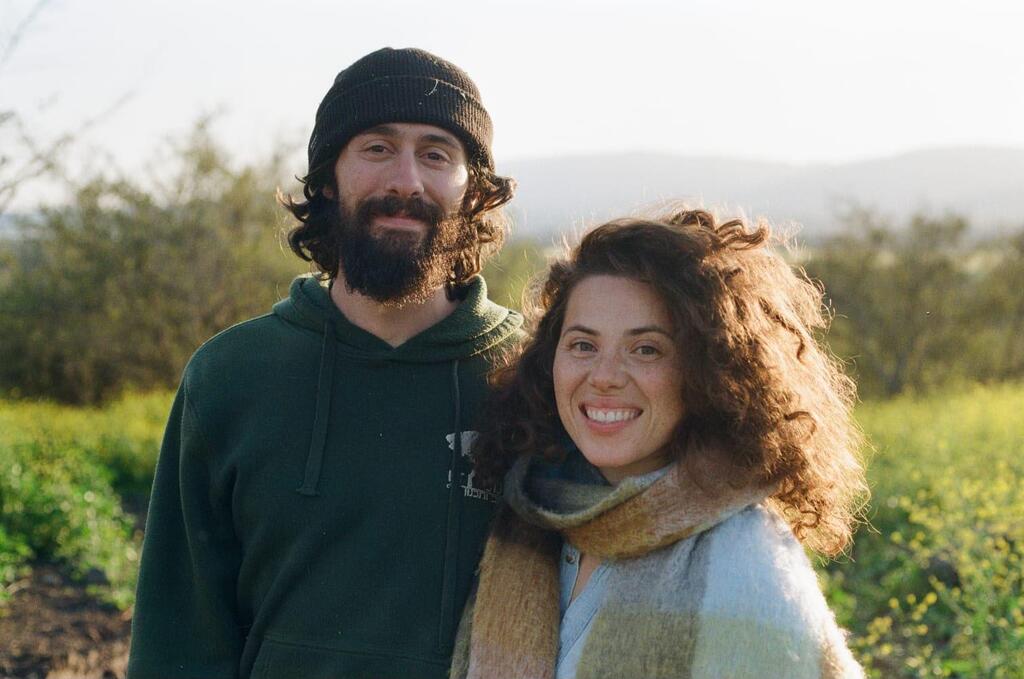
The love story of Jordan Goldberg and Noa Pink proves the power of love to completely change the course of our lives
(Photo: Courtesy of the couple)
“I came here to volunteer at a kibbutz, and I thought that after three months I would return home. And here I am, a few years later, living and working in Israel at a small kibbutz in the north,” Jordan says proudly.
“There is a huge Jewish community in Chicago, and it was important to my parents that I attend a Jewish school three days a week. I also went to Jewish summer camp and joined a Jewish fraternity in college, went to Chabad for Friday night dinners and attended events at Hillel. I’m connected to the Jewish community, and so are my parents, my sister and everyone I know. But I definitely never thought I would meet an Israeli woman until I met Noa.”
Goldberg arrived in Israel after a successful Birthright trip that made him fall in love with the country. Following his father’s advice, he came to volunteer at Kibbutz Grofit in the Arava region. At first, he experienced a certain culture shock.
“I love Chicago. It’s home and it’s my heart. But Grofit is as different as it gets. Chicago is the third-largest city in the United States, it’s green and full of snow. Grofit has 300 people in the middle of nowhere, in the desert, between mountains. It’s as different as possible. And that’s what I loved about it, because I didn’t know what I wanted and I arrived after finishing a degree in a field I wasn’t sure I wanted to work in.”
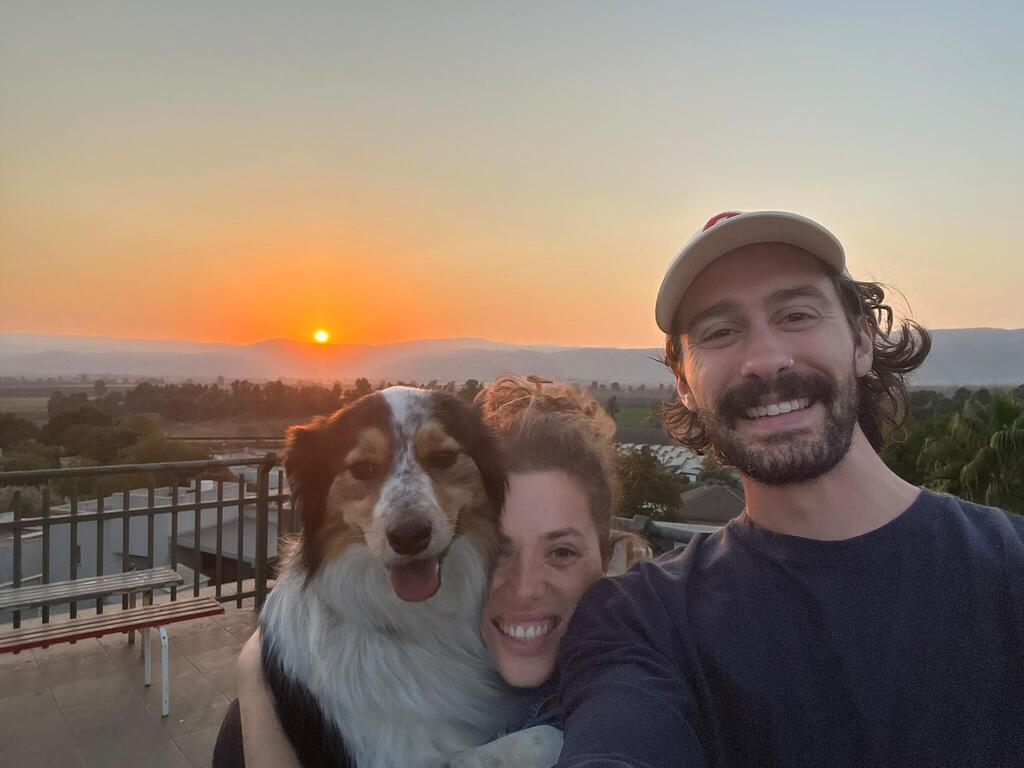
Jordan, Noa and the dog. Only when they were apart did they realize how much they were in love
(Photo: Courtesy of the couple)
He met Noa, who is currently finishing her social work degree at Tel-Hai Academic College and works as a rehabilitation counselor, at the same kibbutz that was so different from his home.
“I worked in informal education,” she recalls. “I first met Jordan when all the kibbutz friends were sitting at our usual spot above the bomb shelter.
“We had couches there and watched the sunset over the mountains of Jordan. It was completely random. We happened to sit next to each other. He took out a guitar. It was my sister’s birthday and I wanted him to teach me how to play a song for her, ‘Maya’ by Arik Einstein, although it never happened. He did become interested in me and started sitting with us every evening because of that, even though I didn’t understand it at the time.”
A second chance at love
Jordan admits it was difficult for him to express his interest because of cultural differences.
“Israelis are more direct, and I’m not that direct. It wasn’t obvious that I was making a move,” he says with a laugh. “It took me time to court her. Looking back, I wasn’t very clear about the fact that I was interested. I was also planning to stay there only three months, and my visa was only for a year. I didn’t know what I wanted to do. I had plans to work in France and then volunteer in agriculture in Japan. Then COVID arrived, and everything changed.”
What happened during COVID?
“We were stuck, but in the best way possible,” he explains. “It was the best place to be because we were in the middle of nowhere and there wasn’t much illness. We continued our routine in this tiny kibbutz, and during that time we continued spending more time together than we expected. It developed into something more serious.”
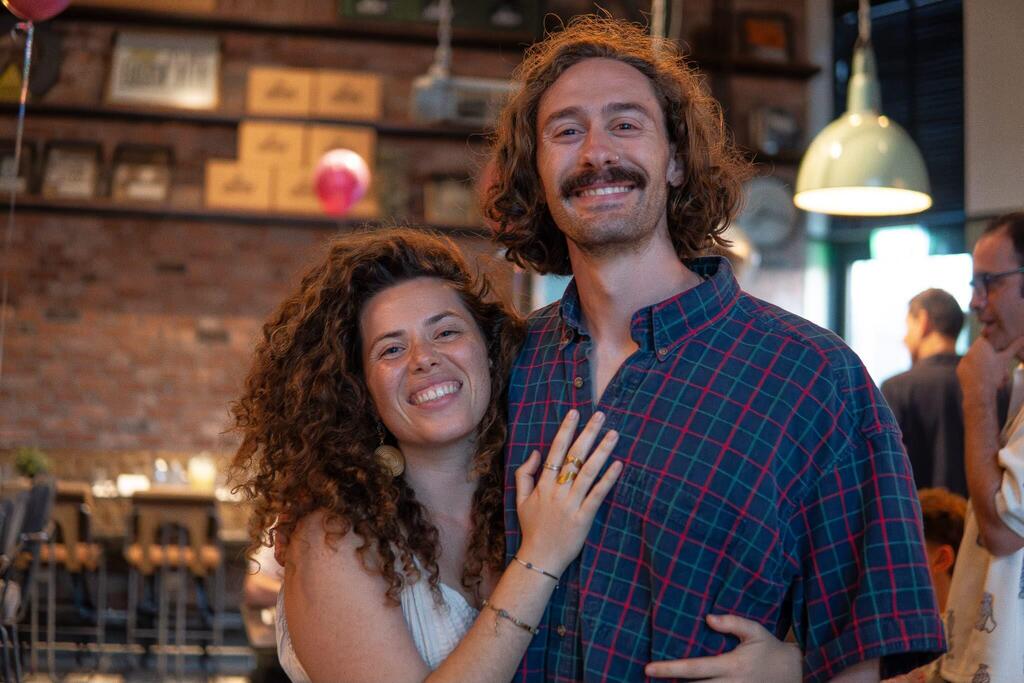
Jordan and Noa. They were separated for three years and are now inseparable
(Photo: Courtesy of the couple)
“Suddenly the fact that we came from different places became a problem. I returned to the United States and she stayed in Israel.”
Noa, why didn’t you go with him?
“I didn’t go with him because I had what I wanted to do in Israel: my studies, which were very important to me. I felt that I had finally found direction in life. I didn’t want to give that up. We broke up and were apart for three years.”
Jordan and Noa did separate, but during those three years they remained in contact and never stopped taking an interest in each other’s lives. In other words, they never truly managed to move on.
“We stayed in touch, we talked, we knew what was happening in each other’s lives. We both tried to move on, but after three years I realized I couldn’t, and he was still in my head and in my thoughts,” Noa says.
She realized she had to do something to stop the endless thoughts.
“I gathered the courage and asked that we talk,” she says. “I admitted to him that I was still thinking about him and that I couldn’t get him out of my head. I assumed he would give me a final ‘no’ and I would be able to move on because I was sure he had someone else. But that didn’t happen. He said he felt the same way and that he hadn’t been able to move on either. We decided that after my preparatory program, I would travel to him in Chicago and we would try again.”
She remembers their reunion as wonderful.
“I flew to him and it was incredible,” she says with a smile. “To see him again, to be with him. People change and go through things. It was beautiful and interesting to see how each of us had developed during those three years. It was also beautiful that after all that time, we both still wanted to get to know each other and discover each other again.”
She could not have imagined the enormous tragedy that would take place in Israel while she was away.
“On October 7, I was in Chicago. I was supposed to return on October 9 for my studies. My cousin was murdered in Kfar Aza.”
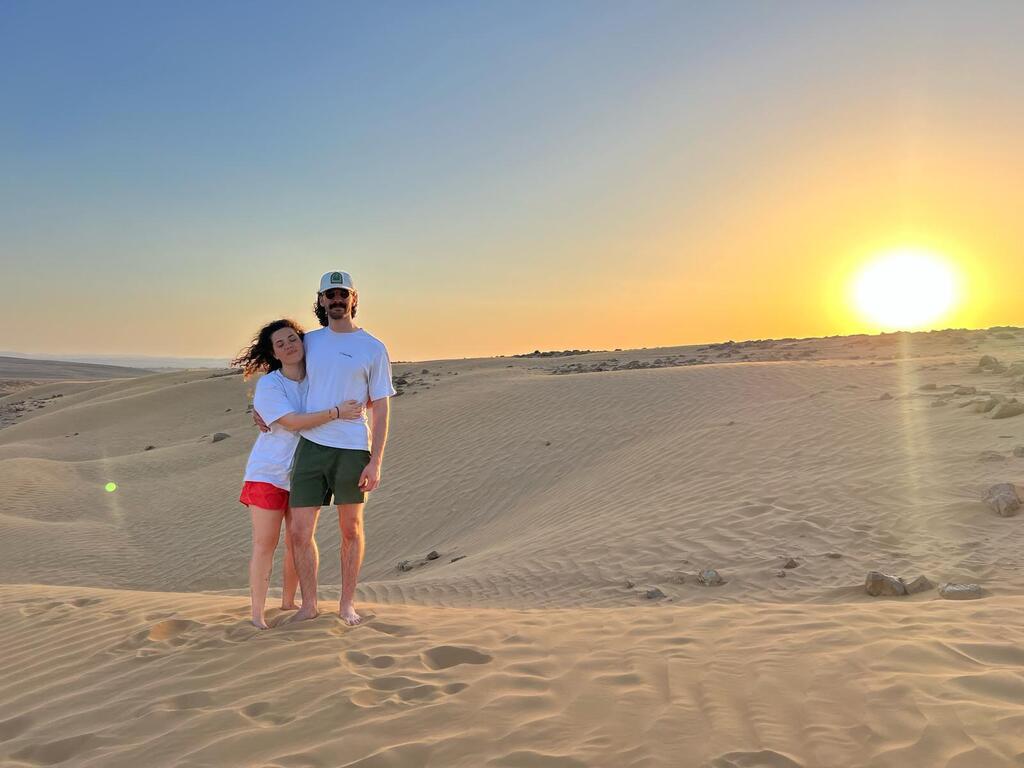
Jordan and Noa. They got a second chance at love
(Photo: Courtesy of the couple)
After returning for the funeral, she decided to go back to Chicago.
“His home there became a place of quiet for me, a place where I could rest. We had an opportunity to be together, get to know each other more and develop our relationship. It was clear to me that I would continue my studies. At the beginning of my second year, he decided to make aliyah.”
“I think that period strengthened the fact that we wanted this to work,” Jordan says. “I came to visit in April for a few weeks, and it happened to be the first time Iran attacked and, at the same time, the Houthis launched missiles.”
How did you cope with the security situation?
“I’m starting to get used to it, although it’s sad that I’m getting used to it. It’s a painful part of life here. Everyone I talk to asks me how it is. During the war with Iran, it affected me. It was every day, every night, constant alarms. I couldn’t work or sleep. Every time I heard a sound, I thought it was an alarm. We are on the Lebanese border and it is still very present. It’s a daily reminder that the war is still happening.”
Noa, what do you love most about Jordan?
“I feel safe with him. He is stable, he creates a feeling of calm and acceptance. Not only with me, but in general. He is open and accepting. He found his dream job here, on his own. It’s incredible and impressive. He built himself here from scratch and in a short time. He hasn’t even been here two years and he has already found his place. He arrived without knowing Hebrew, without family here, and adapted very quickly.”
Today, Jordan manages the farm at the Gonen Culinary Institute (GCI), which is set to open and become an international-level culinary school. The site will include a restaurant, café, wine bar and brewery.
“The concept is a holistic approach to culinary arts, showing where food comes from,” he explains. “I design, build and manage the farm located in Gonen. The culinary center will open with the support of Jewish National Fund-USA. This is a dream job. It’s unbelievable to me that I have this job. My passion is small-scale organic agriculture, which is exactly what this farm is. I have the opportunity to build and design from scratch. I love food and everything connected to food. This is a dream for me.”
Do you see building a farm from scratch here as a Zionist act?
“Yes. One of the philosophies of the new place is to invest in the Galilee and the Hula Valley, to bring opportunities, tourism, people and jobs. This is exactly the dream we had: to build a home in a magical place with a small agricultural farm. When I first arrived here in 2019, I don’t think I could have imagined this.”