

As soon as the tears over the massacre in Sydney dry, we will return to routine. To the press of daily life, the suffocating work schedule, traffic jams, meeting friends, an overly expensive vacation, fleeting moments of happiness with the children in a messy living room. As after every tragedy, it will be a little harder than the time before, but it will happen. Everyday Israeli life will take over. Reality allows no other choice.
In the background, of course, we will remember that antisemitism exists. That it is steadily rising. That it is not necessarily tied to Israel’s actions, but to our very existence as Jews. And that it will happen again. Because the location of the next attack is only a matter of a local imam inciting too far, a random madman, or Iranian direction. Without noticing, a Hanukkah massacre will become just another example we cite to illustrate that hatred of Jews kills.
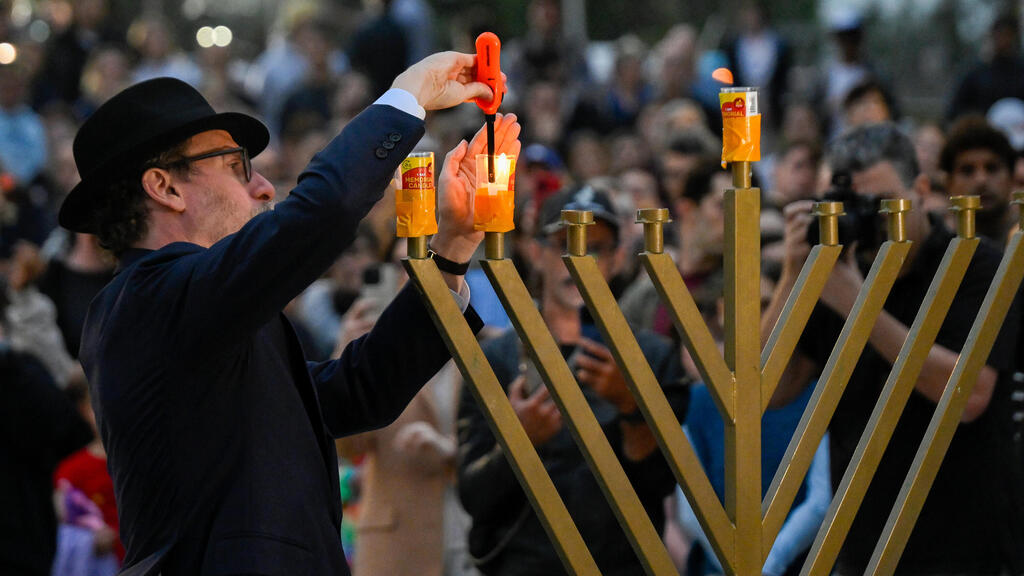
Public Hanukkah lighting in Australia the day after the Bondi Beach massacre
(Photo: Izhar Khan/Getty Images)
And the truth is that this, in itself, would be a tragedy. Because if all we take from this disaster is the fact that we are unpopular and that our enemies are bloodthirsty, then something has been missed. That lesson is too obvious. Too familiar. Fifteen souls who left this world because of their Jewishness illuminate something deeper. This is a wake-up call to reassess our relationship with Diaspora Jewry. Those who are always there in the background. Who support, who pray, who donate, who speak to us with a strange accent, who sometimes love us more than we love ourselves. Those whose place in our lives is not clearly defined, simply because no one really explained it to us. They are there, not here. And the result is that for some of us they are Israel supporters abroad, and for others a ‘walking check’ that appears in moments of crisis to fulfill a moral obligation.
But how many of us see them as a real part of the Zionist story here? How many believe that even without the right to vote, it is worth hearing their views on issues of Jewish significance that will affect them as well?
The Jewish community in Australia is an interesting test case in this regard. Relative to the size of the community, the number of lone soldiers it sends to Israel is equivalent to 80,000 lone soldiers from the United States. In the first year of the war, its members donated about $100 million to various initiatives in Israel. In a survey conducted shortly after October 7, more than 90% expressed unequivocal support for IDF operations. A similar number said that when Israel is at risk they themselves feel personally at risk. And as we can see, these are not just feelings.
But do all of these factors grant them the right to express a position on decisions made here? Is Israel, in some sense, also theirs?
The Law of Return grants every Jew the right to immigrate and become a citizen. That is one of the meanings of being a Jewish state. But more than seven decades after the founding of the state, it is time we understand that the right of return is not the only right Jews have with regard to Israel. Their bond is stronger than that.
Our obligation is broader than that. And if there is one thing the wave of antisemitism over the past two years has taught us, it is that our fate is shared. For that reason, the question of Jewish peoplehood is no less important than other fateful issues that have been debated here since the start of the war.
More than two years after the day that changed our lives, the time has come for Israel, its institutions and the leadership of world Jewry to convene and formulate a vision for the Jewish people for generations to come. One that redefines the relationship between Diaspora Jewry and the largest Jewish community of all, the Israeli one.
It will not include the right to influence the Knesset, but it will mark out our mutual responsibility and give it practical expression in education systems, security and daily life. Not only in times of crisis. The massacre at Bondi Beach is a reminder of that as well.