

The predicament facing Lebanese President Joseph Aoun: Iran’s ambassador to Beirut, Mohammad Reza Sheibani, has been declared a “persona non grata.” For four months, he has not been allowed to submit his credentials and if he leaves the embassy building where he has been holed up, he is expected to be deported to Iran. But that did not stop Lebanese Defense Minister Michel Menassa from physically passing by the coffin of Iran’s former ruler Ali Khamenei in Tehran, after he was killed in a U.S.-Israeli strike. President Aoun even declared that “relations are normal.”
On July 21, the Lebanese president will arrive for a meeting with U.S. President Donald Trump at the White House. The meeting has been postponed several times, while Lebanon’s impressive ambassador to Washington, Nada Hamadeh Moawad, has been shuttling between the White House and the State Department to ensure there will be no “bad surprise” and that Israeli Prime Minister Benjamin Netanyahu does not also show up “by chance.” There is no doubt that from the Lebanese perspective, this is a historic meeting: The last Lebanese president invited to the White House was Michel Suleiman, in 2009.
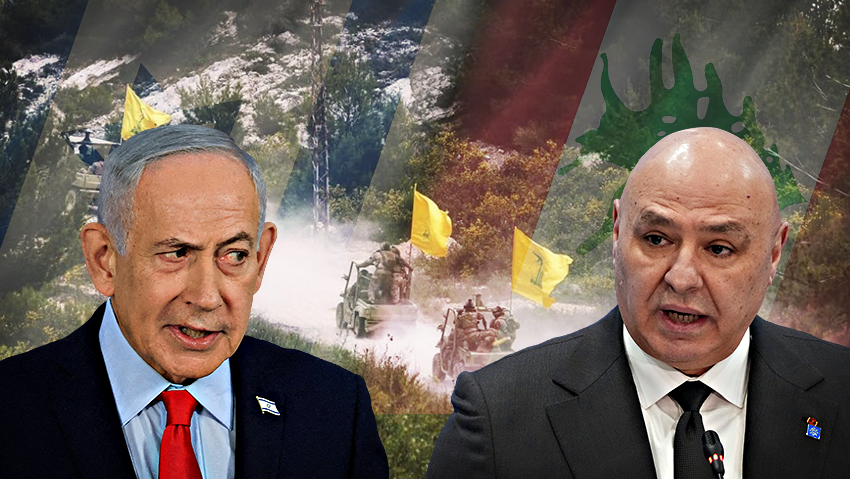
Lebanese President Joseph Aoun and Israeli Prime Minister Benjamin Netanyahu
(Photo: Petros Karadjias /AP, shutterstock, REUTERS/Ronen Zvulun, Aziz Taher/Reuters)
At the same time, members of the Lebanese delegation expressed frustration over the decision to hold the meeting with the Israeli delegation in Rome. They pressed to continue the talks at the U.S. State Department building in Washington. “Why Rome?” they asked. In the end, they agreed with a forced smile.
Trump also pressured Syrian President Ahmed al-Sharaa to send military forces to Lebanon to eliminate Hezbollah and collect its weapons. But al-Sharaa made it unequivocally clear, apparently after consultations with his patron, Turkish President Recep Tayyip Erdoğan, that he would not send forces and that there are issues that must first be resolved, including weapons and drug smuggling along the unmarked border between the countries. Lebanon’s top leadership — the president, prime minister and foreign and interior ministers — welcomed the announcement from Damascus. The Syrian president appears stronger than his Lebanese counterpart. He is also much more favored by Trump and, of course, by Erdoğan.
If not for the threat posed by Hezbollah, which has suffered a series of blows but has managed to recruit young people and strengthen the Shiite presence in the Lebanese army, the talks would be moving at a faster pace.
After all, there is an understanding between Jerusalem and Beirut. Lebanese citizens want a permanent arrangement with Israel. Dozens have already announced on camera that they want to undergo professional training in Israel and even study at the Technion. Israel, for its part, quickly announced that “we would be happy to host tourists.”
 Smadar PeriPhoto: Yariv Katz
In the north, preparations are also underway to bring in Lebanese workers, following the Jordanian model at the Aqaba terminal: They arrive in the morning and return in the evening. Anyone who has not seen Jordanian waiters communicating with Ukrainian colleagues through gestures has not seen what the new kind of normalization looks like.
It is worth noting the special role of Lebanon’s ambassador to Washington. On one hand, she continues to head the political negotiating team opposite her Israeli counterpart, Yechiel Leiter, who has discreetly developed a special relationship with her and is full of praise for her. Yet after each round of talks, the two appear together for the group photo but do not exchange a word and avoid shaking hands. Ambassador Moawad has also received a severe warning not to travel to Lebanon. Hezbollah, with Iranian backing, could attempt an assassination to derail the talks.
In Washington, a new idea is now beginning to take shape: replacing UNIFIL forces with American troops. If implemented, it would be the ultimate solution. This would allow the United States, together with the Lebanese army, to “deal with” Hezbollah, clear the southern communities bordering Israel and strengthen relations.