


More than a month after the cessation‑of‑hostilities pact in Gaza (signed on October 9), the contours of Israel’s past, present and future are coming into sharp focus. First and most striking: the answer to how Israel arrived at the end of the fighting is now unambiguously revealed. High‑level statements from the U.S. administration — led by President Donald Trump — leave no doubt: Israel was compelled to end the campaign after a failed strike in Qatar triggered Washington’s serious doubts about a shift in the strategic balance. The war didn’t end simply because military pressure worked, but because Trump decided that a campaign without defined time‑limits or planning was harmful both for Israel and the U.S.
Since October 9, the new reality in Gaza has also become clear. Behind Israeli declarations of having not withdrawn from the entire Strip lies the fact that the dominant actor in the post‑war zone is no longer Israel but the Americans. The command post established in Kiryat Gat is to serve as Washington’s forward base for unprecedented involvement in the conflict. According to multiple reports, a large U.S. base is also planned on the Gaza border.
The American hegemony in Gaza has been proven multiple times: Trump accepted Hamas’ response to his 20‑point plan despite the group’s refusal to disarm; he insisted the process continue even when the group repeatedly broke protocols (notably the incidents in Rafah in which three IDF soldiers were killed, and the delay in returning hostage remains); and he demanded U.S. approval for any civilian and military move in Gaza.
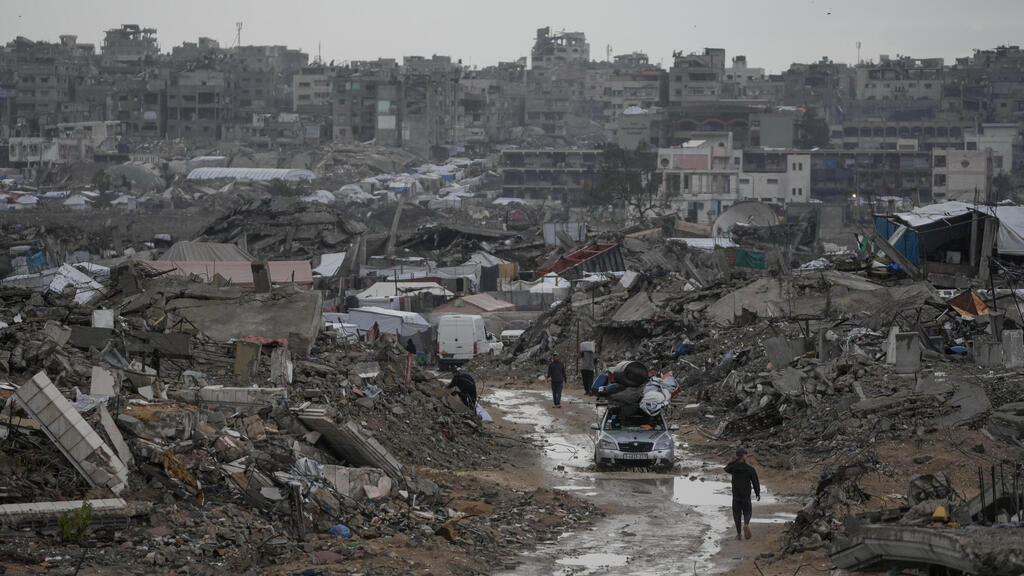
Gaza City after the ceasefire
(Photo: Jehad Alshrafi/AP)
In Israel, policy‑makers continue to assert that at any moment the fighting can resume, that Israel can swiftly seize territory in Gaza — even the whole Strip — and ultimately destroy Hamas. In doing so they reflect a growing divergence from the Americans’ position on Gaza. Furthermore, it appears that every step the U.S. advances is designed to cement a new on‑the‑ground reality that will restrict Israel’s freedom of action and make a return to full‑scale war very difficult.
A U.S.‑sponsored resolution is expected at the UN Security Council next week: President Trump’s post‑Gaza plan that centers on deployment of foreign forces in the area. Approval is far from certain (Russia and China remain skeptical), but even the draft texts introduced so far expose a complex challenge: the inclusion of the Palestinian Authority and the mention of a potential Palestinian state as part of the Gaza settlement.
The issue of terrorists trapped in tunnels in Rafah also illustrates the expanding gap between Jerusalem and Washington. In Israel many politicians and commentators demand the elimination or at least incarceration of the fighters — while the U.S. insists they lay down arms and may return to Houthi‑controlled or Hamas‑controlled territory, reflecting Washington’s lack of interest in undermining the ceasefire. If Israel persists in clinging to damaging fantasies — as it did in the half‑year span from March 18 to the end of war — it risks losing relevance and, crucially, its veto power over major decisions: for example a future Gaza government dominated by former Hamas figures or foreign forces from hostile states (Turkey above all).
Trump’s eagerness to salvage the deal may push Washington to accept compromises — even at Israel’s expense. For example, Hamas might be required to disarm only partially rather than fully. With the return of hostage remains completed and stage one of the deal nearing close, U.S. pressure on Israel to deepen its withdrawal past the “yellow line” may grow.
Israel now stands at a strategic junction and must recognize it faces only two realistic choices: confront Trump and set red lines (a feasible path, but one that risks a heavy price) or accept the changing reality and attempt to preserve maximum operational freedom (especially the right to strike emerging threats, such as in Lebanon), and retain a veto over decisions that sharply conflict with Israeli interests. At a more distant stage a return to war may still arise — if Trump abandons the deal given Hamas’s intransigence and gives Israel a green light.
The end of intense warfare in Gaza allows Israel a clearer strategic view of other arenas of conflict. Thus it becomes all the more apparent that, despite impressive gains in Lebanon and Iran‑linked fronts, the job is unfinished and requires additional effort to deepen the damage inflicted on the enemy. Fixating on Gaza and returning to large‑scale war there erodes Israel’s ability to deal with other key fronts — and, crucially, threatens international legitimacy, especially American.
Dr. Michael Milstein is head of the Forum for Palestinian Studies, Dayan Center, Tel Aviv University