

“When you have two options and neither is good, look for a third, the one that does not exist.” Fifty years have passed since an Air France plane en route from Ben Gurion Airport to Paris was hijacked and flown to Entebbe Airport in Uganda. After a selection process, 93 Jewish passengers and 12 crew members remained on board as hostages, including families with children. The Israeli government was given seven days to decide between yielding to the hijackers’ demands or refusing to negotiate at the cost of the hostages’ lives. Two very bad options.
A military rescue operation in the heart of Africa, 4,000 kilometers from home, in total intelligence uncertainty, with extreme ambiguity, no time to plan and at the risk of hostages’ and soldiers’ lives, was not even on the table.
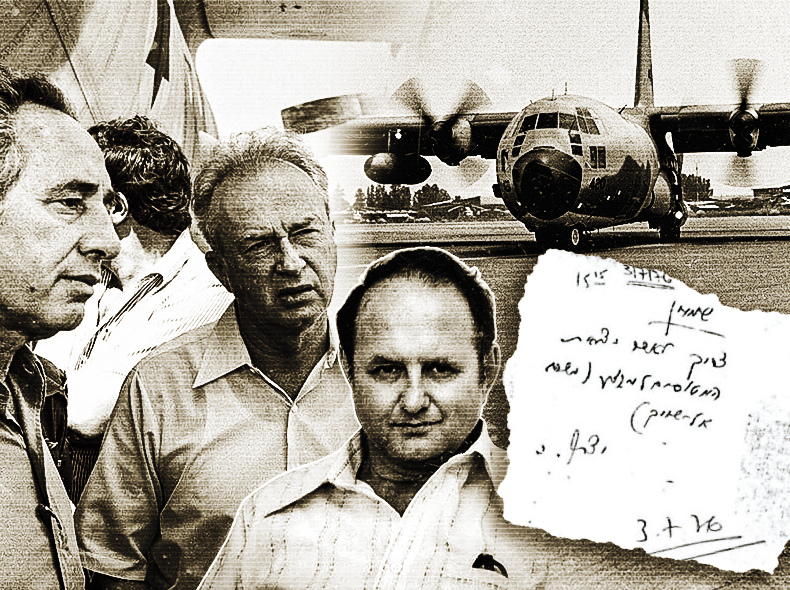
A military rescue operation in the heart of Africa, 4,000 kilometers from home, in total intelligence uncertainty
(Photo: IDF Archives at the Ministry of Defense/Uri Herzl Tshik, State Archives)
In the history of a nation, there are events that time turns into legend. The night of July 4, 1976 was one such moment. While the United States celebrated 200 years of independence, Israel marked a victory beyond imagination, etched into the collective memory of its citizens.
A jubilee has passed and we now mark 250 years of American independence and 50 years since Operation Entebbe. Over five decades of terrorist attacks, aircraft hijackings, hostage-taking and prisoners of war, there has been nothing like it in the world. Operation Entebbe was a military, intelligence and leadership victory. The refusal to accept selection and the vow that “never again” would Jews be killed for being Jewish made it a resounding moral and human victory as well.
Those were days when we upheld the promise not to leave the wounded behind and not to abandon anyone. Days of mutual responsibility. Every soldier and every citizen knew that the State of Israel would do everything possible, everything, to bring them home.
During those days of tension, Prime Minister Yitzhak Rabin and Defense Minister Shimon Peres exchanged notes between them. In one of them, the defense minister wrote to the prime minister: “How does an operation begin? They say it is impossible. The timing is not right. The government will not approve. The only question I see and still see is how it ends.”
After seven days of hesitation and opposition, of dead ends and intense discussions between government ministers and the top ranks of the military and security services, a decision was made against all odds. The leadership refused to accept the assumption that this was a problem without a solution and, with extraordinary courage, decided to launch the operation. All of Israel is responsible for one another.
Ahead of the jubilee year, together with Yedioth Ahronoth, we decided to publish the Entebbe Diary, the book written by the defense minister.
The Entebbe Diary is not a book about victory. It is a book about the path to it.
Seven days, hour by hour, from the hijacking to the rescue
The intense drama of those seven days stands at the center of The Entebbe Diary. Shimon Peres, then defense minister, wrote it not as a memoir or a retrospective analysis but as a script. Seven days, hour by hour, from the hijacking to the rescue, in real time of thought and action. This was not a stylistic choice but a substantive one. It denies readers the comfort of knowing the ending. It places us inside uncertainty, inside direct confrontation with moral and leadership dilemmas essential to making courageous life-or-death decisions.
The book offers readers another insight, the distinction between the correctness of a decision and its outcome: “Even if we had failed,” Peres wrote, “it would still have been the right decision. A decision can be correct even if it ends in failure. Many leaders find this difficult to internalize.” In these words lies a real challenge to the way we judge leadership, in hindsight, by outcomes, when the risk is no longer a risk. Peres wrote from the opposite place, from the moment when the end was still unknown.
Fifty years have passed. The blood price of Operation Entebbe has not been and will not be forgotten. On renewed reading, The Entebbe Diary remains as relevant and sharp as ever, as the questions at its core are timeless: What is required of a leader when there are no certain answers? What is the fine line between courage and recklessness, between caution and paralysis, between imagination and illusion? “A daring military action is not necessarily the right solution,” Peres wrote. “Daring thinking is always the best way.”
The Entebbe Diary is Shimon Peres’ book, written in his voice and through his unique perspective. It remains faithful to the moment in which it was born and open to the questions raised by the years that have passed since.
First published: 00:29, 07.06.26