


Five years ago today, Benjamin Netanyahu achieved the most significant diplomatic breakthrough of his career: peace agreements with the United Arab Emirates and Bahrain. As prime minister, he managed to shatter the long-standing cliché that progress on the Palestinian track was the only way to normalization with the Arab world.
The dynamics of the agreements, described in journalist Barak Ravid’s book on the Abraham Accords, show that there was little advance planning, certainly not from Israel. Netanyahu was pursuing annexation of parts of the West Bank, while the Trump administration was presenting its “Deal of the Century,” built on the formula of two states for two peoples. The Emiratis wanted direct access to Washington, security guarantees and a way to block an irreversible step against the Palestinians.
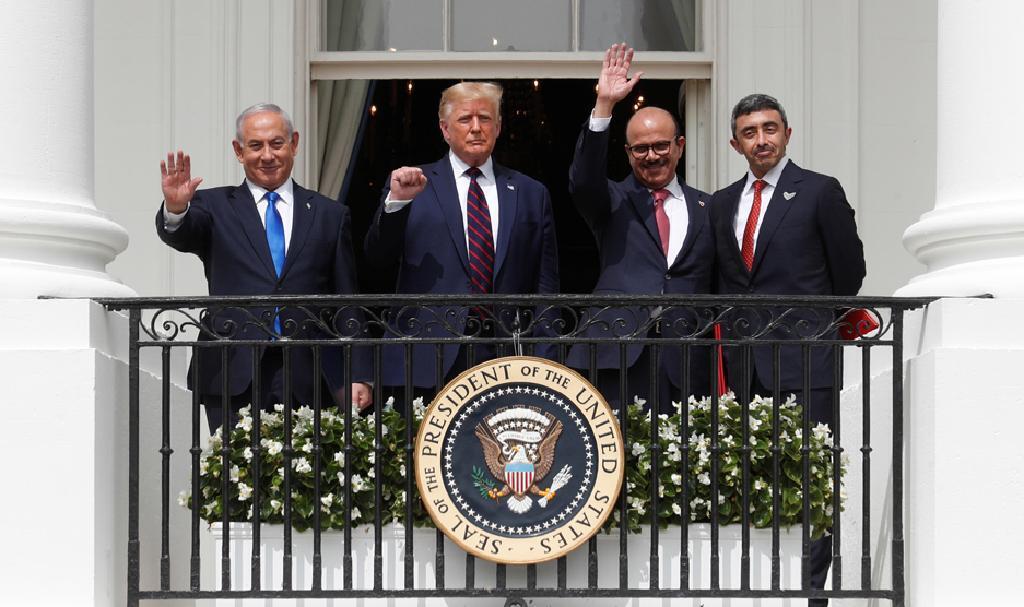
(Photo: Reuters)
It was a historic moment, set in motion by a front-page op-ed in Yedioth Ahronoth. The UAE’s ambassador to Washington wrote directly to the Israeli public—and essentially to its government—stating that Israel had to choose between annexation and normalization. Netanyahu overcame his political anxieties, dropped annexation (which President Donald Trump's administration would have vetoed anyway) and chose peace. Since then, trade between Israel and the Gulf states has steadily grown, even in wartime. Direct flights continued, even when European and American airlines suspended service to Tel Aviv. The Naftali Bennett-Yair Lapid government is still remembered as a golden era in relations, particularly for its decision to send security aid to the UAE immediately after the Houthi attack in February 2022.
But those times feel like ancient history. Today’s reality is bleak. Israel’s strike in Qatar has fueled skepticism and hostility toward Israel across the Arab world, and embarrassed the Gulf states that signed peace with it. From Abu Dhabi to Washington, none of Israel’s allies understand how the strike served its declared goal: acceptance of Donald Trump’s latest proposal for a comprehensive hostage deal and an end to the war. The military and security establishment, which objected to the timing of the strike in Qatar, proved weak in the face of Netanyahu. The prime minister approved an action with strategic implications outside the authority of the security cabinet.
What is going on?
After Oct. 7, Israel woke up to discover it had no deterrence—not against Hamas in Gaza, Hezbollah in Lebanon, the Houthis in Yemen or Iran. These actors all attacked Israel on their own initiative and by surprise. Israelis rightly chose to rebuild Ze'ev Jabotinsky’s “Iron Wall”—the message that they will not go anywhere, and that the plan to destroy Israel, born in Tehran, Gaza and Beirut, will not succeed. The impressive achievements in Iran and Lebanon restored deterrence, but Israel did not stop. It went into overdrive—hyper-aggressive action without limits, and more importantly, without forethought.
Bombing a meeting of Hamas leaders who were discussing Trump’s proposal—at a time when Qatar was still accepted by Jerusalem as a mediator—is an absurd decision, unless you have planned two steps ahead. Israel had not. Another example is Defense Minister Katz’s inflammatory tweets, often accompanied by videos of destruction in Gaza in which frightened civilians can clearly be seen.
In other words: even if Israel wants to be seen as “the neighborhood madman” no one dares touch—a concept popular among amateur strategists on Israeli social media—there is a thin line between being too dangerous to provoke and being so reckless that others have no choice but to unite against you. Even if the Qatar summit ends without concrete steps, this stew should have been simmered carefully, not ruined. Time and again, the security establishment opens windows of opportunity for the political leadership. Time and again, the leadership fails to act, choosing instead the blunt instrument of military force. Military power is only one component of strength.
Netanyahu’s diplomatic legacy—the one true achievement he leaves behind—is now in serious jeopardy. Israel gravely miscalculated the timing of its strike in Qatar, handing the extremist state, which consistently funds terror and incitement, the chance to play the victim. Meanwhile, the Israel Defense Forces are preparing a ground maneuver in Gaza in the coming weeks. The army’s top brass oppose it outright. As we heard last night, Hamas is trying to use living hostages as human shields in Gaza City.
 Nadav Eyal
It is time for a breakthrough. Hamas does not want Israel to occupy Gaza. Israel does not want to occupy Gaza. And anyone who imagines this is the way to defeat Hamas should face the facts: Israel is currently allowing unsupervised evacuations from Gaza City, including by car. If Hamas wants to leave, it can. After Gaza, we will hear about the need to enter the central refugee camps, then Muwasi, then back into Gaza again, with Hamas returning in the cycle.
There is another way, and the Trump administration is trying to lead it: a deal to end the war, in one or two stages, that brings hostages home and leaves Gaza without Hamas rule. Just before it is too late—in fact, just after—it is time to break the march of folly and blood.