

In a world where a single image can shape public perception more than a thousand explanations, Israel continues to speak the language of yesterday. Decades of political and military struggles have created confidence, but also a dangerous kind of blindness. While the IDF is among the most advanced militaries in the world, Israel’s public diplomacy remains fragmented, bureaucratic and detached from emotion. The failure of October 7 was not only military, but also communicative, perceptual and moral.
Israel has learned to speak about borders, threats and legal rights, but has forgotten how to tell the story of its people. In today’s media age, emotion outweighs logic. A message built on charts and statistics sounds cold and disconnected. While Hamas portrayed Gazans as victims, Israel appeared to much of the world as a powerful machine without empathy. And where there is no empathy, there can be no legitimacy.

Instead of one clear, unified voice, Israel sounds like a mosaic of officials speaking in different directions. Ministers, ambassadors, spokespersons and private organizations each deliver a different narrative. There is no central authority for public diplomacy, no coordination and no strategic management in times of crisis. In an age of social media and 24-hour news, even a single minute of confusion can mean losing the battle for global opinion.
When the international public sees contradictions in messages or inaccuracies in visuals and data, it stops believing. This is no longer a war of information, but a war of credibility. After October 7, the world saw the horror, but also heard conflicting voices from Israel. Who was responsible? What was hidden? How could a country so strong be caught so unprepared? Instead of shaping the narrative, Israel found itself chasing it.
That dark morning was not only a national wound, but also a mirror held up to the world. As Israel was struck by unimaginable brutality and civilians were massacred, the international narrative began forming without Israel’s guidance. The film Bearing Witness, screened to diplomats, was a step in the right direction, but far too late. When the first images seen globally were of destruction in Gaza, rather than of the atrocities committed in the Israeli kibbutzim of Re’im, Nir Oz and Be’eri, the narrative war had already been lost.
What must Israel do now?
Israel must establish a single, professional, non-political public diplomacy authority, one capable of coordinating messages, responding in real time and managing the struggle for hearts and minds strategically.
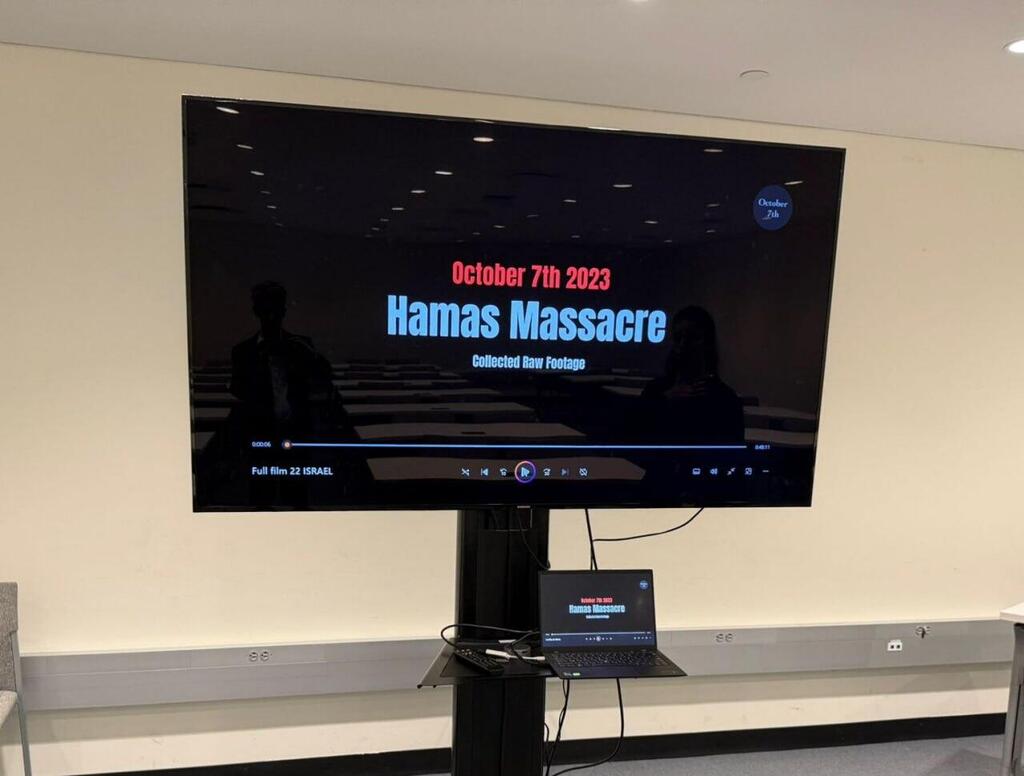
A compilation of October 7 atrocities screened at the United Nations
(Photo: Prime Minister's Office)
It must stop merely explaining and start telling. Not more speeches from behind podiums, but real people speaking eye to eye. Not only tanks and borders, but families, children, artists, survivors and doctors. The world connects to human stories, not PowerPoint slides.
Israel must also take control of the digital arena. It should invest in content creators, short videos and localized materials, especially for younger audiences. Today, TikTok and YouTube shape minds more effectively than any diplomatic statement.
At the same time, Israel must turn internal criticism into an asset. A nation that examines itself honestly, accepts responsibility and demonstrates moral clarity gains credibility, not weakness.
Public diplomacy is not only about war. It is about culture, innovation, art, sports and education. Israel must rebrand itself as a nation of hope, of life and of shared human values. A country’s image is built over time, but it begins with a change in language and tone.
 Munir Dahir
October 7 was the day when not only Israel’s fence was breached, but also its wall of trust with the world. Public diplomacy failed because it forgot its essence, to connect, not only to convince.
To rebuild its image, Israel must lower its voice and speak from the heart, through the stories of real people. Those stories already exist: heartbreaking, human and courageous. Israel’s public diplomacy must embrace the face of humanity and share with the world the stories of the hostages, the murdered mothers and the children whose lives were stolen.
Take, for example, the Bibas family, the infants kidnapped and brutally murdered. They are not only a symbol of Israeli grief, but also a reflection of the inhumanity of terror. Only when the world sees their faces and feels their pain will it truly understand what Israel is fighting for.
The battle for global opinion is not won with words, but with humanity. When Israel learns to tell its story through its people, the world will finally listen again.
- Munir Dahir is a political and strategic commentator and writer on Israeli and Middle Eastern affairs.