

From the very first statement by the IDF on Sunday, it was clear that what happened in Khan Younis was out of the ordinary — even by the grim standards of a war that has dragged on in Gaza for nearly two years, leaving behind staggering destruction and loss of life.
If the army’s spokesperson unit — usually adept at framing every operation with polished language — cannot officially explain what justified bombing a hospital and killing civilians, and instead offers only anonymous security officials claiming “a threat was identified from within,” then perhaps more thought should have gone into the decision before the button was pressed.
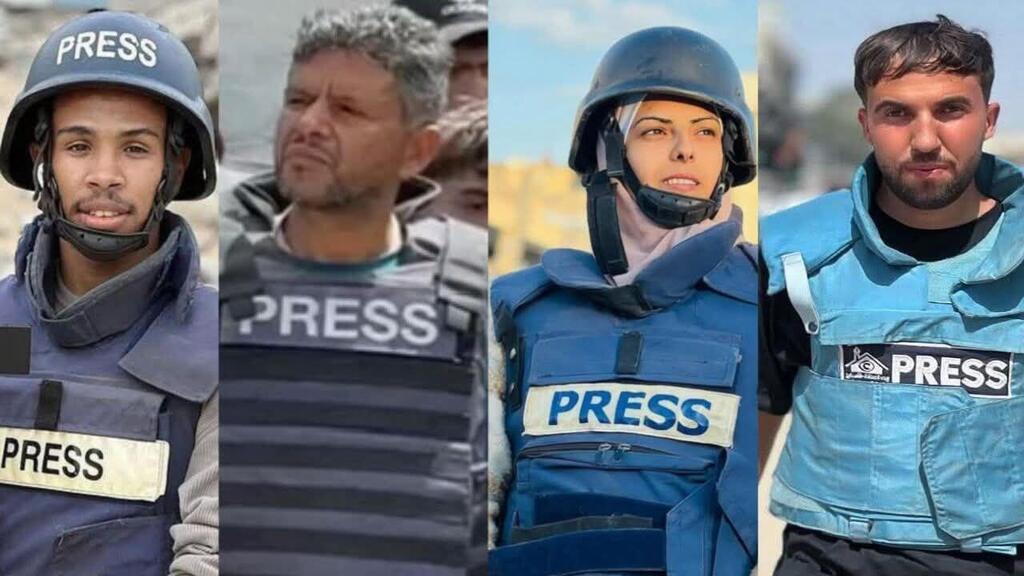
Gazans journalists who were reportedly killed in the strike on Nasser Hospital in Khan Younis
This is no longer a matter of public diplomacy, Israel’s fixation on public diplomacy, and the so-called “battle for consciousness.” Nor is it only about the journalists — those allowed into the combat zones, since international media is barred from reporting inside Gaza — who were caught in the strike. They are no less innocent than the four rescue workers who were killed. The army has stressed it does not target journalists “as such,” but rescue crews are undeniably noncombatants.
Meanwhile, in Israel, public debate is increasingly focused on the fate of the remaining hostages — around 50 in total, of whom some 20 are believed to still be alive. For many, their return outweighs the continuation of the war. Incidents like Khan Younis underscore how endless fighting has become a bottomless pit, one that even the army struggles to rationalize. Instead of dismantling Hamas rule, what is collapsing is the legitimacy of the war itself — not only internationally but morally, in human terms, as a defensive response to the atrocities of Oct. 7.
Khan Younis hospital was attacked during a live broadcast


Two years in, Israel finds itself returning again and again to areas where “decisive victories” were supposedly achieved, leaving behind devastation on a biblical scale. Officials continue to claim there is “no choice,” but that refrain convinces fewer and fewer people — even those who once supported reshaping the reality that allowed Oct. 7 to happen, but not at the price of moral disintegration and dubious military gains.
 Einav Schiff
Whether The Guardian publishes outraged editorials or social media fills with horrifying footage, the issue is not primarily international reaction. Events like the Khan Younis strike, as well as the worsening hunger in Gaza, are first and foremost an Israeli nightmare — and, one could argue, a Jewish one. They should have long since prompted a mass demand to end the war, especially given that the army chief himself has said there is “an opportunity to bring back hostages,” while the prime minister has refused partial deals, even those he once demanded, to avoid agreeing to a broader cease-fire.
Instead, the state — with hundreds of thousands of reservists called up again and again, and families increasingly broken under the strain — continues to barrel toward the full occupation of Gaza. If that happens, scenes like those from Khan Younis will almost certainly multiply, on steroids. And yet, in the end, the fallback will remain the same: blaming the problem on “bad PR.”