


The military confrontation that unfolded in the region over the past week appeared to have been taken straight out of the “Roaring Lion” campaign, as if no memorandum of understanding had ever been signed that was supposed to put the sides on the path toward an agreement.
Alongside the similarities, there is one striking difference: Israel is not involved in the current episode. Iran, which is striking countries across the region, is making sure not to hit Israel, while the Americans, who are striking back at Tehran, are emphasizing that, at least for now, the matter does not involve Netanyahu, even though he very much wants to join the fighting.
Gallery
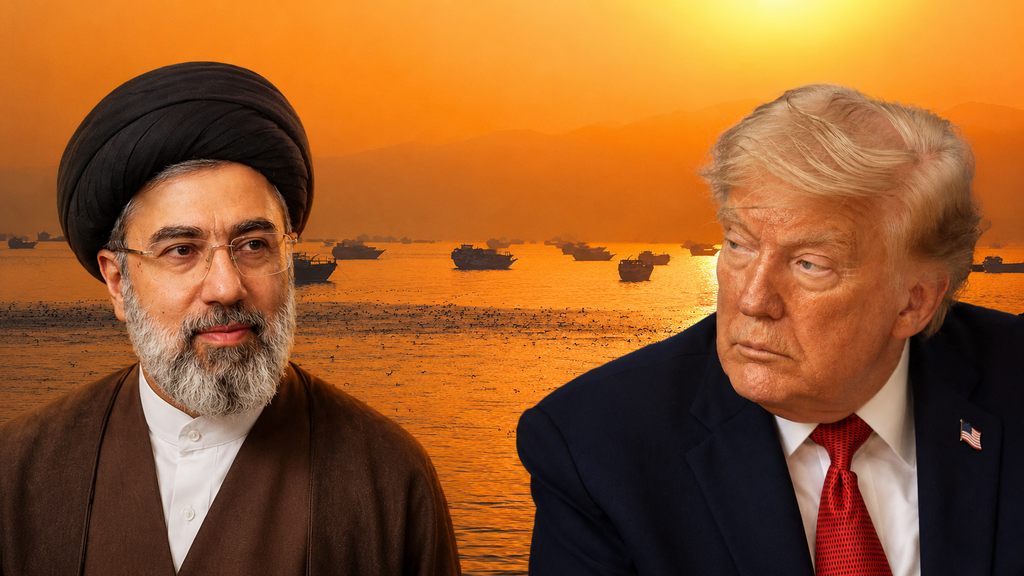
Mojtaba Khamenei and Donald Trump
(Photo: Stringer/Reuters, Anna Moneymaker / GETTY IMAGES NORTH AMERICA / AFP)
At the center of the crisis is the Strait of Hormuz. Tehran, it appears, is deliberately maintaining tensions around the issue by disrupting and restricting the movement of ships and has even attacked several vessels, a move that led Trump to announce about a week ago that he was renewing the fighting.
This appears to be Iran’s way of turning the Hormuz issue, a card that did not exist before the war, into the focus of the conflict while pushing the nuclear issue to the sidelines. “Hormuz is more important than dozens of atomic bombs and we will defend it,” declared Mohsen Rezaei, the military adviser to Iran’s leader, this week, adding: “After the recent attacks, it is impossible to speak about friendship with America.”
“The confrontation provides an interesting glimpse into the decision-making process in the regime’s new-old structure, in which the Islamic Revolutionary Guard Corps plays a dominant role and the supreme leader is not the final authority,” Danny Citrinowicz, an expert on Iran and the axis of resistance, explained in a conversation. “The leadership in Tehran does view Washington as the ‘great Satan’ that must be avenged for the killing of Khamenei the elder, and it is more willing than in the past to use force. At the same time, it attaches great importance to negotiations, which serve its interests well. Tehran is demonstrating rigidity and is willing to take the heavy risk of escalation and a prolonged confrontation, but its goal is to return to negotiations under improved conditions from its perspective.”
The ever-volatile Trump broke new records this week. He is frustrated by the Iranians’ rigidity, claiming they are “dying for a deal,” and by the renewed surge in oil prices, which reached about $80 per barrel compared with less than $70 before the crisis and is affecting the lives of American citizens.
This week he announced that he would impose heavy fees on vessels passing through Hormuz, but reversed course a day later following, according to him, an offer by Gulf leaders to invest the amount he demanded in the U.S. economy. Along the way, Trump declared that Mojtaba Khamenei was “90% dead,” that he was checking whether the Iranians had stationed missiles and drones in Cuba and would “deal with it,” and that he had left precise instructions on how to strike Tehran hard if he himself were killed in an assassination.
At least at this stage, it appears that Trump has not taken his eyes off the nuclear issue. In this context, attention this week focused on “Pickaxe Mountain,” a secret facility carved 100 meters deep into a granite mountain near the Natanz enrichment site. Unlike Natanz, Isfahan and Fordow, this facility was not hit during the 2025-2026 campaigns and international inspectors have never visited it. In recent weeks, unusual activity has been detected there, possibly related to uranium enrichment. Trump, for his part, declared: “ But Pickaxe is a possible target for a nice, big, fat shot right in the front door. We’re going to take out Pickaxe Mountain. Tell the Iranians to get ready. Tell them we’re coming, and there’s nothing they can do about it.”
Citrinowicz highlights the risk posed by the nuclear issue under the current circumstances: “Unlike the elder Khamenei, who demonstrated great caution on this issue, the current leadership may take greater risks and explore progress toward nuclear weapons. The statements recently made by senior officials in Tehran in this context could indicate a dramatic shift taking place in the thinking of the new leadership.”
Meanwhile, a dramatic revelation emerged this week regarding contacts between the Mossad and former Iranian President Mahmoud Ahmadinejad, who was known for his repeated declarations about the need to destroy Israel. The contacts were reportedly part of a plan to topple the Iranian regime and establish a new, supposedly “moderate” government. The information reinforces suspicions regarding the unfounded assumptions, bordering on fantasies, that underpinned the goals of the “Roaring Lion” campaign. It joins reports about plans to activate Kurdish militias against the Iranian regime and reflects an extreme misunderstanding of the nature of the “other,” a fundamental problem exposed on October 7 that appears not to have been addressed and may even have worsened.
The Iranian-American tensions also spilled over this week into Yemen. In this context, an unusual Saudi strike against Sana’a airport stood out, in an attempt to prevent the landing of an Iranian aircraft that Riyadh claimed had violated the airspace of Yemen’s official government, which is engaged in conflict with the Houthis. The Houthis, as expected, did not remain silent and responded by attacking an airport in southern Saudi Arabia with missiles and drones.
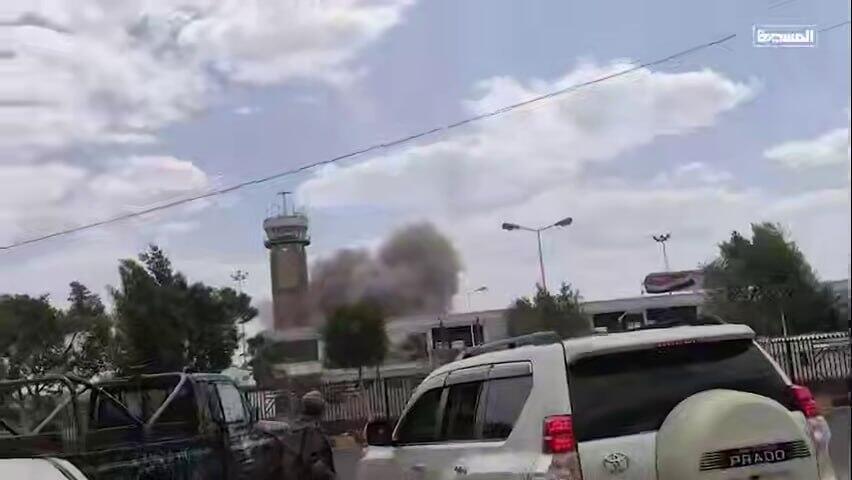
Saudi strike against Sana’a airport
“The attack represents a certain deviation from the cautious line Riyadh has pursued in recent months. It may stem from concerns over deeper Iranian involvement in Yemen in a way that threatens Saudi interests and required signaling and the drawing of red lines, without risking a slide into broad escalation,” explains Dr. Michal Yaari, an expert on the Gulf, in a conversation.
The Saudi attack is an exception that does not represent the broader trend, namely the overall Arab and Muslim effort to prevent further escalation in the current crisis. The Qataris and Pakistanis, the sponsors of the memorandum of understanding, along with the Omanis, are working intensively to persuade the United States and Iran to halt the fighting and resume negotiations.
The Gulf states, as well as Jordan, absorbed painful blows from the Iranians this week, as usual in response to American strikes, but they still appear committed to the view that a status quo and calm with a revenge-driven and self-confident regime is preferable to a prolonged confrontation that would destabilize them politically and economically and could, among other things, provide Israel with a renewed opportunity to try to establish regional hegemony.
Indeed, Iran’s decision not to strike Israel appears highly calculated and based on the understanding that bringing Israel into the campaign could increase the damage to Iran itself, would not necessarily mobilize popular support in the Muslim world and could turn the current confrontation, which appears “controlled” for now, into a far more complicated conflict, even leading to the complete collapse of the memorandum of understanding signed a month ago.
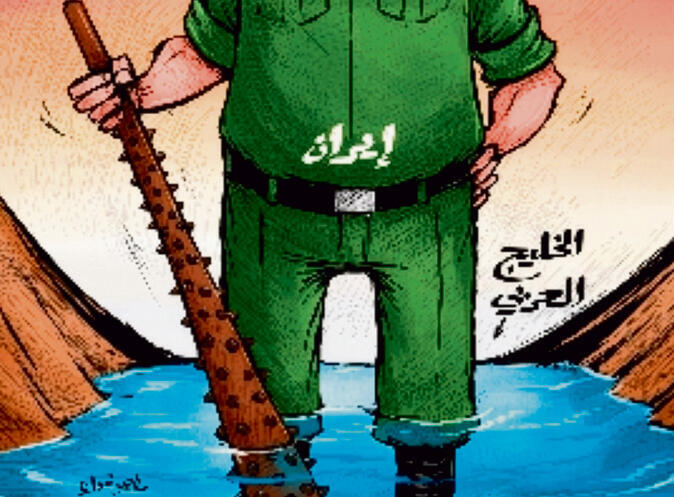
Iran, with the “Arab” Gulf behind it, closes Hormuz. Illustration published in the Kuwaiti newspaper Al-Jarida.
Such a scenario could also, from Tehran’s perspective, rescue Netanyahu from the strategic predicament he has recently found himself in, after being forced to accept Trump’s terms for ending the war against Iran through an agreement viewed in Jerusalem as deeply problematic and a fragile arrangement in Lebanon.
The current escalation demonstrates that the agreement between Iran and the United States still rests on shaky foundations and deep mistrust between the sides. Nevertheless, it appears that neither side wants to return to a broad and intense campaign, and both view the current confrontation as part of, or a continuation of, diplomatic discussions, which they will likely return to after the current round, which may be the first in a series.
Israel is required to maintain close monitoring and, in the event of a dramatic deterioration, may be able to pursue deeper strikes against the nuclear program, which has not been destroyed. However, it would be preferable that this opportunity not again be accompanied by harmful fantasies about toppling the regime, a goal that would consume resources and divert efforts away from focusing on the nuclear issue. Until then, Israel would be advised not to surprise the Americans with an offensive move, a step that, as Israel has learned several times since October 7, ends with enforcement and causes more harm than benefit.
Dr. Milshtein is a senior researcher at the Moshe Dayan Center at Tel Aviv University.