


Even as worrying details are emerging about the deal that the United States signed with Iran, Somaliland flags are flying along King David Street in Jerusalem, near the hotel where important official guests customarily stay - the president is visiting. The coincidence says a great deal about Israel's increasingly troubling international position.
Six months ago, Israel recognized Somaliland. Without entering into the debate whether it deserves recognition from the international community, the fact remains that among all UN member states, only in Israel's capital is the president of Somaliland received as the head of a sovereign nation.
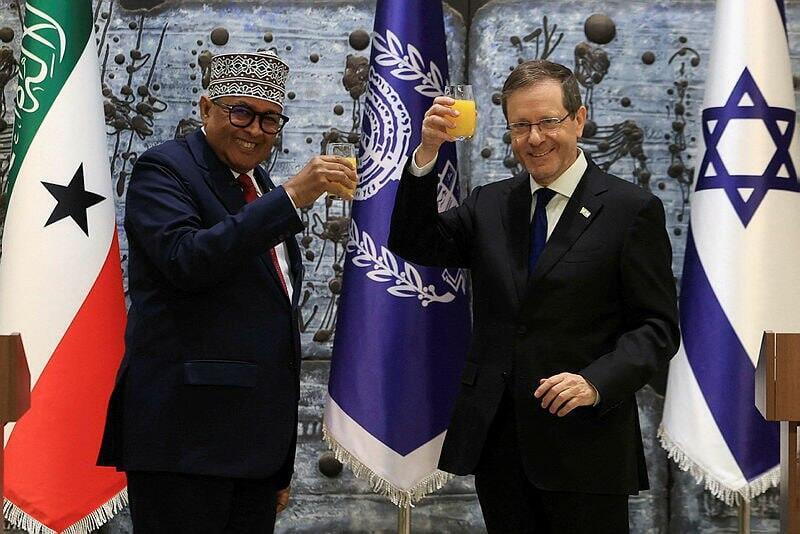
Somaliland President Abdirahman Mohamed Abdullahi and President Isaac Herzog
(Photo: Reuters/Ronen Zvulun)
Somaliland's location at the entrance to the Bab el-Mandeb Strait gives it immense strategic significance. Yet countries such as Ethiopia and the United Arab Emirates maintain close ties with Somaliland without extending formal recognition. Israel's decision provoked strong reactions across the Muslim world and in Africa, where it was viewed as a violation of Somalia's sovereignty and raised concerns about encouraging other separatist movements. For years, Israel avoided such recognitions, because of the obvious parallel with Palestinian demands for statehood. In this case, perhaps legitimately, it chose perceived advantage over principle. But is there really an advantage?
This is not an isolated case of searching for friends wherever they can be found. Recently, Israel opened an embassy in Suva, the capital of Fiji in the Pacific Ocean, a country that does not criticize Israeli policy. Fiji has a population of roughly one million, and its GDP per capita ranks around 126th globally, slightly below its position on the Human Development Index.
In principle, I welcome the opening of as many diplomatic missions as possible - the more embassies, the better. But diplomacy is not a zipper that can be opened and closed at will. While Israel recalled ambassadors from countries such as Spain for consultations following criticism of government policy and never returned them, effectively downgrading relations, and while it closed its embassy in Ireland, despite the years it took to secure permission to open it, it chose instead to invest in an embassy in Chișinău, Moldova, whose GDP per capita ranks around 128th globally.
At the same time, polling continues to indicate a deterioration in Israel's standing among voters in both major American parties, a matter with potentially existential implications, even as its image is worsening across liberal democracies. Rather than confronting these trends, or engaging seriously with them, Israel either ignores them or dismisses critics as antisemites. Meanwhile, it announces the opening of an embassy in Slovenia, reportedly in the hope of preventing a consensus within the European Union once Viktor Orbán is no longer in power in Hungary.
 Tova Herzl
The Somaliland flags flutter in Jerusalem while President Trump leaves Israel facing a resentful and capable Iran. Placing these developments side by side illustrates what happens when, instead of investing deeply in relations with the United States and Europe, in their economies, institutions, and yes, their values, and instead of doing everything possible to preserve those relationships, despite the hypocrisy and antisemitism that certainly exist, Israel chooses to invest in a Fiji–Somaliland–Moldova–Zambia axis. As though these were its natural strategic partners, as though salvation would come from them.
Any reasonable observer should understand that this is not a wise approach for a country whose academic and economic viability depends on remaining part of the Western world, nor is there wisdom in alienating Arab states while simultaneously proclaiming a desire for normalization. As in so many other fields, foreign policy is increasingly measured by "achievements" that can be showcased to party activists. And after Somaliland, let come what may.
- Tova Herzl is a former Israeli ambassador to South Africa and the Baltic countries, and served as liaison between the U.S. Congress and the Israeli Embassy in Washington