

An emergency landing in Bulgaria under fighter jet escort, passengers evacuated from an aircraft at Ben Gurion Airport and a delayed departure in New York: In less than a week, three bomb threats were reported on flights to and from Israel, none of which resulted in the discovery of an explosive device.
The incidents came amid heightened security vigilance following an attempted terrorist attack aboard a flydubai flight in late September, illustrating how even an anonymous phone call can disrupt an entire flight. So what actually happens when a bomb threat is reported aboard an aircraft, and who decides how to respond?
Gallery
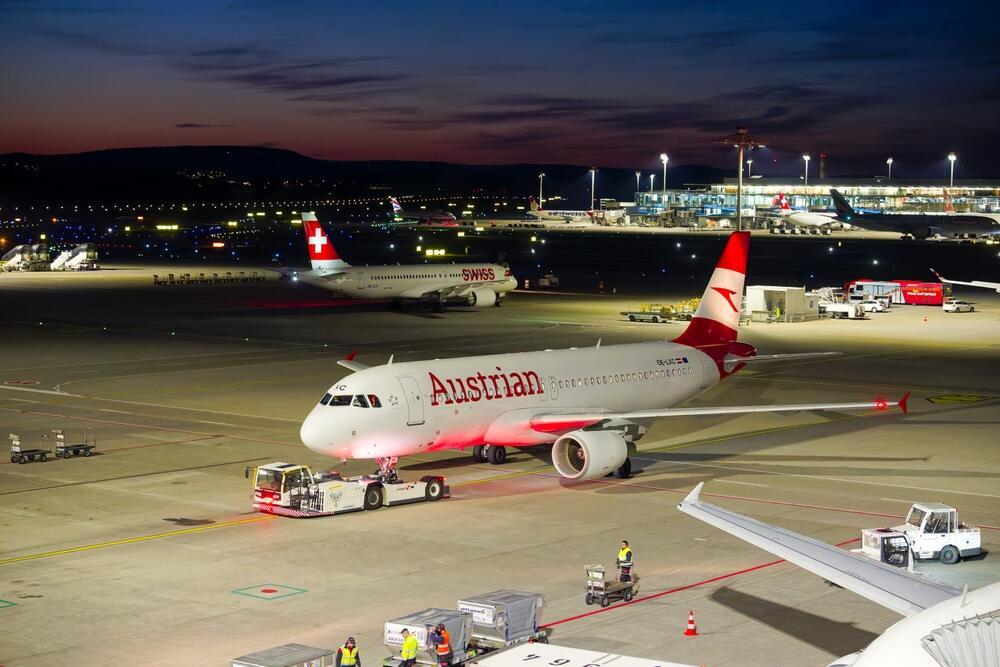
An Austrian Airlines aircraft at a European airport
(Photo: Michael Derrer Fuchs / shutterstock)
‘A sudden blow to my head’: Flydubai captain recalls cockpit attack that nearly downed the jet


The latest incident occurred Sunday when Austrian Airlines Flight OS82, which departed Ben Gurion Airport for Vienna, was forced to divert and land at the airport in Sofia, Bulgaria's capital, following a bomb threat. The Airbus A320 was carrying 51 passengers and six crew members.
According to Bulgaria's Defense Ministry, the country's air force scrambled MiG-29 fighter jets in response to the threat. Bulgaria's Transport Ministry said one of the fighter jets escorted the passenger aircraft until it landed.
Austrian Interior Minister Gerhard Karner confirmed that the threat against the aircraft had been received in a phone call to Vienna Airport and that authorities had launched an investigation. The threat was reported after the aircraft had already left Israeli airspace and was approaching the Romanian border.
After landing in Sofia, the aircraft, passengers and crew underwent security checks. Austrian Airlines confirmed that no danger had been found and that, once the inspections were completed, passengers reboarded the aircraft and continued to Vienna, where they landed early Monday morning.
But this was not the first threat of its kind in recent days. Last Tuesday, an anonymous bomb threat was reported involving a Delta Air Lines aircraft that had arrived from New York and landed at Ben Gurion Airport. In response, all passengers were evacuated and the aircraft was moved to an isolated parking area, away from the airport's regular operations.
Security personnel searched the aircraft, after which the Israel Airports Authority announced: "The aircraft was thoroughly searched by Ben Gurion Airport security personnel. The incident ended with no unusual findings. Operations have returned to normal."
Another threat was received the same day, this time involving a different Delta flight scheduled to depart New York's John F. Kennedy International Airport for Tel Aviv. That flight also carried the number DL234, the same as the flight that had landed in Israel that morning after departing New York the previous day.
Its departure was delayed following a report that a bomb had allegedly been planted aboard the aircraft. It was cleared for takeoff only after security checks were completed and the necessary approvals were obtained.

Anonymous caller. Illustration
(Photo: Galileo30 / shutterstock)
Security officials also consider the possibility that a threat originated within the aircraft's ground-handling operations before departure. For example, they examine whether ground personnel with access to baggage may have placed a suspicious object in a suitcase or whether a technician working on the aircraft may have exploited that access.
Senior aviation industry officials told ynet that although none of the three incidents resulted in the discovery of an explosive device, every security threat requires serious attention and investigation.
"Each case must be assessed individually. TThere are many ways to respond to a terrorist threat aboard a plane," they explained.
According to the officials, one of the main considerations is the source of the threat. Did it come from a phone call made by someone who was not aboard the aircraft, as in the Austrian Airlines incident, from a passenger's report during the flight or from a suspicious object identified by crew members or ground personnel?
The stage at which the threat is received is also significant: before takeoff, while the aircraft is in the air or after it has landed.
The officials said security authorities also consider the possibility that a threat originated within the aircraft's ground-handling operations before departure. For example, they examine whether ground personnel with access to baggage may have placed a suspicious object in a suitcase or whether a technician working on the aircraft may have exploited that access.
For this reason, in addition to investigating the source of the threat, it is important to examine who had access to the aircraft and its baggage before departure.
The three recent incidents illustrate these differences. At Ben Gurion Airport, Delta passengers were evacuated and the aircraft was moved to an isolated area for inspection. In New York, takeoff was delayed until security checks were completed. In the Austrian Airlines incident, however, the threat was received while the aircraft was already airborne, forcing the pilots to divert and land in Sofia.

Footage from aboard the Vienna flight, filmed by Israeli passengers
Procedures published by the U.S. Federal Aviation Administration (FAA) also illustrate how the circumstances of a threat determine the response.
Under the guidelines for air traffic controllers, a distinction must be made between a general threat and one directed at a specific aircraft. In the case of a specific threat, controllers are required to notify the pilot and may refer the pilot to an explosives expert for professional guidance.
When an aircraft is on the ground, the guidelines also call for moving it away from other aircraft and facilities and transferring it to an isolated area for inspection, depending on the circumstances.
These are U.S. procedures, not a description of Israel's aviation security protocols, but they underscore a central principle: The response is not the same in every incident. It depends on the aircraft's location, the nature of the threat and the assessment of the risk.
Senior aviation industry officials explained that the security system at Ben Gurion Airport, which includes screening passengers, baggage and aircraft, greatly reduces, in their assessment, the possibility of an explosive device being brought aboard an aircraft departing Israel.
Nevertheless, even stringent security screening does not mean that threats received after takeoff can be ignored.
"When it comes to passenger safety in aviation, no chances are taken," the officials stressed.
Referring to a serious threat received while an aircraft is already airborne, they added: "An aircraft facing such a threat will land at the first available airport."
Heightened vigilance following attempted flydubai attack
Security concerns surrounding flights to and from Israel have intensified since the attempted terrorist attack aboard a flydubai flight from Dubai to Tel Aviv on September 30.
During that incident, the co-pilot attacked the captain and attempted to seize control of the aircraft, which was ultimately diverted to Saudi Arabia.
According to findings released by the United Arab Emirates' attorney general, the co-pilot, an Omani citizen, had planned to take control of the aircraft and crash it into the passenger terminal at Ben Gurion Airport in a suicide attack.
If information is received about an attempted hijacking of an aircraft heading to Israel, the Israeli Air Force may scramble fighter jets to monitor the aircraft and prevent it from entering Israeli airspace.
Following the incident, security vigilance surrounding civilian flights to Israel increased.
However, senior aviation industry officials emphasized that a distinction must be made between a bomb threat and concerns about an aircraft hijacking or attempted takeover.
If information is received about an attempted hijacking of an aircraft heading to Israel, the Israeli Air Force may scramble fighter jets to monitor the aircraft and prevent it from entering Israeli airspace, depending on the threat assessment.
In the Austrian Airlines incident, the threat was received after the aircraft had already left Israeli airspace. The response was coordinated between the airline and the relevant authorities, while Bulgaria scrambled fighter jets in accordance with its local procedures.
The deployment of fighter jets did not necessarily indicate that an explosive device had been found aboard the aircraft.
According to the officials, major aviation security incidents can also lead to an increase in anonymous threats that ultimately prove to be false alarms.
They noted that numerous bomb threats involving aircraft were also reported following the September 11 terrorist attacks in the United States.
At this stage, however, there is insufficient data to determine whether the three recent incidents indicate a growing wave of false bomb threats or whether they are connected to the attempted flydubai attack.
All three incidents ended without the discovery of explosive devices or any injuries, but the disruptions were significant: passengers evacuated from an aircraft after landing, a flight delayed before takeoff and a passenger aircraft forced to divert and land in another country under fighter jet escort.
For airlines and security authorities, this is the dilemma posed by every such threat: Even a warning that turns out to be a false alarm can cause major disruptions, but ignoring a genuine threat could end in disaster.