



Israel has tentatively agreed to allow Qatar and other countries to begin channeling resources and funds for Gaza’s reconstruction during a potential ceasefire, Ynet learned on Thursday. Hamas insists on this as a guarantee of serious intent to end the war. Israel, however, demands that Qatar not solely control the funds, involving other nations as well.
For Hamas, this would mark a critical signal to Gaza’s Palestinian population that the war is concluding. The issue was raised during talks in Washington this week with a Qatari delegation, coinciding with Prime Minister Benjamin Netanyahu’s visit to push for a hostage deal. Regional powers, including Saudi Arabia and the UAE, refuse to commit to Gaza’s reconstruction until Israel confirms the war’s conclusion.
U.S. President Donald Trump on Gaza ceasefire deal
(Video: C-SPAN)



The main sticking point in negotiations remains the Morag Corridor, where Hamas has not agreed to a deal despite Israel’s new proposal for partial presence in the area. Palestinian sources claimed Wednesday that talks were stalled but gaps may have narrowed by evening, with Israel presenting Qatar a revised plan addressing IDF deployment in Gaza, particularly in the Morag corridor.
A senior Israeli official told Reuters on Wednesday that a Gaza ceasefire is possible within one to two weeks, though not imminent. Speaking anonymously during Netanyahu’s Washington visit, the official said both sides agree to a 60-day ceasefire, which Israel would use to pursue a permanent truce requiring Hamas to disarm. “If Hamas refuses, we’ll advance military operations,” the official warned.
Three months ago, Netanyahu revealed the IDF’s control of the Morag Corridor between Khan Younis and Rafah in southern Gaza. Israel plans to establish a “humanitarian city” in the area, a large civilian complex to separate Gaza’s population from Hamas.
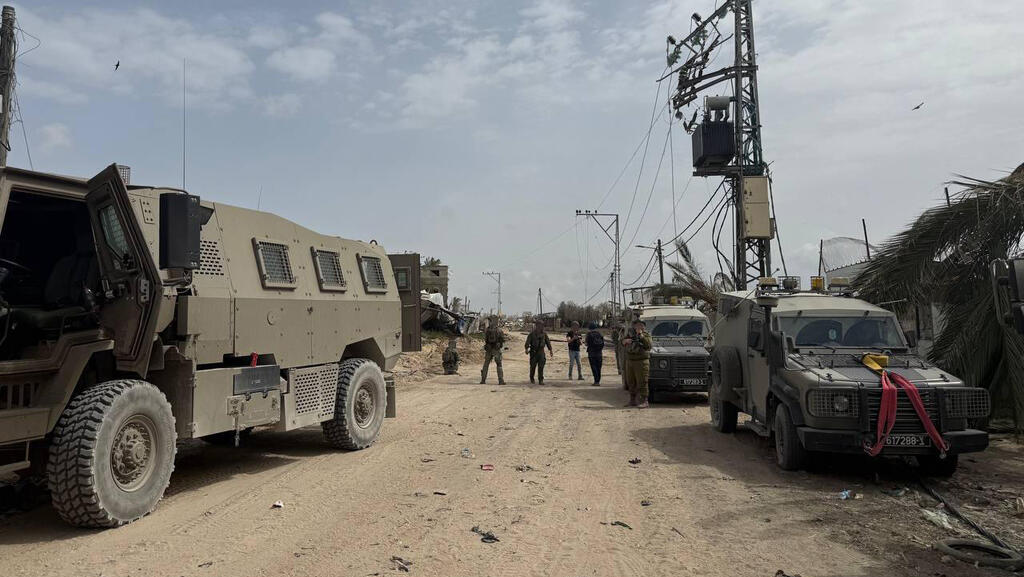
IDF forces at the Morag Corridor
(Photo: Roni Green Shaulov)
Israel insists on retaining control of the Morag Corridor post-deal to screen hundreds of thousands of Palestinians returning to Rafah, voluntarily or by force, at IDF checkpoints. With Rafah’s infrastructure largely destroyed, the government aims to build temporary facilities like refugee camps with portable structures and tents.
U.S. President Donald Trump told reporters at the White House on Tuesday that a Gaza ceasefire has a “very good chance” within a week or two. Commenting on his second meeting with Netanyahu during the prime minister’s Washington visit, Trump said, “I think there’s a good chance we have a deal with Hamas during the coming week, but it’s not certain. Nothing is certain in war—Gaza or elsewhere.”
Get the Ynetnews app on your smartphone: Google Play: https://bit.ly/4eJ37pE | Apple App Store: https://bit.ly/3ZL7iNv
“I will tell you we're getting very close to a deal," he said. "I don't know if it's secret or not secret, but doesn't matter to me – secrets fine if it gets us to where we want to be, we want to have a ceasefire. We want to have peace. We want to get the hostages back. And I think we're close to doing it.”
Hamas official Taher al-Nunu told Al Jazeera on Tuesday that the group is showing significant flexibility in Doha talks and cooperating with mediators. He said Hamas agreed to release 10 Israeli hostages to ensure humanitarian aid flow and halt aggression.

Humanitarian aid distribution in Gaza
(Photo: Social media)
Despite challenges in the current negotiations, al-Nunu emphasized Hamas’s firm stance on key demands: full Israeli withdrawal from Gaza and a complete end to fighting. He stressed the need for international guarantees, noting that the U.S. holds the key to pressuring Israel to end the war if it chooses to act politically.
Al-Nunu described the talks as complex, focusing on unrestricted, “dignified humanitarian aid,” without Israeli interference or mechanisms that would “harm Palestinian dignity or cause displacement,” alongside defining Israel’s initial withdrawal to protect civilian lives.