

Hezbollah aircraft exploded on Sunday morning in Israeli territory in what the IDF described as a “military area.” Israel has threatened to respond with strikes in Beirut’s Dahieh district to any fire aimed at Israeli communities, but has not clarified what action would be taken if Hezbollah attacks military bases or other military-designated areas within Israel. Several hours later, the IDF issued an evacuation warning covering 16 villages in the Nabatieh region of southern Lebanon, though no warning was issued for Beirut.
In an official statement issued Sunday morning, following alerts activated at 08:07, the IDF said: "Two suspicious aerial targets were identified falling in the State of Israel near the border with Lebanon. There are no casualties and the incident is under investigation." Military sources said the targets exploded in a military area rather than a civilian community. The closest civilian homes to the scene are in the town of Shlomi.
Documentation of a drone strike near Shlomi
(Video: According to Section 27A of the Copyright Law)


Around midday, additional sirens sounded across the western Galilee, including in Even Menachem, Zar'it, Shomera and Shtula. The IDF later announced that "a suspicious aerial target was identified falling in the State of Israel near the border with Lebanon. There are no casualties and the incident is under investigation." Military officials again said the impact occurred in a military area rather than a residential community.
The distinction between impacts in military zones and civilian communities has become standard since the ceasefire took effect and Israel formulated its current deterrence policy. Since then, military officials have routinely specified whether projectiles landed in populated areas or military zones.
Finance Minister and Security Cabinet member Bezalel Smotrich wrote on X: "The fire toward northern communities is a test of the Dahieh equation that the prime minister announced. I call on him to implement it firmly and decisively and to bring down buildings in Dahieh today. We are in critical days that will shape the region for many years. We promised security to the residents of the north and we must deliver."
National Security Minister Itamar Ben-Gvir also weighed in on X, writing: "I will again make my position clear in today's discussion with the prime minister: For every drone, a missile. For every violation, fire. For every UAV, Dahieh should shake. For every hair on the head of an IDF soldier, a thousand Hezbollah terrorists. Terror is not contained — it is defeated."
Senior members of the political-security cabinet said last Tuesday, one day after the announcement of a renewed ceasefire with Iran, that Israel had decided any Hezbollah launch intended to cross the border would trigger an IDF strike in Beirut's Dahieh district, despite Tehran's threats to retaliate whenever Israel does so.
A senior cabinet official said at the time: "We instructed the military to maintain the equation we set for Hezbollah, and this will be the test. Any fire intended to cross the fence toward our communities will be answered with strikes in Dahieh, and we will see what happens in Iran."
Israeli officials have pointed out that despite continued Israeli operations in southern Lebanon, particularly around Tyre, Iran has not responded or intervened on Hezbollah's behalf. "The IDF is deepening its maneuver," officials said. "We are operating there with force and the Iranians are doing nothing. We are destroying the strategic infrastructure Hezbollah built in the Beaufort area. This will create a different reality for residents of northern Israel for the next 20 to 30 years."

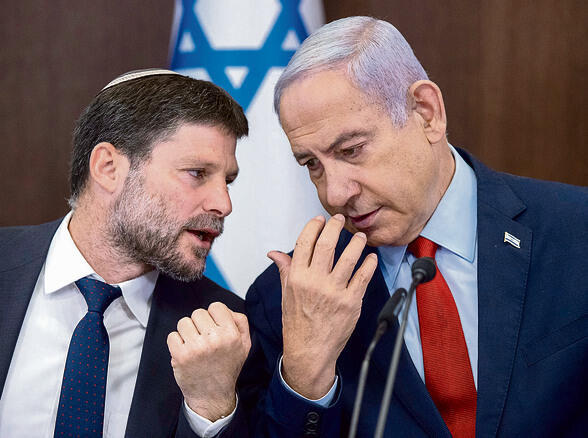
Netanyahu alongside Smotrich and Ben Gvir
(Photo: AP Photo/Ohad Zwigenberg)
A ceasefire agreement taking shape between the United States and Iran is bringing the situation on the northern border into sharper focus and raising the question of whether Lebanon will be included in the memorandum of understanding expected to be signed within days. Iranian Foreign Minister Abbas Araghchi said over the weekend: “The end of the war in Lebanon means an Israeli withdrawal from the territories it occupied.”
According to information held by Israel, the ceasefire agreement between the United States and Iran refers to a “cessation of hostilities on all fronts, including Lebanon.” While this appears to amount to a merging of arenas, Israel stresses the agreement will not limit the IDF and that it will oppose any such framework or any withdrawal from territories captured in southern Lebanon. A security official said over the weekend that the IDF will continue “to tear Hezbollah apart” in southern Lebanon and that the army is working to dismantle its infrastructure.
First published: 09:10, 06.14.26