


Israel’s security cabinet is set to meet Tuesday for a final vote on plans to take over and evacuate Gaza City, against the backdrop of two major developments.
The first is a matter of principle: Chief of Staff Lt. Gen. Eyal Zamir has argued in preliminary discussions that Israel should accept a partial deal, the one Prime Minister Benjamin Netanyahu supported until recently, in order to save 10 hostages’ lives and then return to fighting. Most cabinet members oppose this proposal, and those ministers are expected to clash with Zamir again. Heated exchanges are anticipated, as Zamir insists this is the correct course of action at this stage.
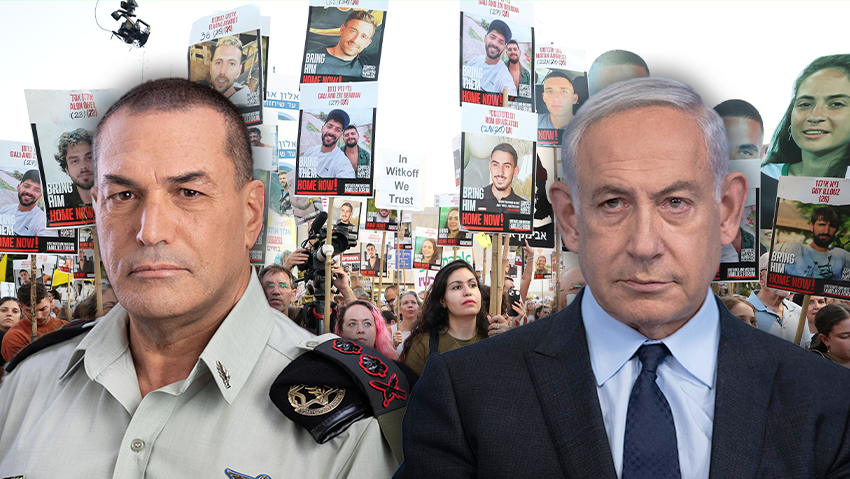
IDF Chief of Staff Eyal Zamir and Prime Minister Benjamin Netanyahu clash over how to take over Gaza City
(Photos: Alex Kolomoisky, Dana Koppel)
Netanyahu, for his part, continues pressing for a broad military operation until a comprehensive deal is achieved. The Israel Defense Forces has drawn up a sweeping plan that would begin with evacuating Gaza City’s population to humanitarian zones — which have yet to be established — followed by an extensive assault, with humanitarian aid allowed in under international pressure, in order to push civilians southward.
Meanwhile, Hamas has launched an aggressive campaign urging residents to remain in their homes, as much of the Gaza Strip lies in ruins after Operation Gideon’s Chariots. Netanyahu wants to accelerate the timetable — also under pressure from U.S. President Donald Trump — but the operation could take many months due to the scale of the evacuation.
The sharp divide between the military and the political leadership is not only over timing and the evacuation but also the “day after” question of who will rule Gaza. Senior IDF officials fear the cabinet is steering toward a scenario in which the army effectively governs Gaza — a military administration. The military strongly opposes this due to its far-reaching implications: manpower commitments under constant risk, endless friction with the population, and legal and international responsibility. Military leaders say the political echelon should have already developed alternative political frameworks.
 יוסי יהושוע
The hospital incident Monday in Khan Younis illustrated the challenge of expected urban warfare in Gaza City, which remains densely populated. In Khan Younis — as in Gaza — civilian infrastructure such as hospitals, mosques and residential buildings is interwoven with combat sites. Even with precise intelligence, the chance of misidentification or hitting a civilian structure is high. Hamas fighters fire from nearby buildings, exploit underground tunnels, and appear and disappear within seconds. The pressure to respond quickly — for example, with tank fire — increases the risk of civilian casualties.
If a pinpoint operation — which included an errant strike that hit a hospital — was so difficult, officials say, it underscores how daunting a sustained presence in Gaza City would be. Such an effort would require total fire control, continuous intelligence, and massive forces — and even then, militants will continue to hide among civilians.