

An Israeli military operation overnight in Syria, reportedly involving a ground force landing near Damascus, marks a notable shift back to Israel’s long-standing policy of ambiguity regarding its activities across the border.
According to Syrian media, Israeli commandos landed by helicopter in al-Kiswah in the Damascus countryside and operated for more than two hours—allegedly in response to the discovery of an Israeli surveillance device on Syrian soil. While Israeli officials did not confirm the details, the lack of open acknowledgment stands in contrast to recent months of overt military disclosures.
IDF airstrikes in Syria


Under former President Bashar Assad, Israel routinely struck Iranian targets in Syria as part of its "war between the wars" strategy, rarely confirming its role. That changed after the rise of Syria’s new leader, Ahmad al-Sharaa, when Israel began openly taking responsibility for strikes—including the widely publicized Operation Many Ways, a raid on an Iranian missile factory in Masyaf.
Israel also openly disclosed Operation Bashan Arrow, a major aerial and naval assault that destroyed nearly all of the Assad regime's strategic capabilities. In February, the IDF confirmed dozens of strikes on Syrian radar systems, military command sites and detection equipment, saying the goal was to eliminate “future threats.” The military released footage showing 22 fighter jets deploying 60 munitions.
Defense Minister Israel Katz publicly took credit for a strike in Damascus targeting a Palestinian Islamic Jihad command center, where senior operatives were reportedly planning attacks. Ten days later, the IDF struck deep inside Syria, hitting strategic weapons stockpiles in the T4 and Palmyra airbases—again, taking responsibility.
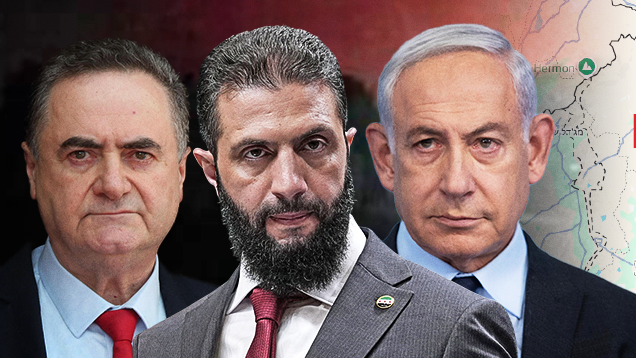
Defense Minister Israel Katz, Syrian President Ahmad al-Sharaa, Prime Minister Benjamin Netanyahu
(Photo: Alex Kolomoisky, MEHMET ALI OZCAN / Anadolu via AFP, Menahem Kahana/AFP)
In April, as unrest grew among the Druze in southern Syria, Israel escalated further, launching a strike near the presidential palace in Damascus. Prime Minister Benjamin Netanyahu and Katz both declared the attack a “clear message” to the new regime. A day later, Israel struck multiple provinces, with Syrian sources calling them “the most intense attacks of 2025.” In May, the IDF struck coastal Latakia, targeting ship-to-shore missiles that threatened maritime freedom.
After the massacre in Syria’s Druze-majority Sweida province, Israel launched another wave of strikes, including some 90 attacks and more than 100 munitions dropped on tanks, APCs and military vehicles. The most significant blow reportedly hit the Syrian military’s general headquarters in Damascus, an attack prominently featured in a video shared by Katz. “The painful blows have begun,” he wrote.
In contrast, Thursday’s reported operation was carried out without official confirmation. The only hint came in a cryptic post by Katz that offered no details. The alleged raid, which Syrian sources say involved four helicopters and dozens of Israeli troops, appears to be a return—at least for now—to Israel’s former doctrine of plausible deniability.
Hours after the operation, Netanyahu paid a visit to the spiritual leader of Israel’s Druze community, Sheikh Mowafak Tarif, in the northern town of Julis. The visit was not officially linked to the raid.