


Four months have passed since Operation Roaring Lion ended after 40 days of intense fighting. At the time, after a series of Israeli strikes in Iran, the killing of senior officials and attacks on nuclear and missile infrastructure, a ceasefire was declared — one that was described from the outset as temporary and fragile. It has since been violated repeatedly, Iranian threats have not disappeared and the confrontation between Washington and Tehran has flared again.
CNN reported overnight that Gen. Dan Caine, chairman of the U.S. Joint Chiefs of Staff, is looking for an “off-ramp” from the war with Iran. But the reality created by the latest exchanges is clear — and different: The United States struck Iran for several consecutive nights while Israel remained outside the campaign.
Gallery
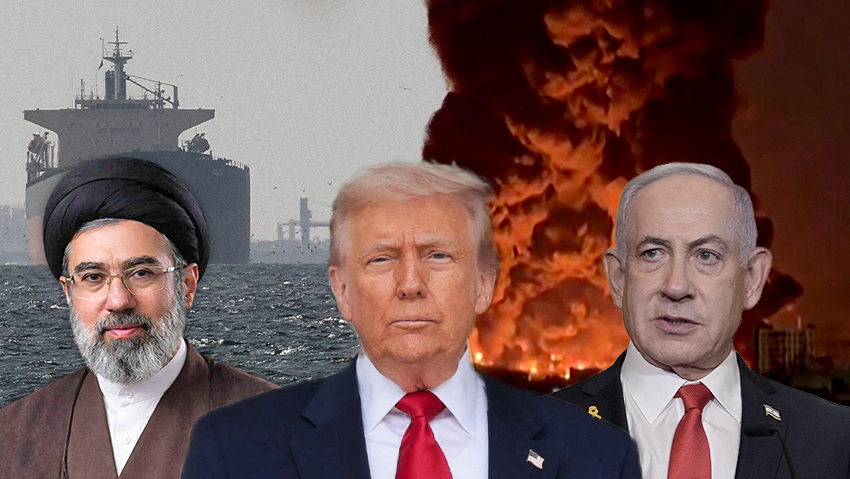
(Photo: AFP - SOURCE: UGC / UNKNOWN, Reuters/Jessica Koscielniak/Stringer, Oliver Contreras/AFP)
Israel did operate in Iran after the end of the operation. On June 7, 60 days after the ceasefire, the Air Force struck launch sites, air defense systems and other targets in response to the firing of 11 missiles at Israel. But in the latest U.S. round, the picture was different: For nearly two consecutive weeks, the U.S. military struck military bases, infrastructure, ports, bridges and airfields in Iran while the IDF did not take part in the attack waves.
Israel’s absence was not solely the result of an independent decision in Jerusalem. The Americans made clear that they wanted Israel to stay out as long as Iran did not attack it directly. The result was a kind of new ground rule: The United States runs the campaign, Israel remains on alert and will join only if Trump wants it to or if Tehran gives it cause.
Israel therefore watched the exchanges from the sidelines. Iran launched missiles and drones at U.S. bases and countries in the Gulf region and Jordan, attacked infrastructure and repeatedly threatened escalation. The United States, for its part, enforced a blockade on Iranian ports and said the strikes were meant to punish the Revolutionary Guards, protect U.S. troops and restore control over the Strait of Hormuz.
But even while not taking part in the strikes, Israel did not disappear from Iran’s sights. Tehran threatened to “punish” it over actions attributed to Israel or carried out by it in other arenas, forcing Jerusalem to raise its alert level and prepare for the possibility that the U.S.-Iran confrontation could spill over at any moment.
Israel, which for years has defined the Iranian threat as its foremost existential danger, thus found itself in an unusual position — outside the campaign, but still under direct threat.
Trump’s remarks this week on the fighting with Iran
(Video: From X)


Dr. Avishay Ben Sasson-Gordis, head of the U.S. research program at the Institute for National Security Studies and a senior lecturer in political science, government and international relations at Tel Aviv University, said the current situation creates “three major problems and about a quarter-glass-full that is still worth noting.”
“First, on the practical level, Israel finds itself in a situation in which, if it identifies a significant emerging threat that is not immediate, it cannot act against it independently because its actions are integrated with and subject to the wishes of the U.S. president,” he said. “This is particularly challenging for Israel’s security doctrine after October 7.”
Ben Sasson-Gordis said Israel’s enemies on various fronts are also noticing that Israeli freedom of action is being subordinated to U.S. policy in different arenas, and are testing Israel more aggressively.
“At this stage, they still understand that it is wiser not to challenge Israel directly,” he said. “But the more the United States becomes invested in the quiet produced by arrangements on the ground, the greater these challenges will become, and Israel currently has no answer to them.”
 Dr. Avishay Ben Sasson-Gordis Photo: Tomer Appelbaum for INSS
He added that Israel’s strategic standing was long supported by the belief that it could influence decision-making in Washington.
“The image of Israel as challenging U.S. interests, or at least influencing them, is far less damaging to how Israel is viewed in the region and to its standing in domestic U.S. politics,” he said. “Israel now finds itself both less influential and seen as a burden on U.S. security. That is an extremely negative combination.”
On the other hand, he said, there have been cases in recent years in which members of Israel’s leadership, including at the highest levels, used U.S. pressure to overcome coalition constraints and pursue steps that served Israel’s national interest but otherwise might not have happened.
“That is not how things are supposed to work in theory,” he said, “but there is some advantage to having a pressure mechanism that forces Israel to use diplomatic tools as well as military force to advance its goals.”
Trump threatens, orders maximum force — then cancels in a post
The most important decisions are now being made in Washington, and sometimes announced on Truth Social, the social media platform owned by the U.S. president, before the public — and apparently some decision-makers in the region — fully understand where Trump is heading.
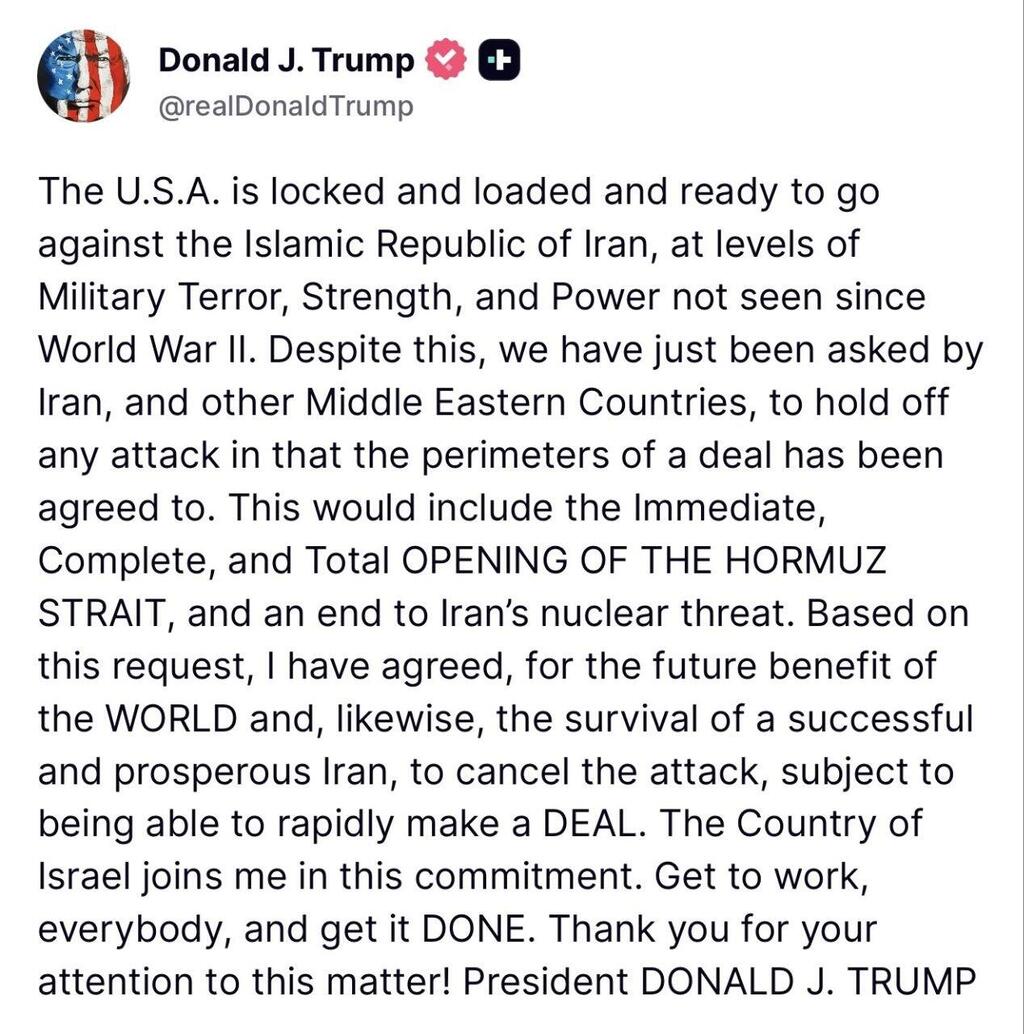
Trump's post from earlier this week
(Credit: Truth Social)
About a week ago, Trump announced that he had canceled a major strike planned against Iran. Only a short time earlier, he had warned that the United States was “locked and loaded and ready to go against the Islamic Republic of Iran, at levels of Military Terror, Strength, and Power not seen since World War II.”
But in a surprise nighttime statement, he said Iran and other Middle Eastern countries had asked him not to proceed and that the “framework” of a possible deal had been reached. He said Israel had also committed to refrain from attacking.
It was not the first time a planned attack was canceled in a sudden Trump announcement. In June, he also said he had called off planned strikes on Iran after claiming agreement had been reached on a memorandum of understanding. Iran denied that a final text had been approved and mocked the president’s repeated claims that a deal was near.
The result is a pattern around which Israel finds it difficult to build a strategy — and one that creates a real problem for IDF planning. Trump threatens an unprecedented attack, the U.S. military prepares and forces in the region are reinforced, then a post appears announcing that everything has been canceled.
The IDF is repeatedly forced to readjust alert levels, force deployment and resource allocation to the president’s shifts in direction.
And even after the latest cancellation, the direction changed again. Trump said talks with Iran were already underway, but soon afterward warned that this was Tehran’s “last chance” before “decapitation.”
For Israel, that means the zigzag is not only between attacking and canceling an attack, but between negotiations, ultimatums and threats to resume the campaign — sometimes within hours.
‘If I tell Netanyahu to do something, he does it’
Hovering over all this are Trump’s public comments about Prime Minister Benjamin Netanyahu.
In early June, the U.S. president was asked whether Israel might return to fighting Iran and said he did not think so. He then added: “If I tell Netanyahu to do something, he does it.”
Trump: 'I don’t need Bibi to tell me that. Bibi’s telling me that because he wants me to stay involved'
(Video: Fox News)
For Trump, this may be another statement designed to project control and power. But for Israel, the message is far more problematic.
The U.S. president is not merely portraying close coordination with Netanyahu. He is publicly describing the prime minister as someone who takes orders from him and carries them out.
Even if the reality behind closed doors is more complex, the impression in the region is clear: Washington decides whether Israel will attack, when it will attack and when it will stop.
The message resurfaced ahead of their most recent meeting. Trump publicly dismissed Israeli concern over the “Pickaxe Mountain” site, the secret nuclear facility where, according to Israeli intelligence assessments, Iran is trying to conceal sensitive capabilities.
“Not a big problem, I don’t need Bibi to tell me that,” Trump said, adding that while he could strike Iranian infrastructure quickly, he wanted this time to avoid doing so.
Netanyahu, by contrast, described the White House meeting as the “best conversation” he had ever had with Trump.
But the meeting was relatively short, was held without joint statements to the media, and afterward Netanyahu did not publicly address differences over Iran, “Pickaxe Mountain” or the possibility of a U.S. agreement with Tehran.
From Trump’s perspective, Israeli participation could change the character of the campaign. It could turn a limited U.S.-Iran confrontation into a broader regional war, trigger massive fire against the Israeli home front and, above all, undermine Trump’s ability to stop the fighting once he believes sufficient pressure has been applied to Tehran.
That is why Washington not only refrained from asking Israel to join, but asked it to remain outside the cycle of strikes as long as it was not directly attacked.
Israel’s version: The gains were achieved, no need to be dragged in
From Netanyahu’s perspective, staying out of the current round is not necessarily a sign of weakness.
Israel’s position is that Operations Rising Lion and Roaring Lion already dealt major blows to Iran’s nuclear program, missile industry, senior security leadership and military infrastructure. As long as the United States continues to apply military and economic pressure, Israel does not have to participate in every strike.
In a statement issued by the Prime Minister’s Office in early July, Netanyahu was said to have led “two historic operations” in unprecedented cooperation with the United States that removed an immediate threat of destruction against Israel and set back Iranian capabilities for years.
The office added that the Tehran regime was weaker and more destabilized than ever and that as long as Netanyahu remained prime minister, Iran would not obtain a nuclear weapon.
According to that view, Israel has essentially already done its part. It opened the way, destroyed targets, killed senior officials and demonstrated its ability to operate deep inside Iran.
It can now allow the Americans to bear the military, economic and diplomatic cost of continuing the campaign without again exposing Israel’s home front to hundreds of missiles and drones.
Ahead of Netanyahu’s latest meeting with Trump, officials also stressed that he did not want to be seen as pushing the United States into another war.
He did not go to Washington to openly demand a return to fighting, but to present intelligence on Iran’s efforts to rebuild its nuclear and missile programs and make clear that any agreement must prevent Tehran from restoring those capabilities.
So why is it still dangerous?
The problem is that staying on the sidelines does not happen in a vacuum.
While Israel is not taking part in the strikes, the United States is also running the negotiations, defining the terms for a ceasefire and deciding which Iranian demands can be accepted.
At the same time, Saudi Arabia, Qatar, the United Arab Emirates, Pakistan and other countries are applying pressure of their own on Trump, sometimes in the opposite direction from Israel.
After Netanyahu’s meeting with the president, the Saudi defense minister, brother of Crown Prince Mohammed bin Salman, arrived at the White House and presented a position calling for de-escalation.
Within a single day, Trump heard Netanyahu voice doubts about the effectiveness of diplomacy and the Saudis urge him not to expand the fighting.
Prime Minister Benjamin Netanyahu speaks to the media after the U.S.-Iran agreement was signed
(Video: GPO)
The more Israel depends on Trump’s decisions, the greater the risk that the campaign will end with an agreement that does not meet its demands.
Iran could agree to temporary restrictions while retaining knowledge, infrastructure and room to rebuild in the future. It could present the regime’s mere survival as an achievement, continue threatening Israel and try to buy time until another shift in U.S. policy.
And alongside all this, even after Roaring Lion and despite the severe damage inflicted on Iran, not all the operation’s goals were achieved.
The nuclear program was not destroyed completely, the regime remained relatively stable and various pieces of infrastructure remained active or repairable. Netanyahu himself said in May that there were still sites that needed to be neutralized, despite earlier statements after previous operations that the nuclear threat had been removed.
There is also a deterrence cost. When Trump publicly says he tells Netanyahu what to do, cancels attacks at the last minute and conducts contacts with Tehran on his own, Iran can conclude that the route to stopping Israeli action runs through the White House rather than Jerusalem.
Even if Israel maintains that it still has freedom of action, it will have to prove that the next time Iran crosses a red line.
Does Israel have a choice?
Militarily, Israel still has the ability to act in Iran. It has proved that several times, including in the June strike carried out after the ceasefire was violated. But military capability is not the same as diplomatic freedom of action.
An independent Israeli strike could reignite attacks on the home front, disrupt Trump’s negotiations and put Netanyahu in direct confrontation with the U.S. president.
Israel depends on the United States for supplies of munitions and interceptors, protection of forces in the region, intelligence assistance and diplomatic backing.
During the latest escalation, the United States also reinforced its forces in Israel and moved refueling aircraft and fighter jets into the region.
That dependence does not eliminate Israel’s ability to act independently, but it significantly narrows its room for decision-making.
Netanyahu can present Israel’s decision to stay out as a successful division of labor: Israel struck the direct threat and the United States is now continuing the pressure.
He can also argue there is no reason to expose Israel’s home front while the Americans are doing the work. But as time passes, the line between division of labor and loss of influence is becoming increasingly blurred.
Now, four months after Roaring Lion, Israel is no longer setting the pace of events. It does not decide when the United States will strike, when it will stop or what it will offer Iran in exchange for an agreement.
Trump can threaten at night, cancel in the morning and announce by midday that understandings have been reached — even when Tehran denies agreeing to them.
Israel still has aircraft, intelligence, a target bank and operational plans. The question is whether, when the moment comes, it will be prepared to use them against Trump’s wishes.
Until that answer comes, the Iranians are watching a new reality take shape: The United States attacks, the United States negotiates and the United States decides when to stop — while Israel, at least for now, remains on the sidelines.