


Should Israel agree to Hamas’s demand to withdraw to the March 2 lines as part of a hostage release deal, the IDF would abandon key strategic corridors secured at a heavy cost in recent months.
This includes the 12-kilometer (7.5-mile) Morag Corridor, stretching from the border near Kissufim to the sea, separating Rafah from Khan Younis, and the newer 10-kilometer (6.2-mile) Magen Oz Corridor, dividing east and west Khan Younis to target remaining Hamas strongholds, including the Al-Mawasi area with 800,000 displaced people and thousands of Hamas terrorists.
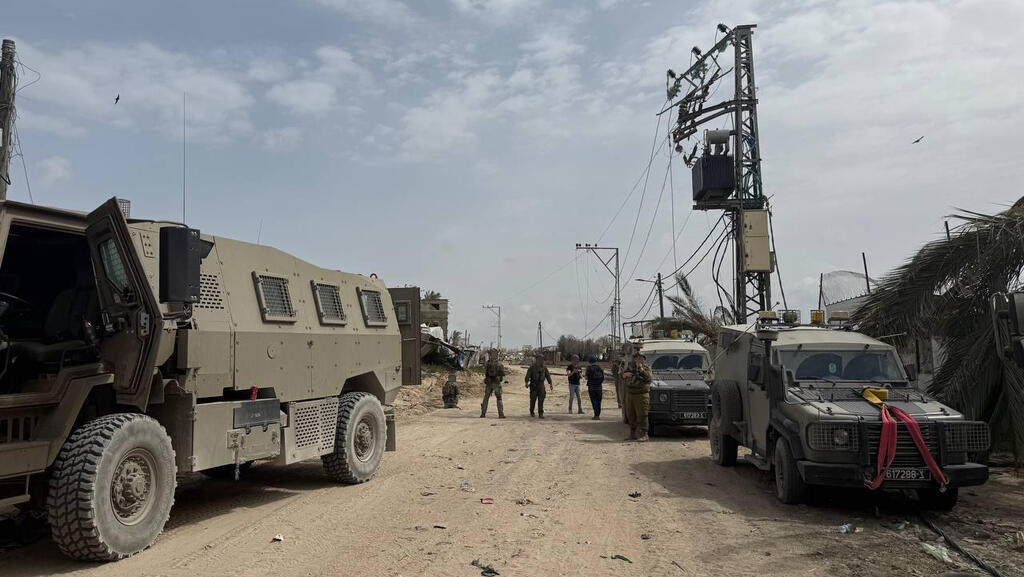
IDF troops at the Morag Corridor
(Photo: Roni Green Shaulov)
A withdrawal from the Morag Corridor would undermine IDF gains in Rafah, the only Gaza city under siege, allowing hundreds of thousands of Gazans, including Hamas operatives, to return without security checks. This could enable Hamas to rebuild its local brigade, despite the destruction of most terror tunnels in recent months.
The retreat would also weaken the IDF’s buffer zone along the Gaza border, critical to preventing another October 7-style massacre.
Get the Ynetnews app on your smartphone: Google Play: https://bit.ly/4eJ37pE | Apple App Store: https://bit.ly/3ZL7iNv
The IDF has seized significant territory, up to 2 kilometers (1.2 miles) into northern Gaza, at the cost of dozens of soldiers’ lives and injuries, particularly in the Jabaliya and Beit Hanoun, areas overlooking Israeli communities like Sderot, Mefalsim and Alumim. A partial withdrawal would jeopardize plans for new outposts to secure the region.
IDF strikes on terror targets in Gaza
(Photo: IDF Spokesperson's Unit)


The IDF’s control of the northern Netzarim Corridor, south of Gaza City, is also at stake. Following the collapse of an earlier ceasefire this year, the IDF reoccupied positions along the Salah al-Din road to block thousands of Hamas terrorists returning with half a million Palestinians to Gaza’s largest city. Opening this key passage fully would give Hamas a military advantage in northern Gaza.
A source familiar with the ceasefire talks described Hamas’s response to Israel’s latest ceasefire proposal as “disappointing” and insufficient, failing to satisfy mediators Qatar, Egypt or the United States. Qatar and Egypt rejected Hamas’s reply outright, refusing to forward it to Israel and demanding a more relevant response.
Jerusalem anticipated Hamas would focus on withdrawal lines, with the gap narrowing to a few hundred meters. Israel is willing to pull back 1,000–1,200 meters (0.6–0.75 miles) from the Philadelphi Corridor, while Hamas insists on 800 meters (0.5 miles). Hamas is also expected to demand the release of 100–150 additional high-profile Palestinian prisoners, a smaller gap than previously thought.