

The scene looks almost pastoral. Visitors sit facing a small vineyard, sipping glasses of wine. Nearby, a cactus garden bursts with color. For a moment, one could almost forget that behind it stands the former home of Yocheved and Oded Lifshitz—Oded was murdered here, and Yocheved survived Hamas captivity. A few steps away is the burned and empty house of Gideon Pauker, who was killed in Nir Oz on October 7. In the distance, Gaza is visible beyond the fields, the dull echoes of explosions rolling from it every few minutes.
Yet the women of Pauker Winery—sisters-in-law Irit and Galia Pauker—refuse to let terror win. They pour wine and serve cheese with quiet resilience, hosting guests in a small trailer amid one of the kibbutz’s few inhabited corners. The walls are decorated with photos of hostages Gali and Ziv Berman and of fallen defender Tamir Adar, whose body is still in Gaza. Anyone lifting a glass of their crisp rosé cannot forget where they are.
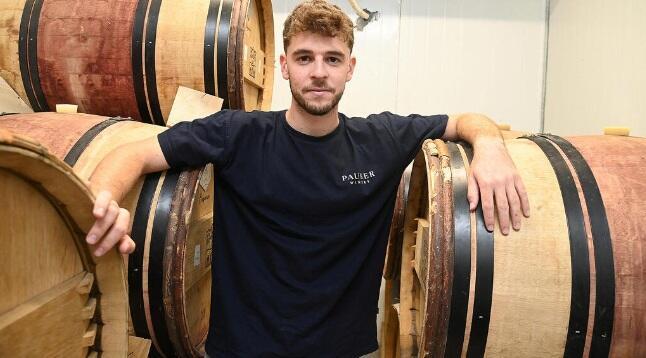
I am waiting for 25-year-old winemaker Gal Pauker, who has inherited the winery founded by his late grandfather Gideon, almost against his will. Gal is busy at the new family facility now under construction, so Irit, his aunt, takes me for a walk through the kibbutz. She shows me the underground shelter where her father and friends made wine for decades—never for sale, just for their own pleasure and for the community.
“My grandfather found wine late in life”
When Gal arrives, he greets visitors warmly and leads them to the small barrel room where the 2024 vintage is aging. For now, he lives in temporary housing in Tze’elim but plans to return soon to Nir Oz. Until October 7, he had little interest in winemaking beyond helping his grandfather with the harvest.
Gideon Pauker planted his half-acre vineyard in 2006, producing about 1,000 bottles a year with friends and fellow kibbutz members: the late Chaim Peri and Yoram Metzger, as well as Gadi Mozes and others.
“Grandpa got into wine after retirement,” Gal explains. “If he’d started earlier, he probably would have built something bigger. He had an agricultural background, took a few courses at the Sorek Winery School, and consulted with people like winemaker Avi Feldstein. There was a regional wine club in Eshkol, and through that he met Haim Gan from Ish Ha’anavim—one of Israel’s oldest wine institutions. After the attack, Haim was among the first to help us salvage what was left and guide us forward.”
The vineyard originally grew Merlot and Cabernet Sauvignon, which have since been replaced with Petit Verdot, Malbec, Marselan, Pinotage and even a rare local variety called Yael.
“October 7 was a blow, but also a door that opened”
That morning, Gal was at his girlfriend Ziv’s home in Ein Hahoresh in central Israel. “I saw on TV the Hamas pickup trucks breaking through the fence,” he recalls. “I called my grandmother, who was in the safe room, and tried texting my grandfather. He answered only on WhatsApp. My brother Sivan was with his girlfriend in Kfar Aza and whispered on the phone that he was hiding. Later, I learned he’d been shot in both hands. When they got a chance, they escaped to her parents’ house and used improvised tourniquets to stop the bleeding.”
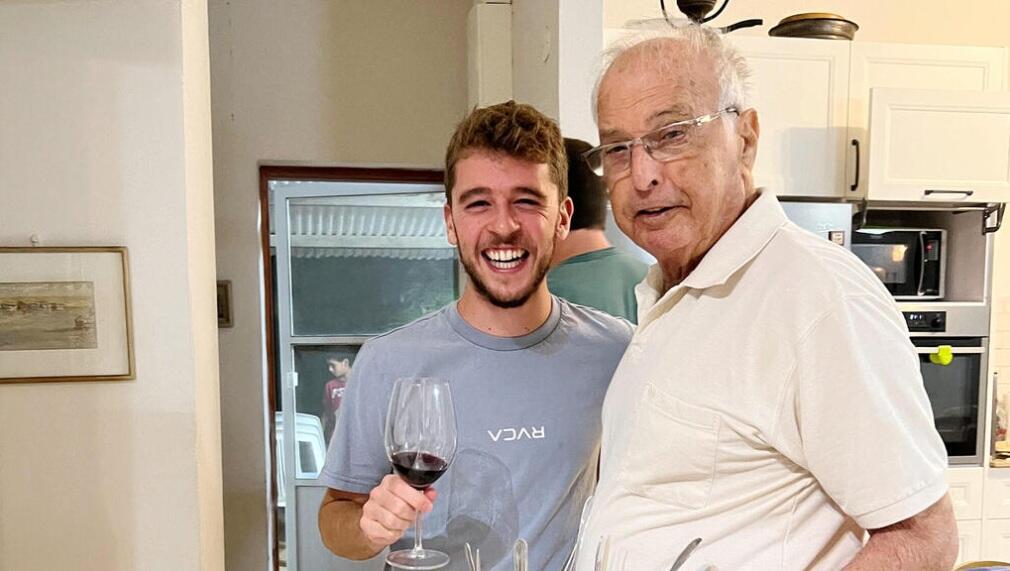
Gal Pauker with his grandfather Gideon
(Photo: Courtesy)
Sivan Pauker is still recovering after a long rehabilitation at Sheba Medical Center. “He can’t work yet, but he helps however he can,” Gal says. “We also lost my cousin, Tamir Adar, who was in Nir Oz’s alert squad. He ran out first and was killed. Two days later, we were evacuated to a hotel in Eilat. We already knew Grandpa had been murdered, though it took the state two and a half weeks to confirm. There was no state. On October 16, he was supposed to celebrate his 80th birthday. Instead, we buried him.”
By late October, Gal and his family were back in Nir Oz. “Haim Gan came with winemakers Shibi Drori and Miriam Harel to help. They showed me what to do—gave me practical tips and then just said, ‘Well, you’ve got a winery to take care of.’ They didn’t ask if I wanted to. They just said, ‘It’s yours now. Call anytime you need us.’”
Gal’s voice tightens. “I knew how much this meant to my grandfather. From the moment I got the keys, I grabbed them with both hands. My father said he thought it suited me—and that we should make wine in Grandpa’s memory.”
From memorial to enterprise
Asked whether building a winery as a tribute risks being only an act of memorial, Gal smiles slightly. “That’s not the whole story,” he says. “We’ve planted another 57 dunams (about 14 acres) of vineyards at Ein HaBesor, on my uncle’s farm.”
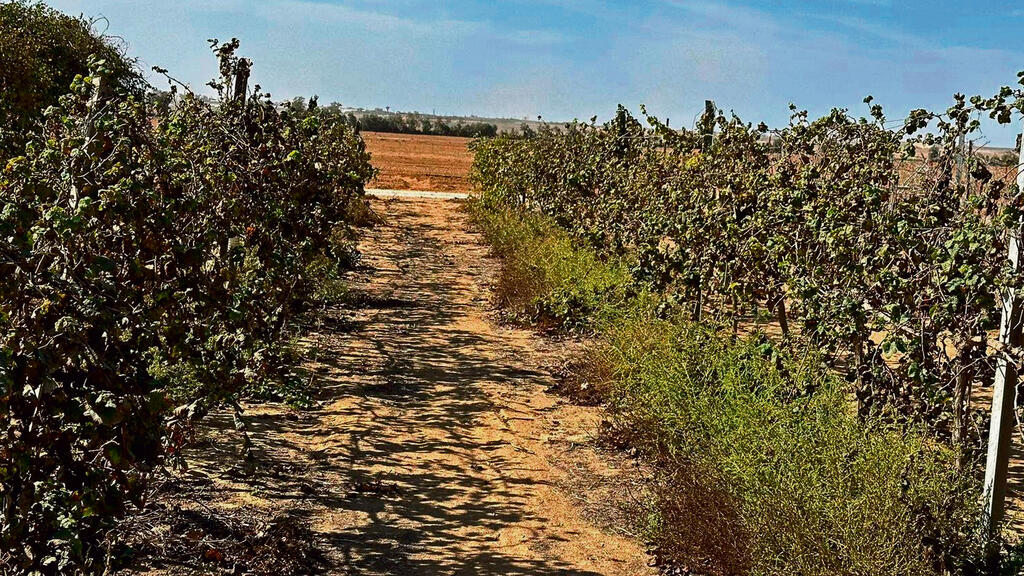
The vineyard in Nir Oz
(Photo: Gal Pauker)
That expansion is no small feat—it will eventually yield over 50,000 bottles per year. “We planted Petit Verdot, Syrah, Petite Sirah, Pinotage and Yael for reds, and Sauvignon Blanc, Semillon, French Colombard and Chenin Blanc for whites. We’re also building a proper large winery there.”
Why not rebuild it in Nir Oz?
“Because Nir Oz went through enormous trauma,” he says quietly. “It’s not ready yet for big decisions.”
This year’s harvest will yield about 7,000 bottles, mainly from purchased grapes. The grapes grown in the original vineyard are still vinified at the old Nir Oz winery, as Gideon and his friends once did. “That wine isn’t for sale—it’s a memorial project,” Gal says. “But Pauker Winery, the one we’re building now, will be commercial. It’s meant to reach the world.”
“I’m not a memorial project,” he adds firmly. “If that were the goal, we’d keep making 1,000 bottles a year. But we chose to build something bigger. Working with the wine helps me process the trauma—it’s my way of moving forward. The winery is my therapy. October 7 was a terrible blow, but it also opened a door.”
“It gave me something to live for”
Gal smiles as he remembers his grandfather. “We were close—he was German-born, so very disciplined, but sometimes he’d surprise me with this Polish humor. Once, after we’d finished working late at night, completely exhausted, he said, ‘Do I have to die for you to finally take this seriously?’
“If he were still alive, I doubt I would have gone into this,” Gal admits. “But in the circumstances, it saved me. The winery gave me purpose—something to get up for in the morning, even during the hardest times.”
He pauses, then adds softly: “There are still hostages in Gaza, and my brother is still recovering. I wish this could have happened while Grandpa was here. It’s a light in a very dark place. I’m grateful for the path it’s given me—but I miss him and so many others every day.
“It’s a strange balance we’ve all learned to live with—hope and loss side by side. A lot of people here chose life. Personally, I haven’t really stopped to grieve yet. Sometimes I feel guilty for being so caught up in work instead of mourning. But honestly, it’s what saved me.”