

After a dramatic wave of assassinations in recent days, Iran’s leadership faces a dual test, one of the most severe in its history: military survival against an external enemy, and internal stability against a restless public waiting for the right moment to erupt.
The reported killings of Ali Larijani, head of the Supreme National Security Council, and Gholamreza Soleimani, commander of the Basij, are not only operational blows but also represent simultaneous damage to two critical pillars of the regime. On one side, Tehran has lost a key figure responsible for strategic coordination at the sensitive intersection of military and politics. On the other hand, it has lost the man who commanded the operational apparatus responsible for suppressing the public and sustaining fear in the streets.
The significance of the Basij commander extends far beyond the military sphere. The Basij serves as the regime’s last line of defense against its own citizens, a paramilitary force designed to enforce order in cities, disperse protests and intimidate those considering change.
Soleimani oversaw violent crackdowns over the past six years, including the killing of thousands of protesters in January. His assassination creates both a symbolic and operational rupture at a moment when the regime needs maximum internal deterrence. Now, more exposed than before, the leadership is turning to the last lever it has left to prevent collapse: the economy. Yet here, too, its options appear limited.
Gallery
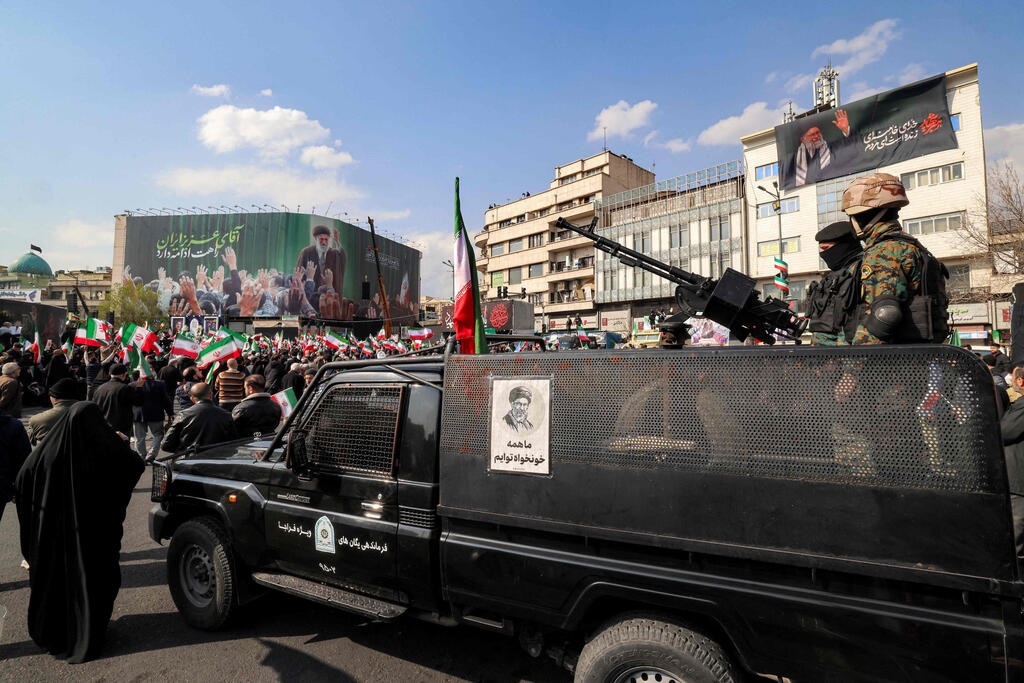
The Basij is the regime’s last line of defense against its own citizens
(Photo: Atta Kenare / AFP)
To understand the anxiety gripping Iran’s leadership, it is important to recognize that the economy was already in critical condition before the current conflict. Official data from Iran’s central bank point to a prolonged structural decline, with annual inflation above 46% and urban consumer prices surging at alarming monthly rates.
On the open market, the Iranian rial has lost nearly half its value over the past year, trading at around 1.5 million rials to the dollar. The only reason the currency has not plunged further in the early days of fighting is that foreign exchange trading has nearly frozen. Many Iranians are holding off, while dollar trading is thin, waiting to see how events unfold before offloading what remains of their savings.
In that sense, the relative stability of the currency is largely an illusion, the calm before the storm rather than evidence of resilience in the banking system. Iranian officials understand that, once the immediate fog of war lifts, pressure on the rial is likely to intensify, further eroding household purchasing power.
The economic measures taken by Iran’s government since fighting began on February 28 are not growth measures but rather standard crisis-management measures aimed at preventing logistical and social chaos. A complete halt to food and agricultural exports is intended to secure domestic supply, a familiar tactic used by regimes under siege seeking to project control over supply chains.
At the same time, the expansion of Iran’s electronic coupon system, known as “Kalabarg,” marks a return to policies last seen during the Iran-Iraq war in the 1980s. For older Iranians, food vouchers evoke memories of shortages and long lines, but for the regime, they are a tool of social control.
The decision to extend the program to all households, removing income-based eligibility, underscores the depth of concern in Tehran. Officials are unwilling to risk even the middle class feeling abandoned. The value, roughly $6.70 per person per month, is modest, but the psychological message is central: the state is the sole provider of basic necessities, and defiance could mean going without them.
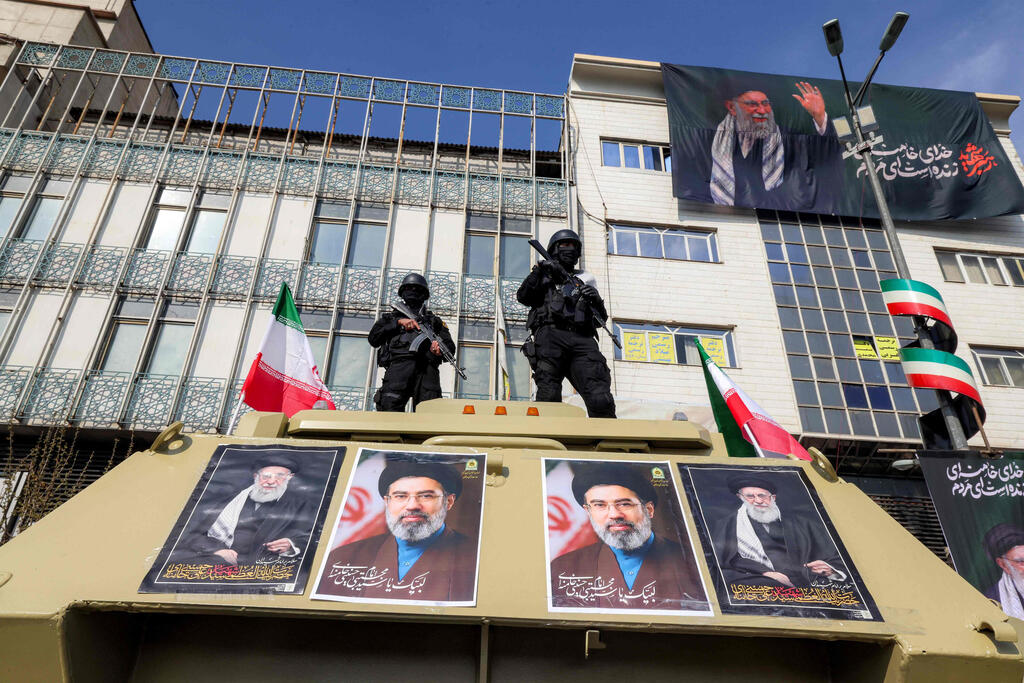
A rally in support of the new supreme leader, Mojtaba Khamenei
(Photo: Atta Kenare / AFP)
This same logic underpins the introduction of a new high-denomination banknote, an “Iran check” worth 1 million toman (1 toman is equivalent to 10 rials). The central bank frames it as a technical response to “special conditions,” but in practice it appears to prepare for a potential cash shortage.
Authorities fear that if citizens encounter empty ATMs, panic could quickly spill into the streets and evolve into a political protest. The new note mirrors the broader crisis: a large nominal value masking rapidly diminishing purchasing power. Each bill represents less in real terms with every passing day, yet officials hope that the physical presence of cash will provide a temporary sense of stability.
Perhaps the most consequential and risky step has been raising the minimum wage by more than 60%. Economically, the move risks accelerating inflation by injecting significant liquidity into an economy where the supply of goods is shrinking due to the war.
For the regime, however, the political risk outweighs the economic one. Nearly 12 million minimum wage workers form a key segment of the labor force capable of paralyzing the economy through strikes. Increasing wages from about $69 to $111 per month is effectively a bid to secure their loyalty.
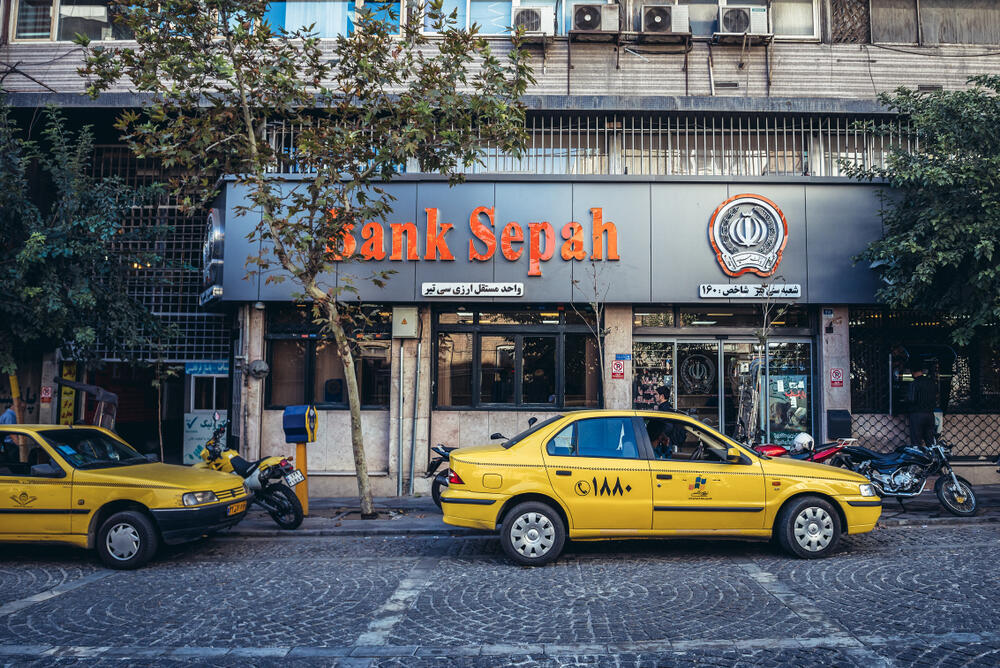
Bank Sepah in Tehran. The regime fears empty ATMs
(Photo: Fotokon/Shutterstock)
What allows Iran to sustain these measures, for now, is its oil sector, which continues to function despite repeated strikes on key infrastructure such as Kharg Island. Limited exports continue through alternative channels and so-called shadow fleets of tankers. This flow of revenue provides the financial oxygen needed to fund subsidies and wage increases. Still, this is a race against time.
Some Iranian officials, including Mohsen Rezaei, an adviser to Supreme Leader Mojtaba Khamenei, appear to be betting on a strategy of attrition, hoping to drive global oil prices toward $200 per barrel and outlast Western consumers’ tolerance for rising costs. It is a risky assumption. While the West faces higher prices, Iran faces a deeper erosion of basic living conditions.
Iran’s current economic system resembles that of a country under siege. Historically, regimes relying on coupons and inflated currency often discover that their greatest threat is not external attack, but internal despair.
In recent weeks, Iran’s economy has effectively been on life support. Tehran's thinning leadership is offering only the bare minimum needed to prevent a breakdown in public order. With Larijani gone, a figure who may have been capable of navigating complex coordination or compromise, and with diminished control over the Basij’s enforcement mechanisms, the regime is left with a narrow economic toolkit.
External military pressure and internal fragility are converging into a volatile reality, where any miscalculation, whether excessive money printing or failure in food distribution, could ignite renewed unrest.
The regime in Tehran has not collapsed, but its actions suggest it has entered a phase of existential survival. Each day of relative calm is being bought at a growing economic cost, one that will eventually come due.
For Iran’s leadership, the greatest danger may not be the military threat it faces, but the moment when millions of citizens conclude that the million-toman notes in their hands are little more than paper, and decide it is time to demand a new social contract with a leadership that can offer them a real future.