

Philosopher Dr. Jeremy Fogel still remembers his astonishment at his first taste of hummus. “When I first came to Israel, friends said, ‘Let’s eat hummus.’
I remember not understanding why people eat a bowl of mayonnaise — because to me hummus was something you put a thin layer of in a sandwich; it’s not something you eat on its own.”
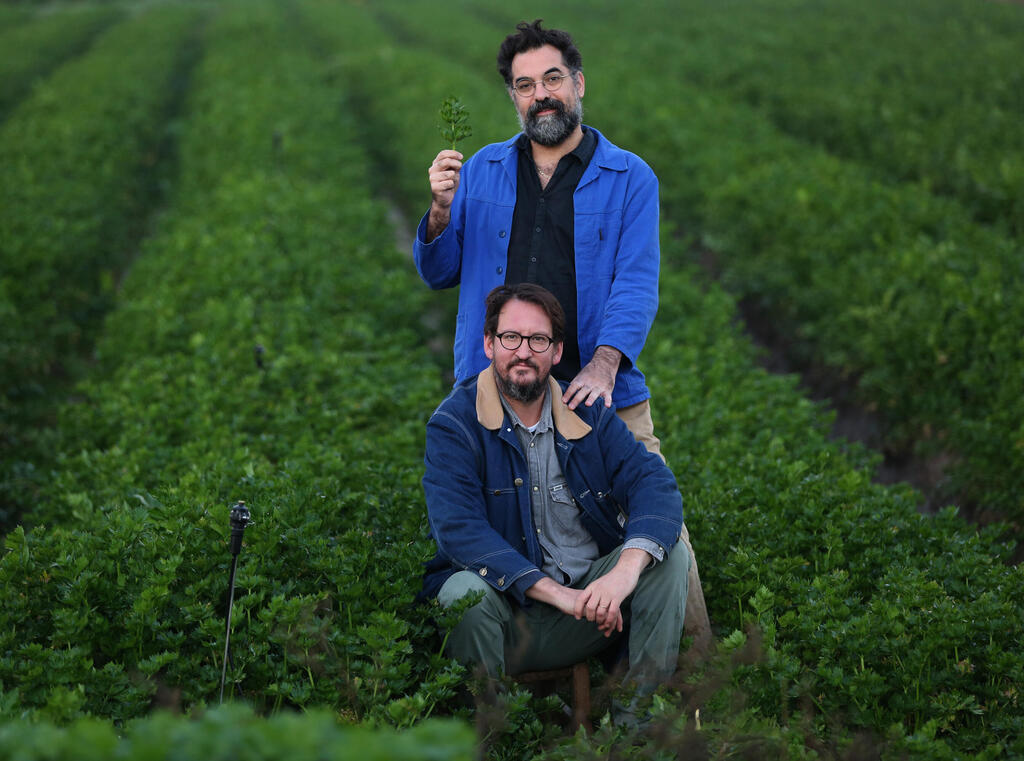
Having grown up in Belgium until age 15, what did you know about Israeli food?
“Very little,” Fogel replies.
“The Belgians know very little about food, period,” interjects chef Asaf Doktor, speaking with decisive certainty.
“Near our school we had Bnei Falafel, and there was a Jewish bakery — we didn’t celebrate a birthday without its black babka,” Fogel continues. “Not long ago a friend flew to Belgium and brought me one. The problem was that by the time the cake arrived it had a little mold. My wife said right away, ‘Let’s throw it out.’ I just cut off the mold and ate around it.”
× × ×
The philosopher with a doctorate and the chef, both Tel Avivians and both 44, met for the first time in professional circumstances, but look compatible — like za’atar and olive oil. Fogel, newly married, is a lecturer, author (“Philosophers Against God”), and host of the podcast "Think & Drink Different." Doktor, married with two daughters, co‑owns the restaurants The Brothers, and together they lead the delightful food program “The Plate of the Promised Land”, airing on the public broadcaster from January 20 (Tuesdays at 10:10 p.m. on Kan 11 and Kan BOX).
Doktor recalls how the show began: “The producer and creator, Ofer Ein Gal, called me one day and said: ‘There’s a tall, kind of goofy guy like you — looks like the uncle from Big Lebowski — but he’s a doctor of philosophy.’”
Jeremy laughs: “It’s very frustrating when they find someone who can make me look small. One of the foundations of my self‑esteem is my height, so they brought the only person in Israeli food who’s taller than me. It’s insane.”
Together they jump from farmers to cooks to researchers, wondering about the precise menu of the Children of Israel in biblical times. Doktor, a man who advocates the use of raw materials from the immediate environment and forages weekly — says he has discovered new insights into ancient diets.
"I'm into localism for its myriad culinary and cultural expressions, but that doesn’t mean I was a good student,” he says. “And honestly, Bible was one of the subjects I liked least, so I learned a lot during filming.”
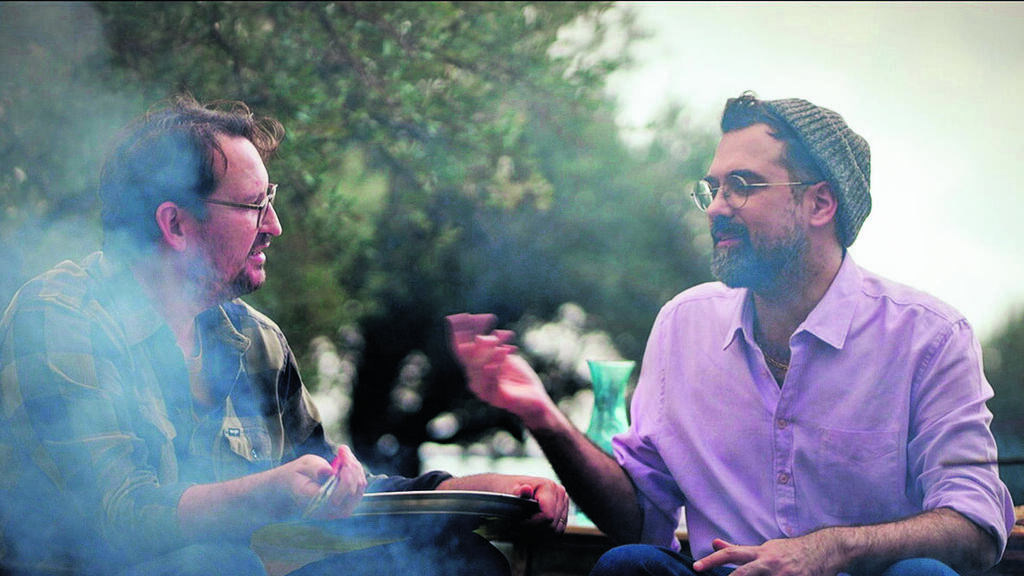
From their new series on Kan 11
(Photo: Kan 11)
Fogel adds: “Food doesn’t lie, the earth doesn’t lie. We tried to step into the shoes of people from Abraham’s time through the era of the Mishnah and Talmud — through the stomach. To understand how they really lived. There’s the famous quote from German philosopher Feuerbach: 'You are what you eat'.”
And what did you discover?
“First of all, we understood that there was always a texture of many groups and peoples here. And there’s also the difficulty of life in ancient times, which we often forget. Look at us now, delighting in the salads, cheeses and bread Asaf brought to the table. We have convenience stores, 24/7 access, and most of us are busy all the time trying to keep food out of our bodies. People here once lived with no food security. In every story in the Bible there’s always hunger — severe hunger. It’s an event that happens at least once in a person’s life; if you live to be 60–70, you will know severe hunger.”
Doktor adds: “We’ve also encountered that word recently in relation to Gaza and the hostages. The word ‘hunger’ has suddenly taken on another meaning.”
Fogel continues: “And then there was the thing with garlic — it turns out Jews have an obsession with garlic. When we left Egypt we cried over meat and onions and garlic, and in the Middle Ages they said we smelled because of it. Basically we ate garlic, onions, za’atar and greens. By the way, today we are still the second‑highest per‑capita consumers of garlic, with China in first place.”
On the appetite for garlic: What did you think about Minister Nir Barkat’s “Israel Basket”? It lists Israel’s 100 most popular products — but contains no garlic or vegetables at all, only snacks, chocolate drink mixes, cola and many processed foods.
Doktor: “I actually think that the subject of locality and the ability to live off your own produce strengthened here because of the disasters of recent years — COVID and October 7.”
Fogel: “That basket reflects what the elite offers the masses to eat. We’re a country where what’s so remarkable is how tasty the vegetables and fruits are here — it’s insane. Now, I really love snacks, but you know, it’s not healthy. People used to say: bread and fun, now they tell us: eat processed food and watch Channel 14.”
× × ×
Perhaps the most startling discovery of Doktor and Fogel — one that ends years of dispute — is about hummus. Doktor recounts: “I have to say, even before we started filming I wanted to go on a journey to validate claims made about us, especially before the war, when we were a big star as a culinary nation in the world, about the accusation that we culturally appropriated hummus.”
And did you find evidence that it wasn’t appropriation?
“It was very important to me to confirm that in the end everyone in the Galilee sat and ate what the Galilee had to offer. Arab, Jewish, Christian and Byzantine — I don’t know who else — all ate what the land gave them. For me, that was a great relief. It turns out everyone ate mujaddara, hummus and fava beans. The hummus war is over; there’s no single inventor of the dish. It’s not mine, and it’s not yours — it belongs to all of us.”
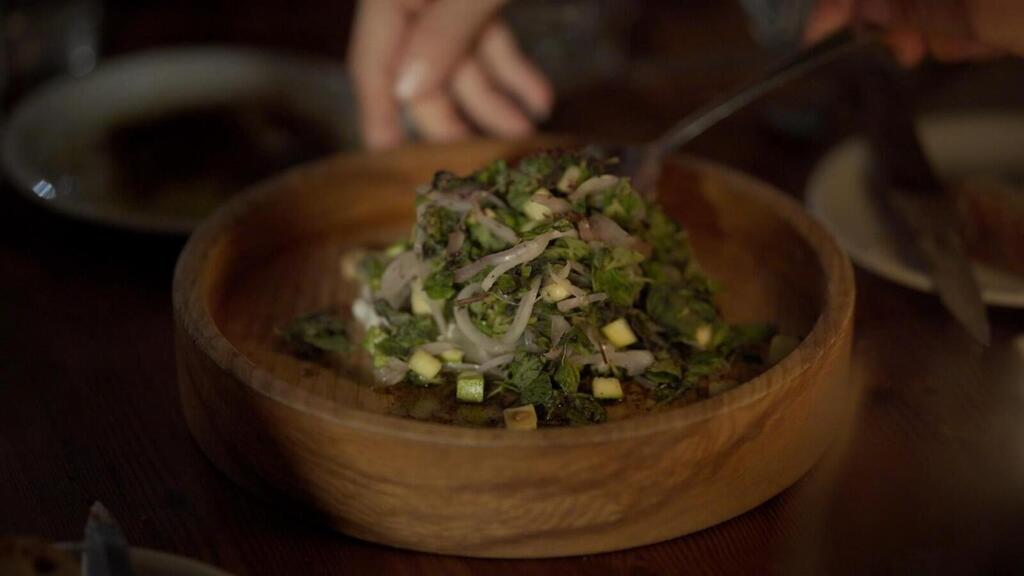
Zaatar salad
(Photo: Tom Gat)
A decidedly regional peace.
“Maybe in Season Two we’ll scoop hummus in Damascus. I’m already dreaming of a Rashed (Shirazi) salad in Iran.”
So can we already settle the debate about whether there is such a thing as Israeli food?
“Of course there is,” Fogel says. “Israeli food is a schnitzel in a pita with hummus and harissa and purple cabbage salad in mayonnaise. Look, we’re a very small, very achievement‑oriented country and we have a lot of drive — in high tech and in food. Unfortunately, you can also find that drive in the younger generation of cooks who want to work in four restaurants in a year, do three roles and then go on MasterChef and then open a restaurant. That’s our strength and our weakness. But that’s also how in 76 years we managed to invent a cuisine — something that took the French and Spaniards hundreds of years. We do everything very, very quickly.”
And if we’re talking drive — do you dream of Michelin?
“Michelin inspectors were funded by the Foreign Ministry a few years ago to come here — and then the war broke out. But without tourism, Michelin is worth nothing. Michelin’s whole idea relies on tourists — and there are no tourists here.”
Fogel: “Maybe we need an Israeli Michelin, only with a Star of David instead of a star.”
Doktor: “Maybe a hangman’s rope icon.”
Fogel: “Yes, you’ve earned three hangman’s ropes.”
× × ×
Like hummus, which was and will always be here, some things don’t change. “Through food you also understand how much corruption there was then, how enormous the class divides were,” Fogel says. “Capital‑power steak well‑done — that’s our slogan for the priests in the Temple. Think about the fact that nobody ate meat then; maybe only once or twice a year. Now who eats meat all the time, under some theological justification that God is nourished by sacrifices? That’s institutionalized corruption, and it’s beautiful that even in the Bible, the prophets criticize it. In these days we should pay very close attention to that criticism.”
Always standing by the protest and those giving — compassionate and hardworking — is Doktor, who alongside his brother Yotam orchestrated an enormous volunteer effort at the restaurant The Brothers after October 7, delivering hundreds of thousands of hot, carefully prepared meals to soldiers and evacuees during the war.
How did that happen so suddenly?
“It didn’t happen suddenly,” he says. “Our history as restaurateurs and our partners Keren Einai and Yaron Ramon have always been tied to social action. Back in 2011, when we just opened The Brothers, we delivered hummus to tents on Rothschild amid the social protest. During COVID we established a system here at Ivy to get cooks back to work and support the invisible — the underprivileged, the elderly, the mentally fragile, and refugees. On October 7, there was no question for me. Everyone already knew The Brothers would do something, and they just showed up — and it became crazy, hundreds of volunteers delivering tens of thousands of meals a day.”
What was your most moving moment?
“When we received our kosher certification. On the third day we already reached 25,000 meals or something like that. Then a truck left for a base in the south and the supervisor wouldn’t let it in — and all the food went to waste. The next day we said, okay, let’s get kosher certification. We made efforts, brought a supervisor, but there were so many volunteers — hosts at the door directing people: you to the kitchen, you to peeling, you to packing. When the supervisor arrived, the host that day insulted him, and he immediately left. Then we’re back to tens of thousands of meals and we need the kosher stamp. We even reached out to President Herzog, who sent us another supervisor — a really sweet guy who recently enlisted, came and helped. In the end, the emotional moment was seeing a selfie of Raz Rahav and me with the certificate, right before the masses were sent out.”
A few days later, his brother — an Air Force veteran — sent him a voice message from a friend in his squadron saying that a kosher delivery had arrived and now he too could eat. “That was a chilling moment. But all of this also brings me back to this optimism that we’re all working shoulder to shoulder, and we’re all brothers — and it pains me so much that it faded, just faded.”
How did that happen?
“What pains me most is our naiveté — to think that now we’re all lined up in tight ranks and the rift between us will heal. It doesn’t heal, not at all, because someone is constantly working to keep us divided. It’s a bit crude to say, a bit un‑optimistic, but in the end I’m a chef at a restaurant and I’m tired of dealing with anything but food. I’m proud of our projects; my brother is at the spearhead of moral and social action — it’s in our blood — but I miss being a citizen who wakes up in the morning to work and enjoys tourism and growth. We’re constantly occupied with adapting to the situation: during COVID, during war, and during one protest or another — and honestly, I’m tired. But we won’t stop doing what we do. We’ll never say, ‘Okay, we’ve done enough.’”
Jeremy, philosophically, how do you explain renewed social division?
“I think what explains Israeli leadership — and the prime minister specifically — is Machiavelli’s "The Prince." It’s a guide on how to gain power and, once you have it, how to preserve it. Now it’s clear how Bibi works. It’s always divide and rule: left and right, Mizrahim and Ashkenazim, religious and secular. Now he’s doing divide and rule with the Haredim to pass the exemption law, and divide and rule with the Palestinians. That’s where the whole Hamas conspiracy came from — even though after October 7, when it collapsed, it somehow turned out it was really Rabin and Begin’s mistake and even Moses himself.”
Can philosophy offer comfort — did it help you through the war?
“Honestly, yes,” Fogel says. “I think Stoic philosophy can offer comfort and resilience in times of uncertainty, pain, cruelty and challenge — which is life. Stoic calm comes from focusing only on what is within your control. Greek philosopher Epictetus says about everything you should ask: Is it within my control or not? If it’s within your control, strive to improve the situation. If it’s not within your control, cultivate indifference. We’re like dogs tied to a chariot with no control over where it’s going. Life, death, poverty, wealth, war, peace — we only control ourselves. Now people say: ‘So what, you want to tell us to do nothing?’ I say: no — do you think it helps to protest? To prepare food for people who need it? Does it solve the problem you’re fighting for? Not necessarily — but you are still acting according to your intention and moral nature.”
Doktor adds: “I try to echo this to my wife, to the staff. In the end, reality is reality — what you do with it now is a choice. Even in chaos it’s better to act. If the world shits on you and you wallow in it, it won’t do you any good.”
Fogel: “One of the biggest dangers to our society is becoming cruel. That the shock, pain and horrific trauma we absorbed from Hamas’ barbaric attack will damage our moral resilience. We need to remind ourselves — and I think this show does that — that this place is a beautiful and diverse place, and we need to think compassionately again, in light of the vision of the prophets of Israel, as Ben‑Gurion said. We cannot let this era — cruel and difficult as it is — turn us into reflections of the monsters we fought.”
Scary.
Doktor: “But the rule of the ayatollahs will fall, and the rule of Bibi‑ism will fall too, even though Yair is now joining Likud.”
Fogel: “Did he eat at your restaurant?”
Doktor: “I believe so, but many years ago.”
Fogel: “Bibi was at yours?”
Doktor: “Not that I recall. But I saw enough of him in my life, because I grew up in Caesarea. I was there before him.”
Fogel grew up in Antwerp, and after immigrating wandered from Paris to Berlin and New York, among other places, becoming the frontman for the band Pissuk Rachav— explaining his rock‑star approach to Gal and Nietzsche. His late father, Daniel Fogel, also released songs, one of which became a major hit in the Philippines, miraculously.
“At the request of the audience I stopped making music, but my father had a bit of a singing career,” Fogel confirms. “He has a song that somehow became a huge hit in the Philippines — hundreds of millions of YouTube views and thousands of video versions, spreading to Indonesia. I now live in Shapira neighborhood, and all my neighbors are Filipinos. During the sirens, everyone would come up to the corridor in my apartment, which we decided was the safe place. In the end I decided to tell them who I am — that I am the native son of the Filipinos — and every time they came up, we sang the song.”
You raised them.
“As the Stoics say: without fear, without hope. Roman philosopher Seneca says: Just as a soldier chained to a prisoner, so hope and fear are linked to one another. They seem very different, but both are symptoms of a stressed soul. Because the only place you can find peace that you control is in the present. Hope means turning your resources to the future. Fear means projecting the past onto the present. It’s very foreign to us — our culture has messianic fundamentals: the Messiah will come, next year in rebuilt Jerusalem, hope, next year. It’s very foreign to say without fear, without hope, but you have to focus on what’s happening now.”
Without fear. Without hope. Without a dream.
“Yes — it turns out even Zohar was a Stoic.”
Recipes from Asaf Doktor inspired by biblical menus
Za’atar Salad
Ingredients:
- 3 cups fresh za’atar leaves, separated, washed and dried
- 1 medium zucchini cut into small cubes
- Half a bunch of scallions, finely chopped
- Dressing:
- 3 tbsp grape molasses (dibs)
- 1 tbsp quality sumac
- 6 tbsp olive oil
- Salt
Preparation:
1. In a bowl combine za’atar, scallions and zucchini.
2. Sprinkle coarse salt and sumac; mix well.
3. Add dibs and olive oil; toss thoroughly.
Serve immediately.
Beef Tongue with Mustard
Ingredients:
- 1 beef tongue
- 2 large onions
- 3 carrots
- 2 leeks
- 1 head garlic
- Half bunch parsley
- 12 bay leaves
For the sauce:
- 2 tbsp whole‑grain mustard
- 5 tbsp quality silan (date syrup)
- 3 grated garlic cloves
- 2 finely chopped shallots
- 6 tbsp red wine vinegar
- ¼ cup olive oil
- Coarse salt
Preparation:
- Place the tongue in a pot, cover with water, add 4 tbsp vinegar, and bring to a boil. Remove from heat and drain.
- Refill with water, coarsely chop the vegetables and add to the pot.
- Bring to a boil, reduce heat, skim foam, add bay leaves, whole garlic and parsley.
- Simmer about 1½ hours until the tongue is tender.
- Remove and let cool slightly. While warm, peel off the outer skin.
- Once cooled, slice crosswise into ~3 mm slices.
- Arrange neatly on a wide plate.
- In a small bowl combine sauce ingredients, pour over the tongue, and serve.
First published: 13:25, 01.21.26