

On the morning of Simchat Torah, October 7, 2023, Colonel Omri Rosenkrantz was out for a morning run on the Tel Aviv promenade. “I was running with headphones near Charles Clore Park,” he recalls, “when suddenly someone ran toward me waving his hands. I took one earbud out and heard him shouting, ‘Alarm, alarm.’ I thought to myself, here is another typical Tel Aviv drunk who finished a night out. I kept running and then I suddenly saw people lying on the ground with their hands over their heads. My wife, who was at our home in a town in the south, called me. She was in her ninth month of pregnancy. ‘There are alarms all over the country. Come back, something is happening,’ she said.”
Rosenkrantz, who a little more than a year earlier had finished commanding the Duvdevan unit, was then commander of the Carmeli reserve brigade under the Northern Command. “I had about three kilometers back to my car,” he said. “Even then I got my first call from a friend who had been with me in the original Duvdevan team and lives in Kibbutz Magen near the Gaza border. ‘What is this? Where is the army?’ he asked me.”
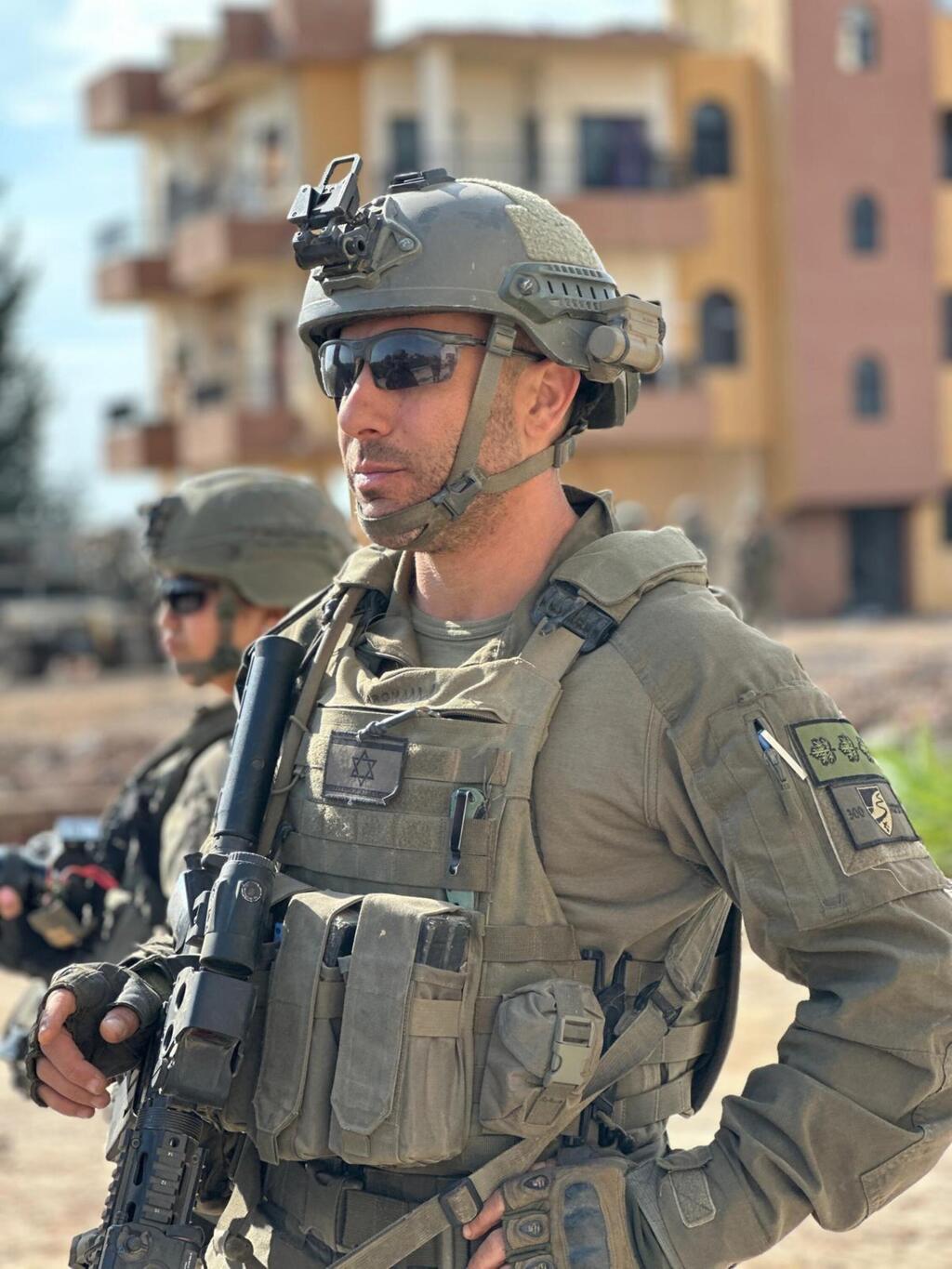
“In the car on the way home, my wife’s cousin called me, he lives in Be’eri. ‘The whole kibbutz, terrorists, they are shooting here, they are slaughtering us,’ he said. I instructed him, ‘Lock yourself in.’ I asked him what weapon he had and when he said he had a pistol I told him it was not enough to go fight and that he should stay inside. I still did not understand the scale of the event. A minute after I got home we saw on television the Toyota in Sderot. I told my wife, ‘It’s fake, nonsense.’”
As someone who throughout his military service sought contact with the enemy and looked many terrorists in the eye, it was clear to him even that Saturday that he would immediately go to the Gaza border communities. “I put on uniform, took my weapon, and then I remembered that my division commander, Shomer, lives in Kfar Aza. I called him and even joked, ‘Did you start fighting without me?’ He immediately said, ‘There is war. Go north and mobilize the brigade.’ I argued. ‘I’m going south,’ I said. He insisted, ‘Drive, mobilize the brigade.’”
What did you do?
“I was in a real dilemma. On one hand there was fighting and I needed to be there. On the other hand I had responsibility for the north. I called Duvdevan for a situation update. They told me initial teams had already gone south and more were on the way. In short, I went north. But the feeling of frustration that I did not go down to fight in the Gaza border that morning will never leave me.”
Emerging from the shadows
Three days ago, Rosenkrantz completed nearly two years commanding Brigade 300 (Baram Division), the regional brigade responsible for defending the western Galilee. In his farewell speech he returned to those moments of October 7. “I put on uniform and prepared to go fight in the south,” he said in the speech. “I was then a reserve brigade commander and during discussions with my superiors I understood my main mission was to reach the northern sector as quickly as possible to prevent the enemy from achieving a devastating outcome there as well. From then until today, that has been my sole mission.”
Rosenkrantz, known to his acquaintances as Rosen, spent most of his career in the shadows. He grew up in the elite Duvdevan unit, served in all its roles, later commanded the Rotem Battalion of Givati and returned to command Duvdevan again. Until now he was referred to only as “R.” Now, he summarizes more than two and a half years of fighting, mainly in the north but also in Gaza, speaks about friends he lost in the war, the challenge of drone threats, the vast quantities of Hezbollah weapons exposed by his brigade, and the injury of his close friend and command post officer Idan Amedi.
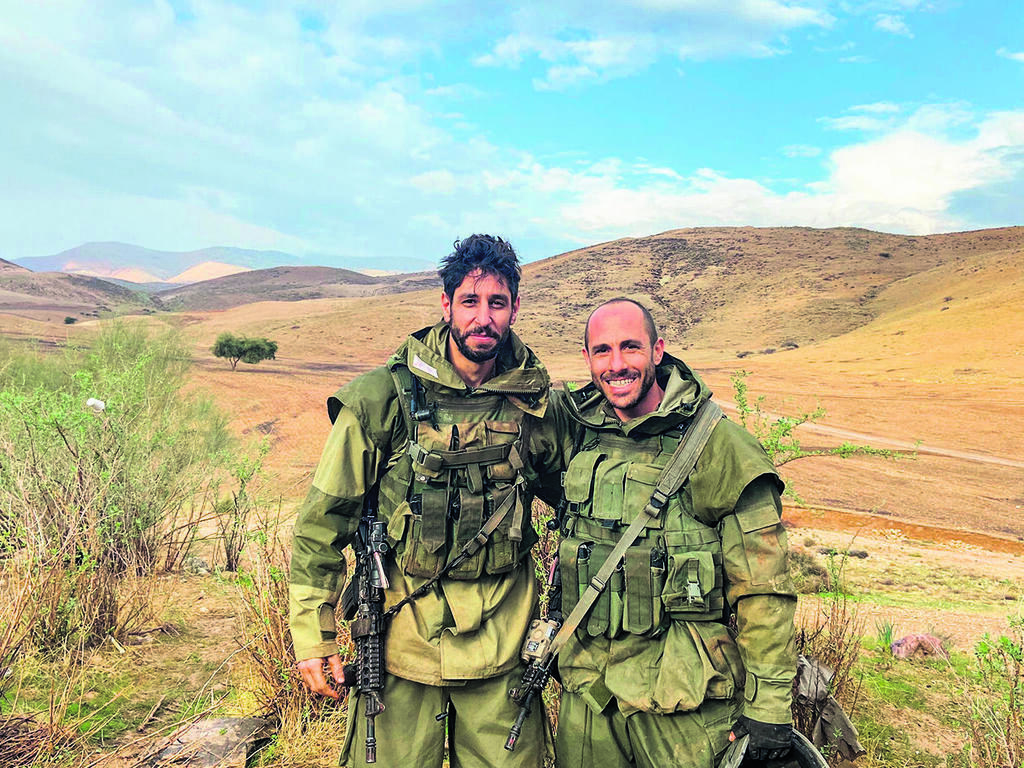
Col. Omri Rosenkrantz with Idan Amedi
(Photo: Personal album)
Rosen praises the fighters of the Carmeli Brigade, which he initially commanded at the start of the war: “It is a brigade built on reservists from Golani’s 13th Battalion and the Golani reconnaissance unit. Good DNA. Golanchiks, cohesive, loyal. People who are not just there for war. Very dedicated. I was not surprised they all showed up immediately on October 7. We organized quickly and then received the order to connect to commander of Division 91.”
For the first six months of the war, Carmeli operated on the northern border, “mainly defense but also offensive actions,” he says.
The biggest fear was that Hezbollah would join immediately.
“We all knew Hezbollah’s plans: the Radwan force, the conquest of the Galilee. The intelligence was very accessible and very worrying. Fortunately, it did not materialize. In my sector there were two infiltration attempts near Hanita (kibbutz in northern Israel) in the first weeks, but at squad level only.”
The person who accompanied Rosen in the early months in the northern arena was singer and actor Idan Amedi. “Idan and I have been close friends since civilian life,” Rosen said. “When I took command of Duvdevan I brought him into reserve duty in my command post, and when I became commander of Carmeli I brought him as well.”
“He was with us from the beginning of the war in the north. After a few months we went on a short break. Instead of resting, Idan asked to go serve in Gaza with his team from his regular engineering service. Because administratively he was under my brigade, when he was injured I received the report. I was at home. I went to Sheba Hospital and was the first to arrive. Through the Intensive Care Unit doors I tried to recognize him. It did not look good. His wife called me too: ‘Is it true? I have casualty officers at my door.’ I told her, ‘Let them in.’”
Since then Rosen has closely accompanied his recovery. “I think most of the footage in the film he made about himself is mine,” he laughs.
Gaza and expanded operations
On Passover 2024, about three months after Amedi was wounded, Rosen entered Gaza. “Just before Passover, Carmeli was assigned to Gaza. We operated under Barak Hiram’s Division 99, an excellent division. In Zeitoun, Sabra, Shuja’iyya. Two and a half months there.”
A few days after he took command, Israel launched Operation Northern Arrows against Hezbollah. Although Brigade 300 is a regional defensive formation, under Rosen it at times became a maneuvering offensive brigade crossing the border.
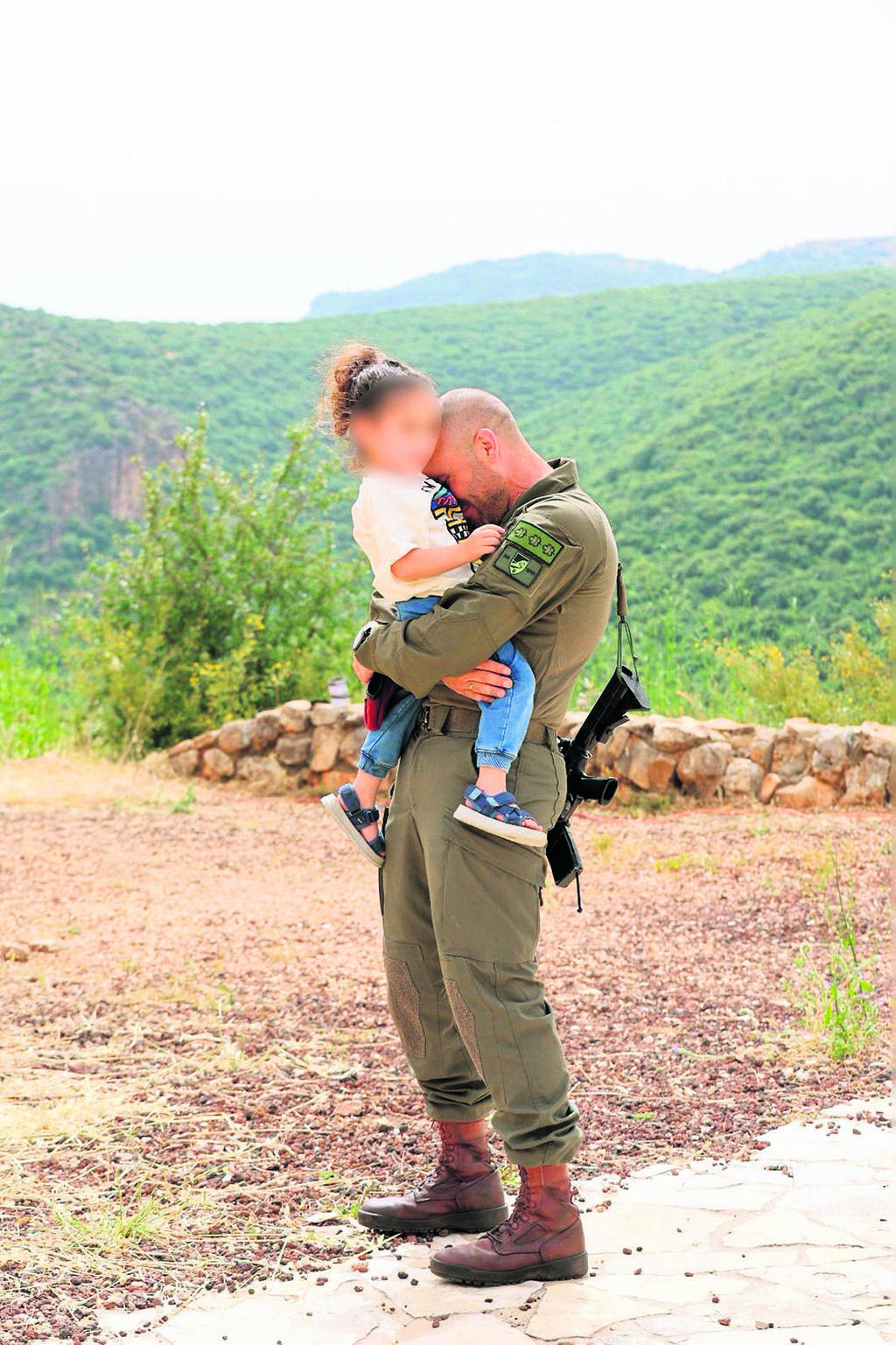
Omri Rosenkrantz with his son
(Photo: Personal album)
“If before October 7 only special units crossed the Blue Line, now there is no issue sending in a reserve battalion with tanks and artillery,” he explains. “Brigade 300 developed its offensive muscle. The guiding principle is clear: responsibility for civilians means forces in the communities, but alongside that constant offensive activity beyond the border — exposing, destroying and detonating infrastructure.”
“During the opetarion 'Northern Arrows,'” he continues, “Brigade 300 maneuvered. We destroyed a lot of infrastructure in the strip close to the border — dense thicket areas, nearby villages, underground tactical compounds. Hezbollah had a structured military system there, with equipment lists, beds, fighters’ rosters and duty schedules. It was a real immediate threat and we dealt with it well. We neutralized that offensive capability — from the dense terrain to the settlements.”
At the end of November 2024, a ceasefire agreement was reached between Israel and Lebanon.
“Today there is no Ayta al-Shaab left in that sense, all infrastructure there was dismantled,” he says. “But at the time it was still there. It is a very dangerous village, a Hezbollah stronghold directly opposite Zar’it, Shetula. I was very concerned about what was there. Ori Gordon was then Northern Command chief. I presented the plan to him and to the Chief of General Staff Herzi Halevi and they told me: ‘Go for it.’ We entered for nearly two and a half weeks and cleared Ayta of Hezbollah weapons. We took out insane quantities — trucks of weapons of all kinds, Burkan rockets, anti-tank missiles. Light weapons in such quantities that at some point we stopped being surprised.”
Drone threat
In the following months, up to Operation “Rising Lion” in June 2025, Brigade 300 continued combined defensive and offensive operations.
“We carried out a series of operations with a lot of freedom of action,” he says. “We kept advancing. When the operation started, we expected Hezbollah to join, but it did nothing. Our offensive activity continued afterward as well. We conducted physical reconnaissance inside Lebanon ahead of the operation. For example, the commander of Battalion Rotem (Battalion 435) under me had been at all the locations beforehand. We knew the routes, evacuation paths, observation points. Ninety percent of what we planned happened.”
And in “Rising Lion”, Hezbollah did join the campaign
“They want to hit civilians”
“As a defensive brigade commander, my assumption is always that terrorists want to reach communities. So once we understood Hezbollah had joined, we strengthened defense. More forces, more firepower. After that we attacked. I entered Ayta again with the forces. It is a symbol. I wanted to ensure no infrastructure was rebuilt. I saw that what remained there was minimal — barely anything in areas we had already maneuvered through and destroyed. In my view, that work is one of the biggest delays to the next escalation.”
Before the latest phase, the brigade killed 22 militants, and since then another 36.
“The eliminations were from a distance — tanks, UAVs,” he says. “Based on intelligence developed by the brigade and a strike cell we operate. It is a significant shift — not thinking only defense.”
“In one case,” he reveals, “we even carried out a sniper operation. There was an operative in Aita we could not eliminate with a drone. He kept escaping. So we operated on the ground for a few days, and when he appeared, he was shot — in daylight. ‘If someone comes to kill you, kill him first.’”
Drone warfare
“Drone warfare is a new-old threat,” he says. “We also looked at Ukraine, where it is a major weapon. Detection systems here have improved significantly, as has awareness among troops. In practice, far more drones are intercepted or fail than actually cause damage. It is a difficult target, a moving target, but there is Iron Dome, personal weapons, and every solution the IDF has. New solutions are constantly being pushed.”
“In the end, it is about proper positioning, not being exposed. Above my command post there were nets stretched out, and twice drones got stuck in them. Nets sound low-tech, but they help a lot. And constant routine disruption is critical, because they fire at known targets. My job is for them to shoot at me, not at the Cohen family in Zar’it.”
Is the threat of invasion still present?
“The situation today is much better than before the war. We are still present along the forward lines in much larger force. But it still does not allow me to sleep peacefully. It has to be maintained constantly.”
In terms of doctrine:
“In my view, a linear defense is less correct, but if the decision is to defend from the fence, then we will defend from the fence. That is not an excuse for any brigade commander.”
Lebanon experience and family
“I only encountered Hezbollah in this war as a brigade commander. I was not in Lebanon in 2000 when we withdrew, and in the Second Lebanon War I was in Duvdevan operating in the West Bank. My father fought in Lebanon in 1982. My brother served in Maglan and reserves in Brigade 551 and was in Lebanon in the Second Lebanon War.”
“Two months before October 7 we completed a major brigade exercise. I pushed hard to get approval for a full readiness drill simulating 72 hours of war in the north. It was summer, hot, people on vacation, but they showed up. Two months later we were already deployed.”
He is married and father of two — a two-year-old and a two-month-old infant.
“I have an amazing wife. After nearly three years of war I understand the real heroes are at home. It is harder to raise children than to command a brigade. The operational load is huge. There is no routine, no planning. The home lives in uncertainty.”
Closing reflection
During the war, Rosen says he lost 32 friends, subordinates and comrades.
Among them was Major Ben Bronstein, killed on October 7.
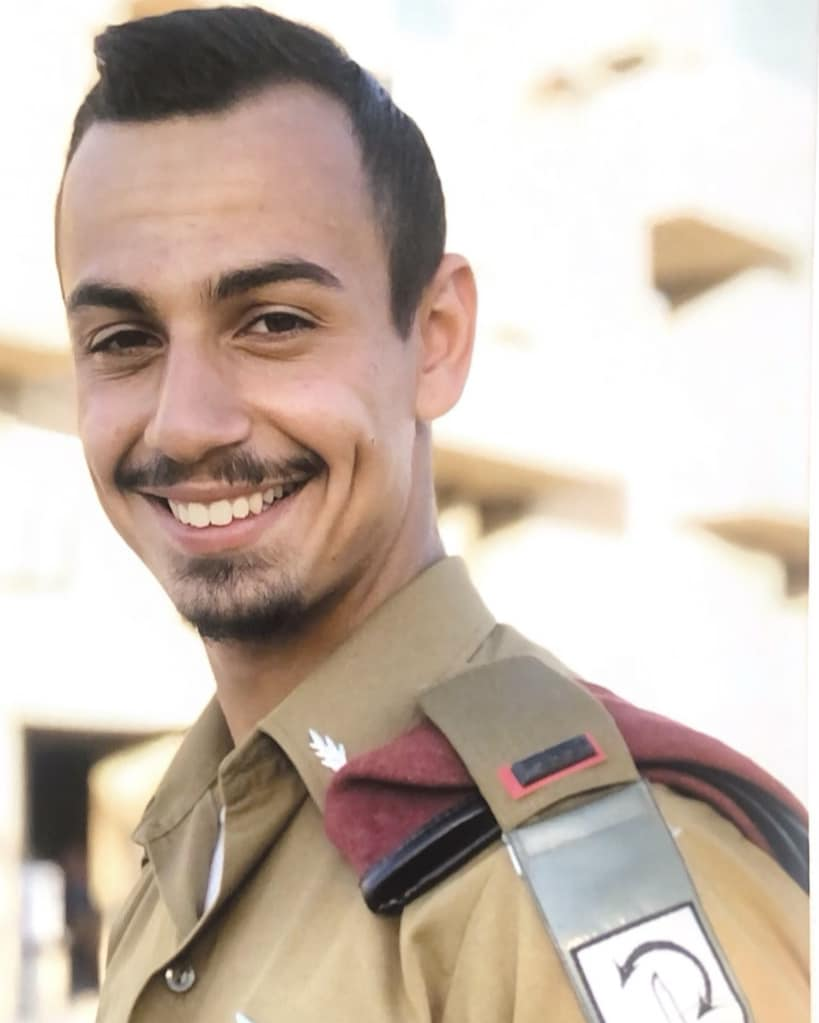
Major Ben Bronstein
(Photo: Courtesy of the family)
“I quoted him in my farewell speech,” Rosen says. “‘To allow a nation to live normally, a few must live abnormally.’”
“We named our son Nadav-Ben after him,” he adds quietly.