

At a Tarbutah forum of the integrated track at Atid Cramim High School in Binyamina, which focused on current social issues, a heated and emotionally charged debate erupted among parents from across the ideological spectrum — religious and secular, supporters and opponents of the judicial overhaul.
These are parents who chose an integrated educational framework out of belief in pluralism, mutual respect and the ability to live together despite differences. Yet during those tense days, they struggled to show tolerance toward one another. As Israeli society as a whole was shaken, the very idea on which integrated education in Binyamina was founded more than a decade ago was put to the test: religious individuals have their identity, secular individuals have theirs, and no one is required to give up who they are in order to live alongside the other.
Gallery
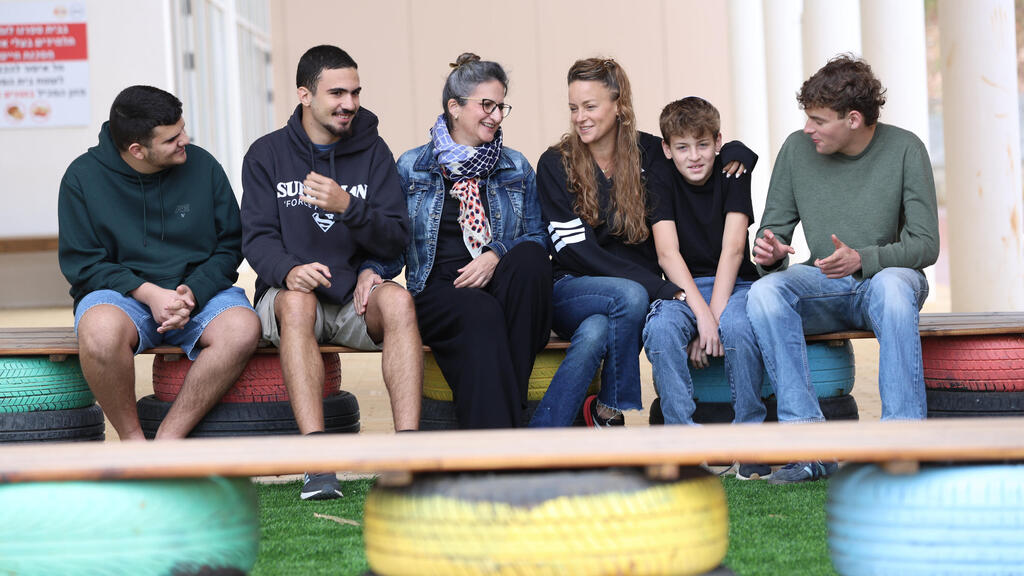
Michal Werdiger and Hila Sirkis with their children who attend the school
(Photo: Elad Gershgorn)
The tension ran deep. Close friendships frayed, personal ties cracked, and the educational staff realized that things could not continue as usual. Instead of meetings on current affairs, they shifted to neutral enrichment sessions — without politics or clear points of contention. Surprisingly, the tension among adults barely spilled over to the students, some of whom hold equally strong views as their parents, yet managed to navigate the complexity, maintain respectful dialogue and get through the turbulent period.
“Like in a family where there are different opinions, and sometimes you say it’s too difficult to talk right now to avoid an explosion — that’s what happened to us,” said Michal Verdiger, one of the leaders of the parent group that founded integrated education in Binyamina. “Suddenly, after years of feeling we saw things the same way, the gaps surfaced. It was a very sensitive time, but it was clear to all of us that we wouldn’t give up. And indeed, we didn’t.”
Bringing the message home
As part of efforts to confront polarization in Israeli society, groups of parents are gradually organizing to raise a different generation — one that will encounter the full spectrum of Israeli society starting in kindergarten and school.
"These are pioneering, trailblazing parents. They took a risk, and that should be appreciated. Often, it’s the children who bring the message home. They develop the capacity for inclusion when they meet those who are different from them, learn to live with complexity, and are not afraid of it,” said Nicole Chen, founder and coordinator of the integrated track at Atid Cramim High School, part of the Atid education network, which opened about five years ago for grades 7 through 12.
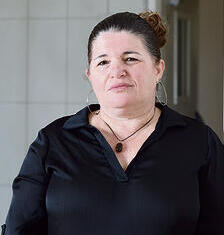
Nicole Chen, founder and coordinator of the integrated track at Atid Cramim High School
(Photo: Elad Gershgorn)
“There are religious parents who would never send their children to a secular system, and others who are troubled by social divisions and want their child to have both a religious identity and a genuine encounter with secular students. There are also secular parents who say: we’re tired of the dichotomy — we want an education that engages with tradition and Israeli culture," according to Chen.
There are also those who cannot accept the idea. Chen recalled meeting a religious father who came to enroll his son in the program. “I introduced myself and said: ‘My name is Nicole, and I live with my partner, Abigail.’ He was very polite, but at the end of the meeting he said his son would not join the program. I asked what happened, and he said: ‘There’s no way in the world my son will be educated by a lesbian woman.’”
Establishing integrated frameworks often faces opposition from local authorities, communities and parents on both sides who fear harm to their children’s identity, and Binyamina was no exception. It began with an integrated kindergarten, followed by the Bereshit elementary school, and later the integrated track at Atid Cramim for middle and high school students in Binyamina-Givat Ada.
Each stage was accompanied by struggles that threatened the fabric of life in a community where residents meet across overlapping social, cultural and educational circles. Before the integrated track was established, graduates of Bereshit would split — religious students to yeshiva high schools and ulpanot, and secular students to the local secular high school. Today, they make up about half of the integrated track’s students.
According to Education Ministry data, 3,946 students in grades 1 through 9 were enrolled in integrated education in 2013. A decade later, that number rose to 13,818, and in 2026 it stands at 15,672. The Jerusalem District leads with 7,923 students, followed by the Central District with 3,500.
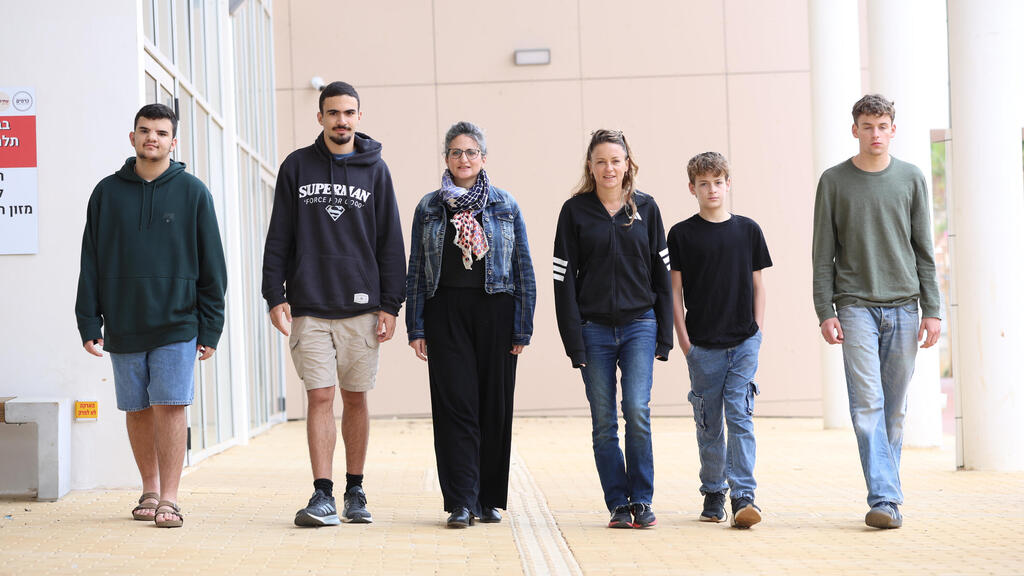
The Verdiger and Sirkis children have been attending school through the integrated track since kindergarten
(Photo: Elad Gershgorn)
The Atid Cramim track began with just 28 students and now has 186. Demand exceeds supply, with 70 to 90 applicants each year competing for 35 spots.
“The program aims to overcome the dichotomy between state and state-religious education,” Chen said. “We told the students: you don’t have to split up. You can stay together through the end of high school.”
Both religious and lesbian
Nicole Chen was born into a Chabad family in Kiryat Malachi and married at 20 in an arranged match. For years, she lived with an identity crisis.
“I was a very good wife,” she said. “I did what was expected — went to the mikveh, had children according to Jewish law — and inside me there was a big hidden story: being a lesbian alongside my religious identity. I had a constant internal dialogue. Why is this the way it is? What would happen if I desecrated Shabbat? Why do I fast? After 10 years we divorced, with four children, the youngest just nine months old.”
After the divorce, she was fired from her job as a teacher in a Chabad school. “I was told that a divorced woman cannot educate and serve as a role model for students. One day I was an educational model, and the next day I wasn’t. I felt like I couldn’t breathe.”
She later came out and believed her connection to the religious world was over. “I thought you couldn’t be both religious and lesbian. When I married Abigail, I decided to disconnect from the religious world, but my religious identity didn’t leave me. By nature, I am a religious person. I want to study, to pray. I told myself: who says there’s no place for me? I won’t be accepted in the most extreme circles, but there are worlds where I will be. And in the integrated track, I found such a place.”
Her personal experience, she said, illustrates what parents and students find in integrated education and why she believes so strongly in its ability to hold complex identities.
“Don’t get the impression that everything runs smoothly and we have no challenges,” she said. “You put religious and secular parents and children together and there are no conflicts? We have plenty — but we deal with them differently from broader society.”
Learning to live together
That complexity is also reflected in the daily routine. The day begins with religious students attending morning prayers with a religious teacher, while secular students attend a cultural session with a secular teacher, covering topics such as current events, mindfulness, yoga or writing workshops.
“We don’t blur identities,” Chen stressed. “We don’t say the secular student should become a bit traditional or the religious student a bit secular. On the contrary — first we strengthen the identity from home, and only then say: now you are together.”
Most classes are shared, except for Talmud studies for religious students. Even here, boundaries are flexible: secular students have requested a joint Talmud lesson. “They told us: Talmud isn’t just for religious people,” Chen said.
In Bible classes for grades 7 and 8, both a religious and a secular teacher lead the lesson, presenting both a faith-based perspective and a critical one. “You can talk about King David, for example, and one will present him as righteous and the other as someone who sinned. Students are exposed to both voices. It doesn’t confuse them. Each brings their own world and takes what they want.”
But the real test, she said, is outside the classroom — for example, during shared Shabbat experiences. Before each such weekend, students describe their home life. Religious students speak about synagogue, no phone use and family gatherings before Shabbat; secular students talk about the beach, outings and travel.
From these differences, a “Shabbat contract” is created — a practical agreement that allows everyone to live together respectfully.
And what do you do when you want to go to the beach on Friday evening? There are secular students who ride bicycles and are joined on foot by religious friends. Another group found that it is possible to join with a skateboard. Sometimes another creative solution is found, when the idea is not uniformity, but mutual adaptation.
Purim celebrations also require special attention: While in state schools a costume party is customary, and in religious education the celebrations have a religious orientation, in the combined track secular students are offered a party with a DJ, and religious students are offered an alternative in the framework of a beit midrash with ethical activities, refreshments and music. "It's like digging a tunnel with a spoon," describes Chen. "We will not change society in Israel in one day. But these children will go into the world with the ability to live in diversity.
Arguing to understand each other
Politics, of course, does not stay outside. Settlements, hilltop youth, tefillin stands, pro- and anti-Netanyahu sentiments, and changes to the judicial system all are very present among the students. “Our children do not live in a vacuum,” says Chen. “But when it happens here, they have tools to cope.” Still, those tools were not always enough. During the mass protests against the judicial overhaul, even the parents who founded the program found themselves helpless. “People who had worked together for years stopped speaking. There was a lot of anger. Religious and secular families who had been close drifted apart.” At that point, they were forced to do the opposite of what they usually advocate and step back from the conflict, because “the emotional strain on both parents and children was too much to bear.”
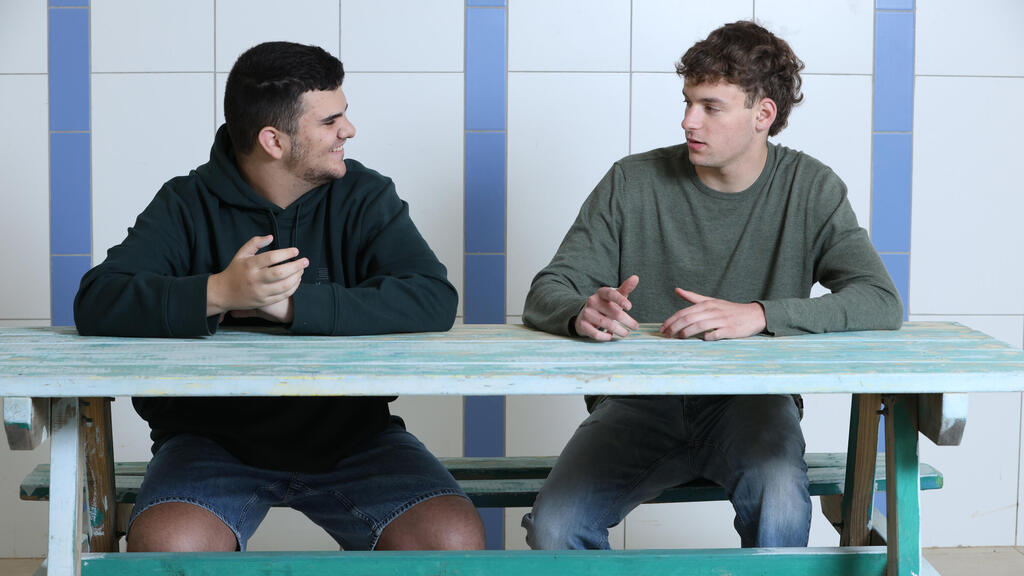
'Know the person and then the opinions': Avshalom Verdiger and Alon Sirk
(Photo: Elad Gershgorn)
By contrast, on the issue of the hostages, the school chose not to avoid the topic. It held an evening for parents and students, attended by Iris Haim, whose son Yotam was abducted and killed in Gaza, and members of the family of Inbar Hayman, who was murdered at the Nova music festival. There were questions and disagreements, but also a clear line: not to erase disagreement, but to recognize that people think differently.
“The most important thing, in my view,” says Chen, “is the muscle that allows you to cope. I’m proud that our students practice this as a routine.” She adds that the teaching staff itself is a microcosm of Israeli society: “There is a rabbi who serves as a spiritual guide, very religious teachers, a kibbutznik teacher, and others who believe in separating religion and state. We meet, we argue, and we practice that same muscle ourselves.”
Avshalom Verdiger, a 12th-grade religious student, grew up in integrated education since kindergarten. “If people get to know the person first and only then their opinions, things would be better here. When you don’t know someone, you develop prejudices, and each side is sure the gaps are huge. With us, it’s different. Most of my friends are secular. It’s not always simple, but we know how to live together and enjoy it,” he said.
On Friday evenings, for example, “they listen to music, and I won’t ask them to turn it down or switch off their phones so as not to make them uncomfortable. On the other hand, I appreciate it when they respect me. If they want to go out after Shabbat begins, they’ll come invite me in person because they know I don’t use the phone.”
Dietary laws can also create delicate situations. “When a secular friend’s mother bakes a separate cake just for me, it’s uncomfortable because they went out of their way. But we all understand the reasoning. In my home, they won’t mix meat and dairy, and I respect the rules in their homes. No one is trying to change the other.”
The same applies, he says, to politics. “There are many arguments. I’m right-wing, and I have friends on the left with more or less extreme views. But when we argue, we’re not trying to win. We’re trying to understand each other and learn. It would have been easier for me to be only in Bnei Akiva (a religious Zionist youth movement) or only in a yeshiva, but if you want to bridge gaps, you need to seek out those who think differently from you.”
His mother, Michal Verdiger, was part of the founding group of 12 families that established the integrated kindergarten in Binyamina. She grew up in the state religious school system and assumed her children would as well. A chance encounter at an event organized by Tzav Pius, an Israeli organization promoting dialogue between religious and secular Jews, changed her life.
“We left with a sense of revelation,” she recalls. “We asked ourselves how we had become accustomed to separating children from the age of three based on belief and worldview.” Motivated, the parents succeeded in enlisting the local council, but when they began establishing the integrated track at Atid Cramim High School, they faced opposition from within the community, both religious and secular.
“I was ostracized for two years. People talked behind my back in synagogue,” Verdiger says. “The fear wasn’t about the initiative itself, but about splitting the community and weakening the existing religious school. Some people still don’t speak to me. In the early years, we went through difficult social challenges. Among the secular public, there were those who feared religious coercion, saying, ‘Today they ask for a class, tomorrow they’ll build a synagogue in the school.’ What gives me hope is that no one in Binyamina can claim there has been religious coercion or harm to the state religious system.”
According to her, “elementary school is like a warm, nurturing greenhouse, but in middle and high school things are more complex. We learned along the way, in a reality that has also become more complex. It’s not that there are no conflicts and everyone lives in harmony. Integrated education is not a one-and-done solution. It deals with your identity without canceling the identity of the other. What matters is not uniformity but seeking out difference, holding tension and recognizing multiple identities. Integrated education is also a security need. Our enemies can tell when we are not connected, and that was one of the factors behind October 7.”
A language of shared living
Where adults sometimes break under the weight of division, it seems that at least some of the children are already learning a different language — not one of full agreement, but of shared life.
Hila Sirkis, a secular member of the founding group of integrated education in Binyamina, has children Alon (9th grade) and Dror (11th grade), who started in the integrated kindergarten and now study in the high school track. She says the kindergarten, which later expanded into an elementary school, was founded by parents seeking a more meaningful educational framework.
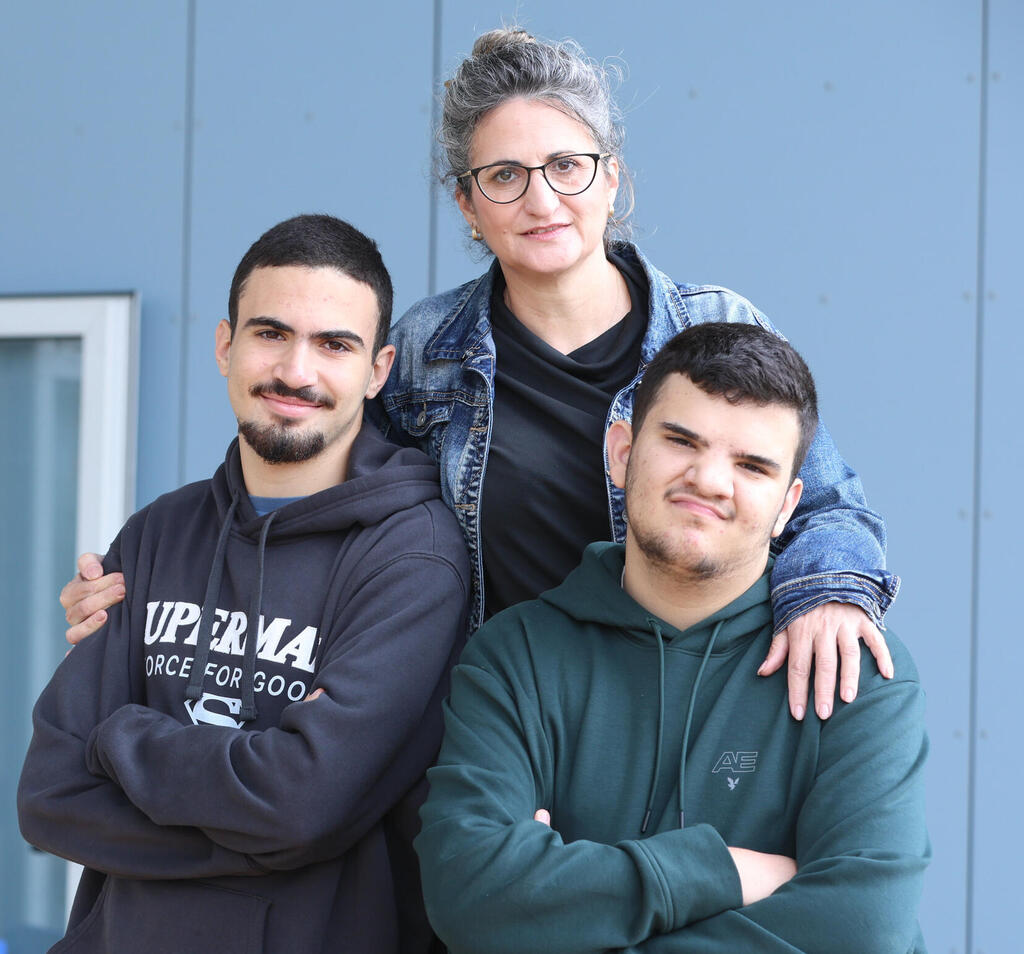
'To see the other': Hila Sirkis and her children Alon and Dror
(Photo: Elad Gershgorn)
“The process was accompanied by many conflicts and questions,” she says. “Would there be prayer? What would holidays look like? What food is allowed? How do you host religious friends? Should the teacher be religious or secular? There was a clear principle that everyone maintains their identity, and no one is pushed to change sides.”
“It’s important to me that my children grow up in a heterogeneous environment, that they learn there are others, and that not everyone is like them. In integrated education, children are exposed to Israeli-Jewish culture in a non-coercive way, with universal values of respect and connection. I’m very secular, but I love Jewish culture and am not intimidated by religious people. When political discussions arise, they don’t unsettle me. Sometimes I hear things from religious friends or colleagues that could drive me crazy, but I remain calm because I can see the other person and understand that they think differently — and that’s okay.”
Her son Alon says the program exposed him to aspects of the religious world he likely would not have encountered otherwise, and that as a secular child he probably would not have formed friendships with religious peers in another framework. “My parents chose an integrated kindergarten for me, and moving to the integrated track in middle school was a natural continuation,” he says. “To reduce polarization in society, integrated education should be introduced to as many schools as possible. When you grow up learning to respect others and experience daily life together in different situations, it’s not as difficult as it might seem. Everyone has their own opinion, which may be the opposite of mine, and I respect and understand it even if I don’t accept it.”
He adds that mutual consideration, compromise and respect are a way of life for the students, and they do not need teachers to enforce the program’s values. “We’re mature enough to understand, for example, that on shared Shabbat weekends you don’t need to bring a phone — no one has to tell us. We understand we need to respect religious students, and they respect those who want to use their phones outside of the group setting.”
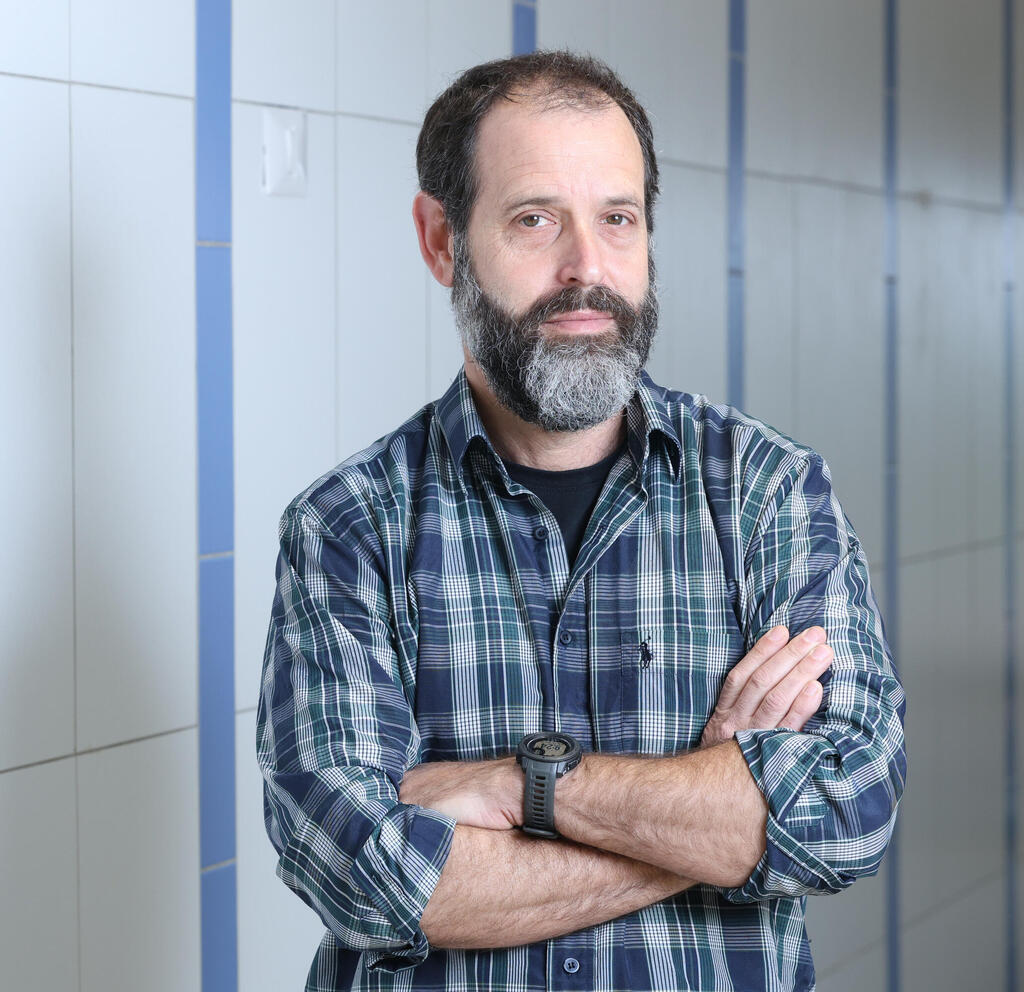
'We must know how to live together': Daniel Hertz, a secular teacher of geography and Israeli culture
(Photo: Elad Gershgorn)
Daniel Hertz, a secular teacher of geography and Israeli culture and a 9th-grade coordinator, says integrated education reflects Israel’s heterogeneous society. “One of the most significant systems, especially for children, is formal education, so it makes sense that this is where we learn to be together, each with their own identity,” he explains. “We must know how to live together while also giving each person their space. That’s why it makes sense to create integrated classes with diverse students — just as each person differs in character and appearance, so too in religious identity.”
He says most challenges stem from the fact that integrated classes are not the default and are still relatively uncommon. “We’re used to the separation between secular and state religious schools, so when people come from outside and see this coexistence, it seems strange because they are accustomed to segregation.”
Another challenge is that the integrated track operates within a secular school, requiring sensitivity to the needs of religious students — “and that is precisely our opportunity as educators to create a meaningful shared space for everyone.”
Yossi Mamo, CEO of the Atid education network, said the network operates on the understanding that education is not only about acquiring knowledge, but also about preparing for shared life in Israeli society. “Our students do not first encounter ‘the other’ in the army or later in life, but already at a young age,” he said. “This allows them to develop the ability to connect, collaborate, and build relationships with people different from them geographically, culturally, and religiously — a skill that is essential for adult life and for a stronger Israeli society.”