

The great Jewish mistake—then and now—is believing that peace ends hatred. We believed it in 1918, when Europe promised there would be no more wars. We believed it again in 1945, when the world said never again. And we believe it still—after October 7, after Gaza, after Tehran’s proxies turned the world into a battlefield once more. But antisemitism is not a reaction to war. It is the disease that causes it.
From the Second Intifada to the atrocities of October 7 and the war that has followed—with new fronts opening by the week—the 21st century has been one long warning unheeded: a continuum of hatred, violence, and denial directed at Jews everywhere.

In Amsterdam, after the Ajax–Maccabi Tel Aviv match, Israeli fans were ambushed and beaten across the city. In Sydney and Melbourne, synagogues were torched—worshippers fleeing through smoke—as investigators traced the arsons to Iran-linked networks. In Washington, D.C., Sarah Milgrim and Yaron Lischinsky were shot dead outside a restaurant for being Jewish; in Manchester, two worshippers were murdered on Yom Kippur. These are not random acts—they mark a new global baseline of antisemitism.
Between 1920 and 1939, European Jews made the same fatal mistake. They believed their success and civility made them safe from the old hatreds. They built culture, not defense. And by the time they realized Jew-hatred had evolved—not vanished—it was already too late.
Now, a new form of assimilation has taken hold. This time, it is not Jews trying to prove they belong in Paris or Berlin, but Jews in New York and Los Angeles trying to prove they are not like the Jews of Israel. The language changed—from “we are loyal citizens” to “we oppose the occupation”—but the instinct is the same. When Jews say Israel is the reason they are hated, they echo their great-grandparents’ delusion—that if only we were different, they would stop hating us. But they never stop. They only change the excuse.
Some argue that antisemitism increases when Israel acts, claiming that the sight of Jewish power provokes hatred. But that confuses cause with reason. Hatred that flares at the sight of Jewish self-defense isn’t outrage—it’s exposure. When Jews were stateless victims, the world pitied us; now, when we defend ourselves, the world resents us. The hatred isn’t new—it just has a new trigger. Others say “criticism of Israel isn’t antisemitism.” Of course not. But every antisemite today claims to be a critic of Israel. When criticism turns into delegitimization—when the right of Jews to self-determination is questioned—that line has already been crossed.

Pro-Palestinian rally in Ireland
(Photo: Artur Widak/GettyImages)
I write this not from New York or Los Angeles, but from Israel—the same Israel that many Western Jews now claim is the source of their discomfort. From here, the irony is unbearable: the Jewish homeland, created to protect Jews from persecution, is now cited as its cause. It is as if safety itself has become offensive.
But the truth is simple: Israel does not create antisemitism; it reveals it. Some say antisemitism only seems worse because social media amplifies it, but amplification isn’t invention—it only gave every coward a megaphone. And though people insist it’s not the 1930s, history doesn’t repeat in costume; it rhymes in atmosphere—in the silences, the excuses and the normalization of fear.
Today, the pattern repeats. From Berlin to Brooklyn, Sydney to San Francisco, Jewish stores are boycotted, schools vandalized, synagogues threatened. Professors are hounded, students hide their Magen Davids and cowardice now speaks every language. We are told to wait for the world to come to its senses, to trust “the good people,” to believe that once the headlines move on, it will quiet down. The Jews of the 1930s were told the same. They waited for a reason. What came was Auschwitz.
We are living in the interwar years of our own century. The Second Intifada was our 1920. October 7 was our Kristallnacht. And the war with Iran—unfolding in shadow, cyber and proxy—is the escalation history demands when hatred is left unchecked. If the Jewish people are to survive this century, they must abandon naïveté. The lesson is not “never again” but “never unprepared.” Because antisemitism does not disappear when the war ends—it festers in the peace that follows. Peace, for the Jew, has never meant safety. It has meant the quiet before the next betrayal.
The age of naïveté must end
Only Jewish power—moral, cultural, linguistic and physical—preserves Jewish life through Hebraization: reclaiming our language, strength and sovereignty. It means raising children who know courage as fluently as compassion and training our youth not to debate antisemites but to outlive them.
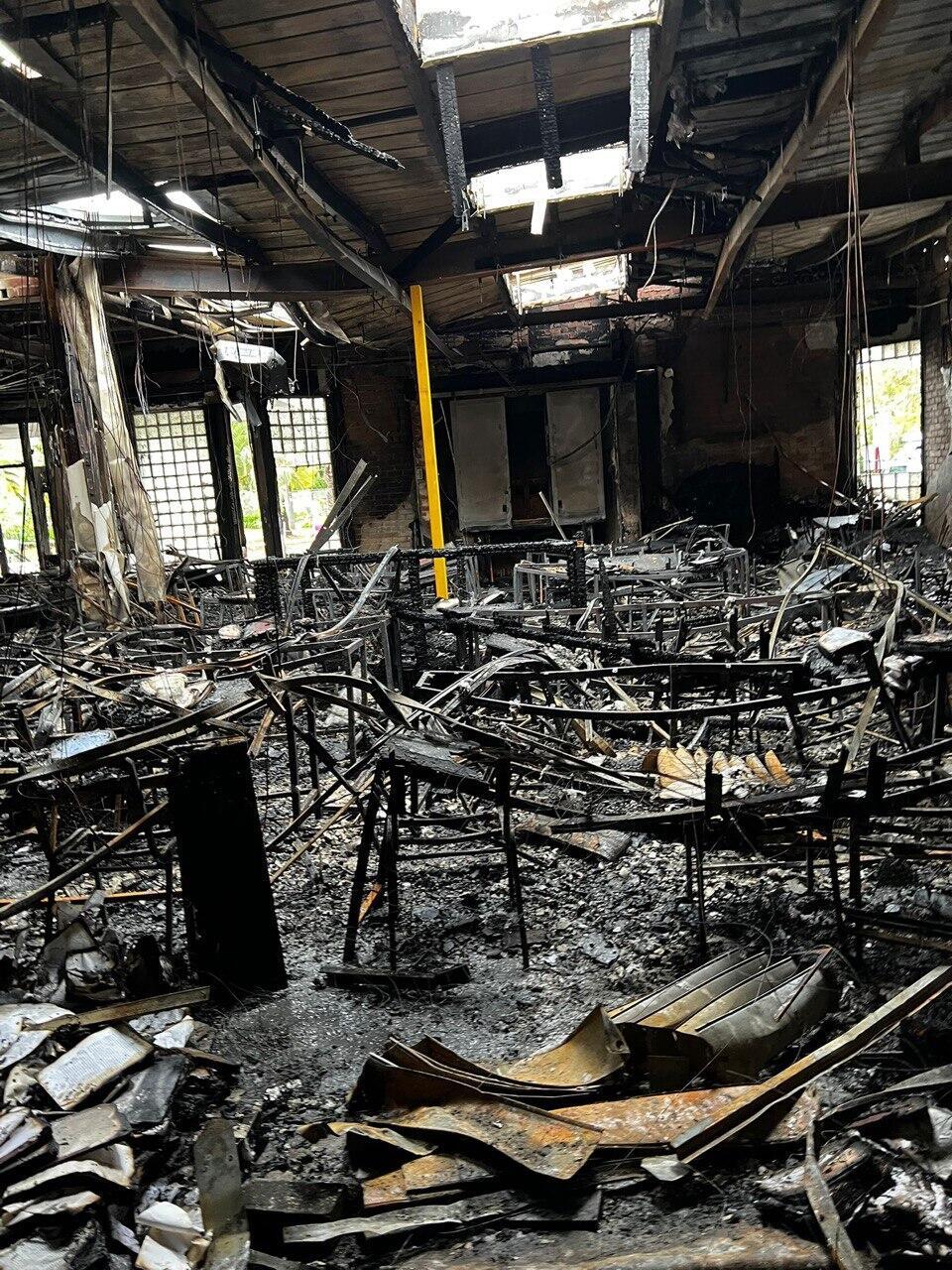
Melbourne synagogue torched in antisemitic attack
(Photo: Adass Israel Congregation)
The slogans of the 1990s—coexistence, peace, dialogue—belonged to a generation that mistook comfort for safety. October 7 shattered that illusion. The war will end, yes. But the hatred—ancient, adaptive and eternal—will remain. The question is whether we will be ready for what comes next. “Never Again” is not a slogan but a system of language, self-defense and unity. Built in Israel, replicated wherever Jews live, it declares that the Jew will no longer be the soft underbelly of civilization but its backbone. Just because the war ends doesn’t mean antisemitism will disappear. It only means the Jews who still believe in peace must finally learn how to fight for it.
Our ancestors built monuments of memory, but remembrance without mastery is paralysis. “Never Again” was not to weep—it was to win. To master memory means turning trauma into strength, exile into sovereignty and fear into readiness. The child of Auschwitz must give birth to the soldier of Sderot, the mourner of exile to the guardian of destiny. That is what Hebraization means: the rebirth of the Jewish mind, body and tongue. It is not merely speaking Hebrew—it is thinking like a people who own their fate. It teaches our children not what was done to us, but what we must now do.
In the 20th century, we built Israel. In the 21st century, we must create the Israelis of the world—Hebrew-speaking, self-defending Jews from Los Angeles to London, from Toronto to Paris, from Melbourne to Johannesburg. Because sovereignty is not a place—it’s a stance. And the stance of the modern Jew should no longer be bowed in apology, but upright in conviction. Wars may end, but hatred will persist. The difference will be what kind of Jew the subsequent war encounters: the naïve Jew who waits, or the Hebraized Jew who prepares.
The Jew who lights Shabbat candles and trains in Krav Maga. The Jew who studies Torah and builds strength for when peace fails. Because history has shown us: the world does not protect Jews. Jews protect Jews. So remember—but master. Mourn—but mobilize. And above all, never again—and mean it.
- Adam Scott Bellos is the Founder and CEO of The Israel Innovation Fund (TIIF) and creator of Wine on the Vine, Project Maccabee, and The Herzl AI Project. His upcoming book is titled Never Again Is Not Enough: Why Hebraization Is the Only Way to Save the Diaspora. He lives in Tel Aviv.