


Nothing that has happened here in recent weeks—especially the release of the hostages and the ceasefire—would have occurred without American pressure. Not exactly pressure. A dictate. Coercion. Two people, White House envoys Brett McGurk and Amos Hochstein, attended the cabinet meeting to ensure there would be no surprises. The fact that this is exactly what most Israelis wanted does not change the reality that these decisions were not made in Jerusalem. They were made in Washington.
- The disarmament of Hamas.
- The return of all hostages—both the living and the deceased. “We are not giving up on anyone.”
- Demilitarization of Gaza—not only disarming Hamas, but also ensuring no weapons are manufactured or smuggled into the Strip.
- Israeli security control over Gaza, including the security perimeter.
- An alternative civil administration that is neither Hamas nor the Palestinian Authority—people who will not raise their children to be terrorists, will not fund terrorism, and will not dispatch terrorists.
“These five principles will guarantee Israel’s security. That is the meaning of ‘victory.’” That’s a direct quote from the official statement. Netanyahu repeated these conditions numerous times in media appearances.
Gallery
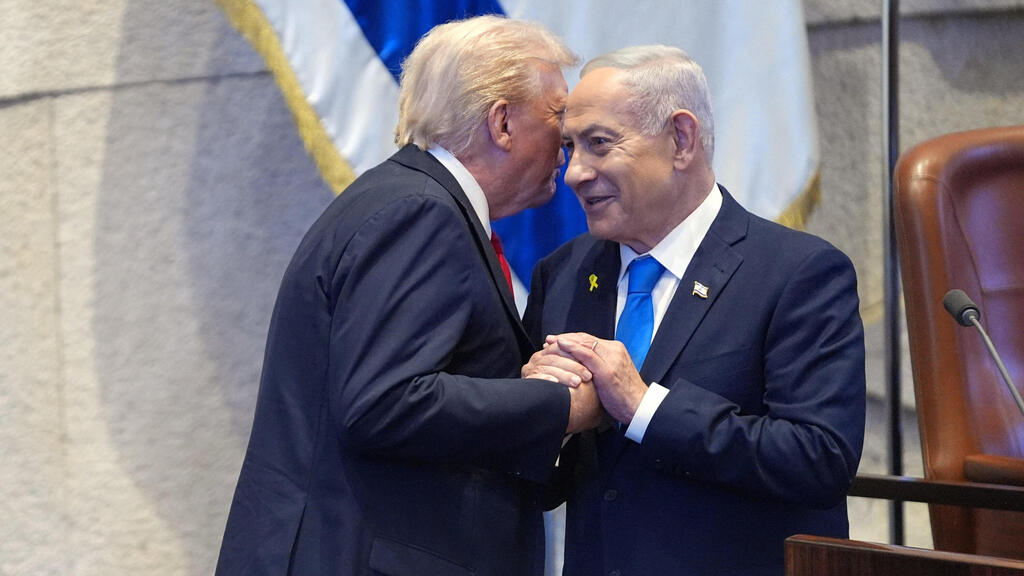
Prime Minister Benjamin Netanyahu and US President meet in the Knesset
(Photo: Jalaa Marey /Pool via Reuters )
Netanyahu did not intend to make a mockery of himself and renege on his own conditions within just a few weeks. But that is exactly what happened.
The first condition, disarming Hamas, has not occurred and it remains to be seen if it ever will.
The second was partially met—most of the living hostages have returned, though not all the deceased.
The third, demilitarization of Gaza, like the first, is highly doubtful.
The fourth, Israeli security control in Gaza, is explicitly not included in the agreement.
So why are most Israelis celebrating? Because Netanyahu’s stated conditions would have prolonged the war for many more months—and even then, it’s likely that the goals would not have been achieved, and most or all hostages would have been killed, along with hundreds more soldiers.

Near Deir al-Balah Gaza Red Cross vehicles wait to travel to Kissufim to receive Palestinian bodies being returned in the ceasefire deal
(Photo: Bashar Taleb / AFP)
But given Netanyahu’s strategy since October 7, there is concern he meant every word. A war with no end.
So why did Netanyahu agree to everything he opposed? Why did he sign an agreement that includes, in Clause 19, recognition of the Palestinians’ right to self-determination and statehood? Because contrary to all the delusional statements, the American administration did not give Netanyahu a “free hand” to do as he pleased. On the contrary. They stopped him. They imposed their will. They turned Israel into a banana republic.

IDF forces withdraw from Gaza Strip ahead of ceasefire
Just the other day, McGurk and Hochstein said in a "60 Minutes" interview that, after the Doha incident, they felt betrayed and that “the Israelis are somewhat losing control of their actions.” It’s not “the Israelis.” It’s Netanyahu. And they took the control back.
This is good in the short term, because the American coercion aligns with what most or all of Israel’s security leadership demanded—and with the will of the majority of Israelis. But the one responsible for advancing Israel’s interests should not be the U.S. government. It should be the government of Israel. Not through coercion, but through strategic vision. Through understanding.
The imposed arrangement has elevated the status of two countries—Qatar and Turkey. They, along with the U.S., share endless economic and security interests. But they remain Muslim Brotherhood–aligned states. Qatar still pours massive funds into demonizing Israel on U.S. campuses and into PR efforts, with reach even into the Prime Minister’s Office.

Qatari Emir Tamim Al Thani
(Photo: Nathan Howard/Pool Photo via AP)
So the future is unclear. It’s entirely possible that this sets a precedent where the U.S. may force Israel into actions that go against its national interests. And unlike what happened in recent weeks, next time, the majority of the public might also oppose the imposed decision.
The problem isn’t that allied states, especially the U.S., exert pressure— that’s an inherent part of international relations. The problem is that Netanyahu created a dangerous precedent—a complete contradiction between his stated conditions for ending the war and what actually happened. A precedent of coercion met with full compliance. A precedent that has turned Israel into a banana republic.
This happened because Netanyahu failed to independently do what was right for Israel. Political interests trampled national interests. Trump showed up with a lifeline. But the problem remains: he who turns Israel into a banana republic when it serves its interests has created a precedent that may drag us into more “banana republic” moments— even when it harms Israel.