

Israel’s Foreign Ministry has launched one of its most ambitious public diplomacy campaigns in the United States since the war in Gaza began, according to newly filed documents with the U.S. Department of Justice. The documents, submitted under the Foreign Agents Registration Act (FARA), reveal that Israel has contracted the U.S.-based firm Clock Tower as part of a wide-reaching effort to influence online discourse, including generative artificial intelligence systems such as ChatGPT.
The campaign, coordinated through the Government Advertising Bureau and implemented by Havas Media Network, focuses heavily on digital platforms. The ministry’s goal is for at least 80% of the content produced to be tailored to Generation Z audiences across TikTok, Instagram, YouTube and podcasts. The exposure target set in the contract is unusually high for social media campaigns: 50 million monthly impressions.
The project comes amid declining support for Israel among young Americans. A Gallup poll published in July found that only 9% of Americans aged 18 to 34 support Israel’s military operations in Gaza. Another survey commissioned by Israel’s Foreign Ministry, while somewhat more favorable, found that 47% of Americans believe Israel is committing genocide.
The most controversial and technologically novel part of the plan is Clock Tower’s initiative to influence how artificial intelligence systems respond to queries about Israel and related topics. The filings describe an effort to build “websites and content to provide GPT framing results in GPT conversations.” In effect, the company aims to create online materials that could shape the data used to train large language models like ChatGPT, X’s Grok and Google’s Gemini, potentially affecting how they present or frame issues involving Israel.
Experts say the approach, sometimes called “GEO” — short for “Generative Engine Optimization” — mirrors the principles of search engine optimization but for AI systems. “Just like SEO maps which websites shape search results, GEO maps which sources influence AI responses,” said Gadi Evron, CEO and co-founder of the Israeli cybersecurity firm Nostick, which specializes in artificial intelligence. “It’s a new field, and some call it GEO for GenAI, but the terminology is still developing.”
At the center of Israel’s partnership stands Brad Parscale, former campaign manager for Donald Trump, who also hired the now-defunct data firm Cambridge Analytica during the 2016 U.S. presidential race. Parscale heads Clock Tower and currently serves as chief strategy officer of Salem Media Group, a Christian conservative broadcasting network that owns radio stations across the United States. In April, the network announced that Donald Trump Jr. and Lara Trump had become significant shareholders.
According to the FARA filings, Clock Tower was hired to “conduct a nationwide campaign in the United States to combat antisemitism.” The Foreign Ministry’s contact person listed in the filings is Eran Shiovitz, the ministry’s chief of staff for strategic communication. Shiovitz leads a broader initiative called Project 545, named after a government decision to allocate 545 million shekels ($145 million) to Israeli public diplomacy in 2025.

Part of the solution? ChatGPT
(Photo: Meir Chaimowitz/ Shutterstock)
The campaign follows the ministry’s decision to end a $600,000 contract with the American public relations firm SKDKnickerbocker, which is associated with the Democratic Party. SKDK had reportedly managed a “bot farm” project promoting pro-Israel narratives online, including stories related to the Bibas family, whose relatives were kidnapped in Gaza. The firm declined to explain publicly why the contract ended, saying only that “the work has concluded.” American media outlets later reported that the deal was terminated after it was exposed and drew public criticism over the use of a family tragedy for paid advocacy.
In addition to the Clock Tower campaign, the Foreign Ministry and the Prime Minister’s Office are expanding outreach through social media influencers. A new initiative called Project Esther is designed to support a network of U.S.-based influencers who promote pro-Israel content, funded by the Israeli government. The project was developed quietly, but its budget and the involvement of top Israeli officials underline its significance as a parallel digital front alongside Israel’s military and diplomatic efforts.
According to the filings, Bridges Partners LLC, a Delaware company founded in June by Israeli strategists Uri Steinberg and Yair Levy, was also contracted for the campaign. The agreements allow payments of up to $900,000, with a potential monthly budget reaching $250,000. The plan includes a detailed schedule: recruiting five or six influencers in the initial phase, each required to publish 25 to 30 posts per month on TikTok, Instagram and other platforms. Later phases are expected to expand the network, including collaborations with Israeli content creators and American agencies. Influencers are expected to earn between tens and hundreds of thousands of dollars for their participation.
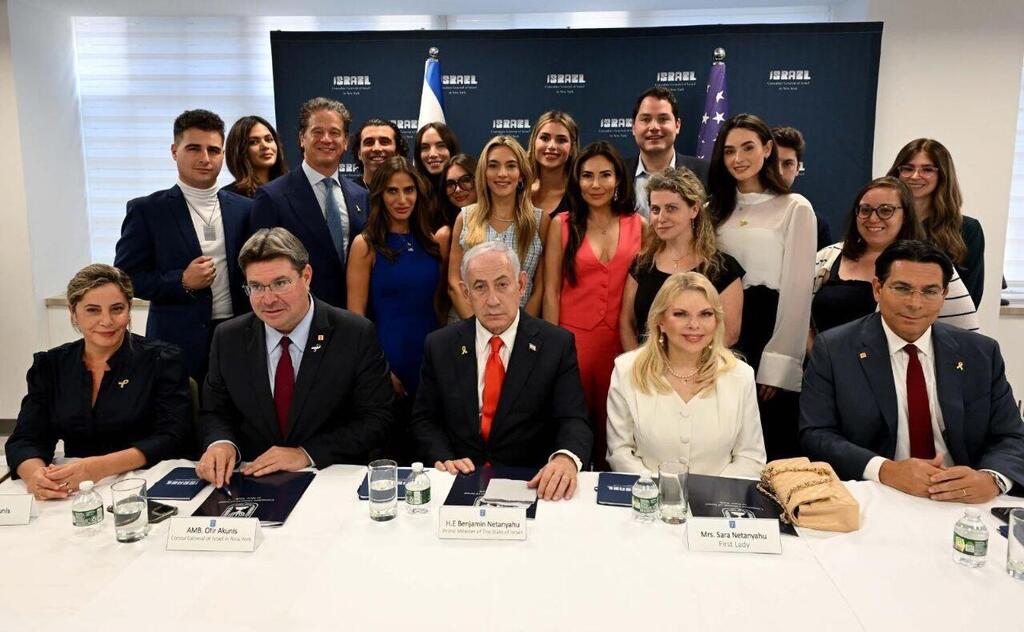
Beyond influencer payments, the contracts cover content production, legal advice, analytics and professional distribution support. The scale of the effort was reflected last week when Prime Minister Benjamin Netanyahu met with a group of pro-Israel influencers at the Israeli Consulate in New York.
When asked at the meeting how Israel should respond to declining international support, Netanyahu said, “We have to fight back. How do we fight? With influencers. They’re very important.” He added that “the most important weapon today is social media.”
Netanyahu has described the online arena as “Israel’s eighth front,” alongside its military, economic and political challenges. In his remarks in New York, he compared “woke culture” to Nazism and urged investment in TikTok and cooperation with Elon Musk to “ensure victory in the most important arena.” His comments drew criticism in the Arab media, which portrayed them as evidence of an Israeli attempt to influence American public opinion during the Gaza war.
Reactions to the influencer meeting were divided. Some social media users accused the participants of insensitivity toward families of Israeli hostages who were protesting outside the consulate at the same time. Others argued that Jewish voices online were essential to counter rising antisemitism. Influencer Shay Sabo, who took part in the meeting, said the purpose was “to strengthen Jewish advocacy, not replace the families’ struggle,” adding that “what we need now is unity, not mutual blame.”