


Iran has made its playbook clear: it retaliates by targeting similar categories of sites in Israel and the Gulf to those attacked on its own soil, and with thousands of such targets already hit, the list is long.
The targets Israel and the United States have struck include nuclear facilities, energy infrastructure and civilian sites used by the Iranian regime, such as industrial factories and universities. While Tehran initially threatened mainly to respond in kind to whatever was struck on its soil, it is now aiming beyond that.
The Haifa oil refineries in northern Israel struck by Iranian cluster missile, March 30, 2026
(Photo: Haifa municipality)


Thus, the Haifa oil refineries in northern Israel were attacked in response to strikes on Iran's South Pars gas field facilities. Dimona, a city near Israel's nuclear research center, came under repeated fire after a strike on the Natanz nuclear facility. Across the Gulf, energy installations have been attacked again and again in line with American strikes.
As early as March 10, Iranian Parliament Speaker Mohammad Bagher Ghalibaf made clear that the Islamic Republic would apply an “eye for an eye” policy, and he repeated that message a week later. “The attempt to attack infrastructure is suicide. The ‘eye for an eye’ equation is still in effect.”
Later, Majid Mousavi, commander of the Islamic Revolutionary Guard Corps aerospace force, warned that if the strikes continued, “this time it will no longer be an eye for an eye, but a head for an eye — and you (U.S. forces) will leave the Gulf.”
Over time, however, the Iranian threats expanded beyond that. Responding to strikes in Iran on March 27, Mousavi said: “This time the equation will no longer be eye for eye. You wait. Employees of industrial companies linked to the Americans and the Zionist regime should immediately leave their workplace so that their lives will not be in danger.”
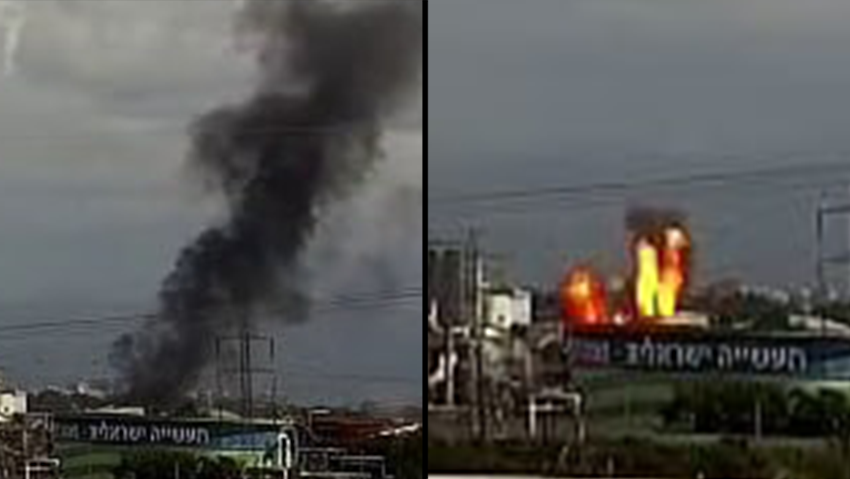
The Haifa oil refineries in northern Israel struck by Iranian cluster missile, March 30, 2026
(Photo: Haifa municipality)
Another senior Iranian figure, Mohsen Rezaei, who was reported to have been appointed military adviser to Mojtaba Khamenei, Iran’s new supreme leader, said on March 23 in response to Trump’s threat to hit Iran’s electricity infrastructure: “This time it will not be eye for eye, but head for eye, and you will leave the Gulf.”
Danny Citrinowicz, a research fellow in the Iran Program at the Institute for National Security Studies and the former head of the Iran branch in IDF Military Intelligence’s research division, said the Iranian equation “illustrates that the command and control in Iran is robust, because at the end of the day, there are strategic decisions and actions on the ground. The fire isn't random.”
According to Citrinowicz, “It is not correct to say they are firing whatever they have. There is strategic and operational planning for the campaign. We saw it in the strike on South Pars, which led to the first strike on the Haifa refineries, and then there was also the strike on Natanz and the response in Dimona. There were also attacks on steel plants in Iran, followed by a strike on a factory in Neot Hovav. The Iranians returned to strike the Haifa refineries a second time because we attacked their electricity infrastructure.”
Citrinowicz added: “For Iran, it is important to create the equation of response — which is essentially an equation of deterrence — and Israel is only part of the event. The strike on Ras Laffan, for example, shut down 17% of Qatar’s gas production capacity following the strike on South Pars.”
 Danny Citrinowicz
 He also pointed to what he described as a new component added to the equation: the Houthi threat to close the Bab el-Mandeb Strait, which he said would likely be carried out in the event of a significant strike on Iran or any ground incursion into its territory.
“This is a significant development. The ‘eye for an eye’ is escalating and, from Iran’s point of view, ‘everything you do to me, I will do to you and more.’ They are not matching; they are escalating. The Iranians are trying to create new rules of engagement. They understand that in order to stop attacks on them, they need to inflict much more pain,” he said.
According to Citrinowicz, the next stage will likely be attacks on academic institutions, following strikes carried out against such institutions in Iran. In recent days, the Revolutionary Guards have already threatened that Israeli and American universities would be legitimate targets.