

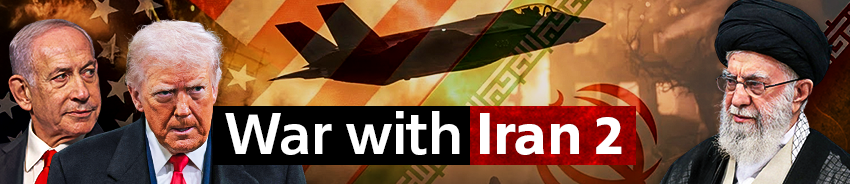

Missile barrages from Iran and Hezbollah, and a “campaign that may last a long time — but is necessary”: Nine days have passed since Israel and the United States launched a large-scale offensive against Iran, and although there appears to be a downward trend in the number of launches by the Islamic Republic, the end of the campaign is nowhere in sight.
Over the weekend, Israel and the U.S. entered the “next phase” of the operation, and on Saturday night Hezbollah launched its most significant barrage since joining the fighting. Prime Minister Benjamin Netanyahu hinted the conflict could continue for some time, telling Israelis in a national address on Saturday night that “we will need determination together.”
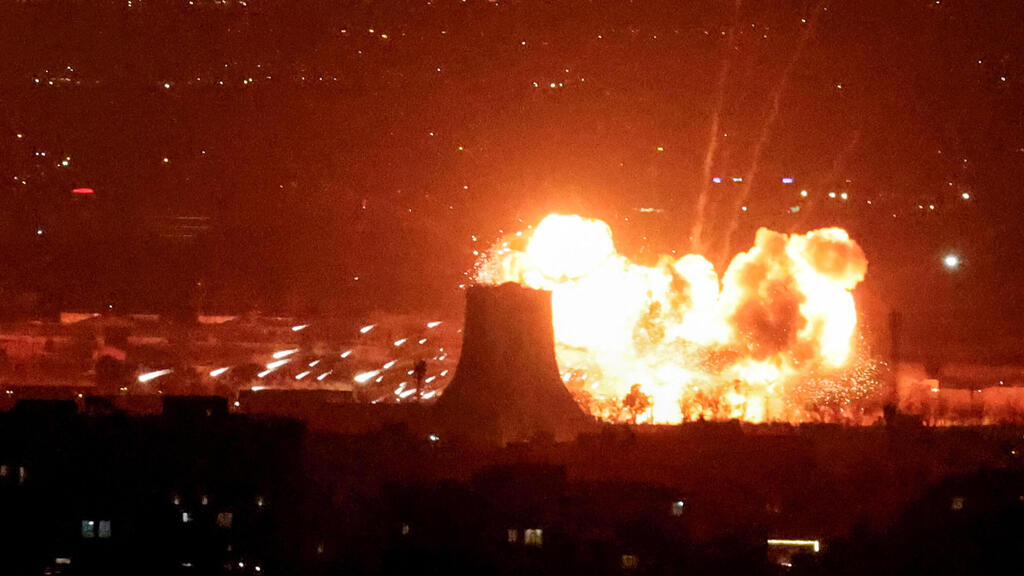
Netanyahu also said regarding the operation in Iran that “we still have many targets, and I will not detail them here.”
IDF Spokesperson Brig. Gen. Effie Defrin also said earlier on Saturday that the campaign may last a long time, but stressed that “it is necessary.”
Meanwhile, the winds of war are also blowing strongly within the U.S. administration. On Saturday, U.S. President Donald Trump sent a threatening message to Iran amid the arrival of four American B-1 bombers in Britain.
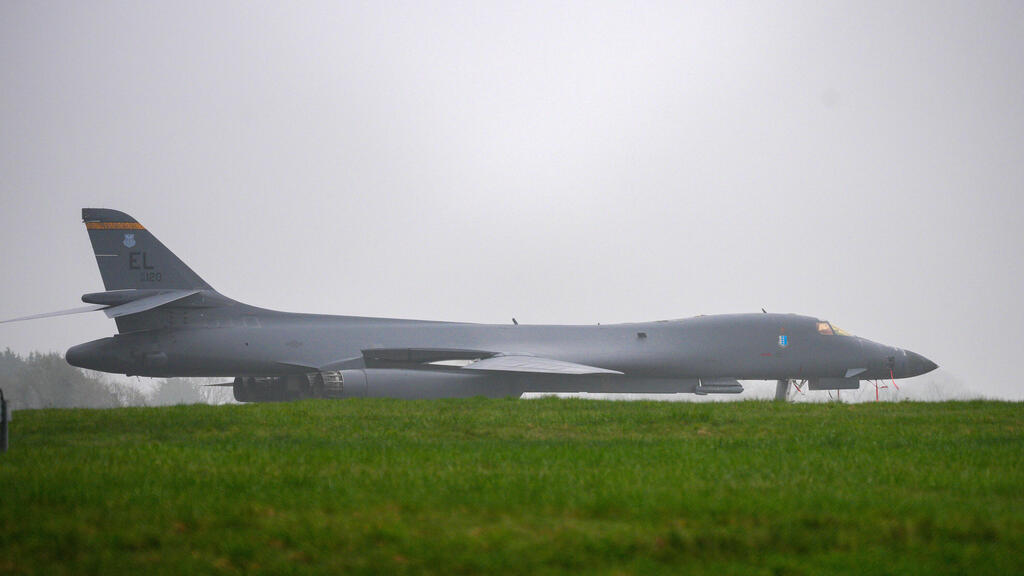
Four US B-1 bombers land at UK base, in a message to Iran
(Photo: Christopher Furlong/Getty Images)
The arrival of the bombers in Britain came as the Pentagon pledged to increase the pace of strikes against Iran. In addition to the bombers, it was reported Saturday that another aircraft carrier — the USS George H.W. Bush — is also on its way to the Middle East, accompanied by a strike group of three missile destroyers, indicating American preparations for a prolonged campaign. In addition, at RAF Fairford in Gloucestershire, the massive C-5M Super Galaxy transport aircraft was also documented. The aircraft can carry two M1 Abrams tanks, six Apache helicopters, or 36 military vehicles.
Trump himself said earlier this week that the United States had expected the war to last four to five weeks. “We can do much more if necessary. I don’t get bored,” he said. U.S. Defense Secretary Pete Hegseth added this week: “We are winning, Iran is finished — and we’ve only just begun.”
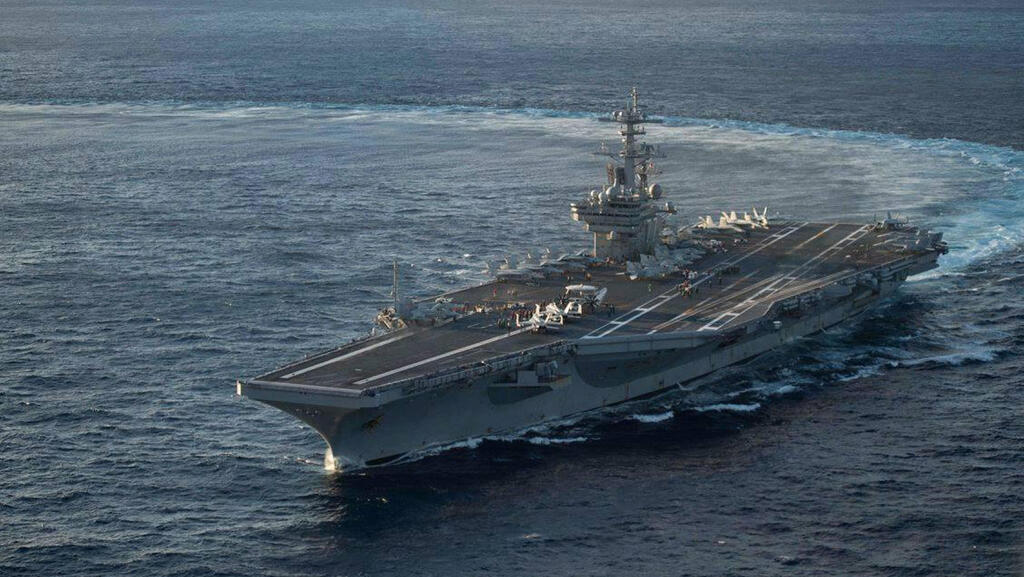
The aircraft carrier — the USS George H.W. Bush — is also on its way to the Middle East
(Photo: USS George H.W. Bush/ Facebook)
He noted that additional forces are on their way to the region, saying: “We’re hitting them while they’re on the ropes. More waves are coming — we’ve only just started. The United States will use an unlimited stockpile of guided bombs. Iran will not be able to withstand us. We can continue this fight easily for as long as necessary.”
An escalation in launches from Lebanon
Amid nearly constant waves of strikes in Beirut’s Dahiyeh district, and despite numerous attacks on villages in southern Lebanon, Hezbollah carried out a significant barrage of dozens of launches toward northern Israeli communities overnight. The move marks an escalation by the Lebanese Shiite terrorist organization since it joined the fighting, after firing far smaller barrages in recent days.
Alongside a major barrage, Hezbollah fired missiles and drones at northern Israeli communities multiple times throughout the day and overnight, indicating that, despite a long confrontation with Israel over the past two years, the organization still retains capabilities to strike the Israeli home front. In addition to the launches, Hezbollah operatives also have been attacking IDF forces reinforced along the northern border and in southern Lebanon. Since Hezbollah joined the campaign, 14 soldiers have already been wounded by anti-tank fire, five of them seriously.
Entering 'next phase' of war with Iran
Netanyahu also addressed the Lebanese government in his statement Saturday night. “It is your responsibility to enforce the ceasefire agreement and disarm Hezbollah — otherwise there will be disastrous consequences," he said. "The time has come for you to take your fate into your own hands. We will do whatever is necessary to protect our citizens.” He added: “We continue with full force in the war and are winning through initiative and ingenuity, but also through determination.”
Defrin also addressed the fighting with Hezbollah in his statement, stressing that “we will not compromise on dismantling the terrorist organization’s weapons. We are exacting a heavy price from it.” Regarding the possibility of a ground entry into Lebanon, he added that “all options are on the table.”
On Thursday, IDF Chief of Staff Lt. Gen. Eyal Zamir and the commander of U.S. Central Command, Adm. Brad Cooper, both spoke separately about moving to the “next phase” of the war in Iran. While the first phase focused on regime targets — primarily degrading Iran’s launch capabilities through intensive hunting of launchers and missiles — thousands of new targets have now been added to the list: Iran’s military industry.
The Israeli and American objective is to dismantle Iran’s entire capability chain, from production to the finished weapon. In the case of ballistic missiles, for example, the goal is to strike the entire process — from manufacturing plants, through missile storage facilities, to launchers and the commanders and soldiers who ultimately operate them. The IDF and the U.S. military intend to apply this approach to all of Iran’s military capabilities in the near future, including the use of American bombers capable of penetrating targets located deep underground.