


Thousands of Israelis rallied in Tel Aviv and dozens of other locations across the country on Saturday night to protest Prime Minister Benjamin Netanyahu's government and a series of contentious laws passed in the final days before parliament dissolved for new elections.
The main demonstration was held at Habima Square in central Tel Aviv, with parallel protests taking place in Haifa, Tzemach Junction, Maagan Michael Bridge, Rosh Pina, Nahalal and Karmiel Junction, among other locations.
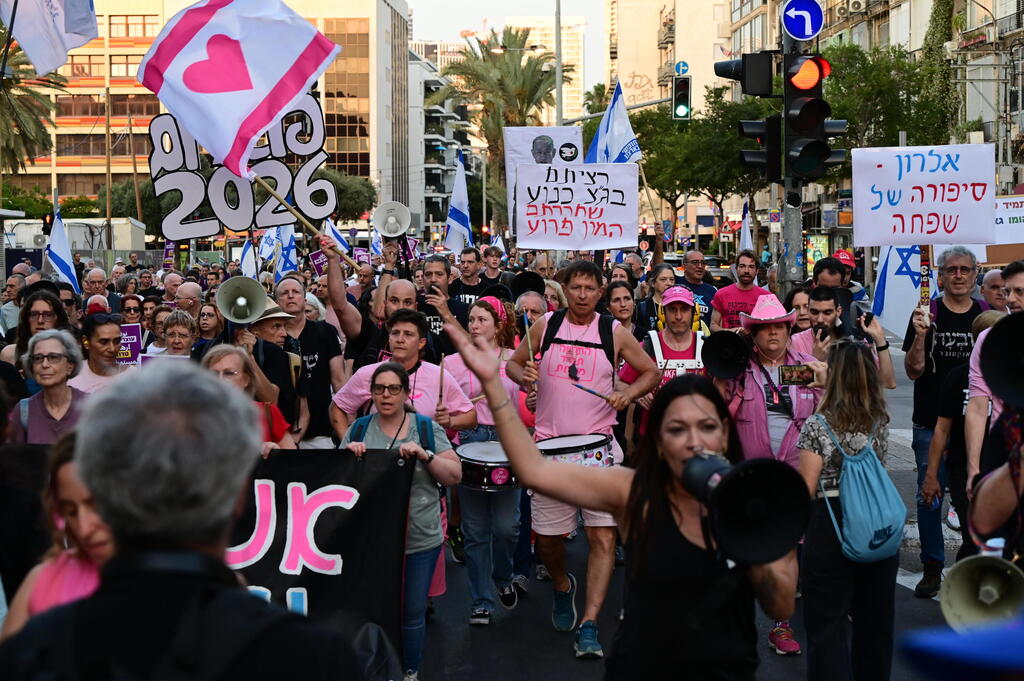
The Tel Aviv rally was organized by a coalition of civil society groups, including the Movement for Quality Government in Israel, the October Council, the Defensive Shield for Israel Forum, Paratroopers for Democracy, 555 Patriots and the umbrella Forum of Protest Organizations.
Organizers accused the outgoing coalition of pushing through controversial legislation in exchange for the continued support of ultra-Orthodox parties.
"In just three nights, days before the Knesset dissolved, the coalition passed a series of laws: the Basic Law on Torah Study, the law granting immunity from arrest to draft evaders, legislation weakening the attorney general and a law increasing government control over the media," organizers said in a statement.
"All of this was part of one political deal: the ultra-Orthodox parties received draft exemption legislation in exchange for supporting measures to weaken the judiciary and the free press."
The demonstrations followed an intense legislative push before the Knesset entered election recess. Several bills had been negotiated in advance between Netanyahu and his ultra-Orthodox coalition partners as part of an agreement aimed at preserving the coalition until parliament dissolved.
Among the measures advanced were legislation allowing gender-segregated graduate programs at universities, a media reform bill, legislation splitting the role of the attorney general, repeal of Israel's kosher certification reform, the Basic Law on Torah Study, legislation suspending the arrest of ultra-Orthodox Israelis who evade mandatory military service, and a bill establishing a political commission of inquiry into Hamas' Oct. 7, 2023, attack. The inquiry bill passed a preliminary reading but is not expected to advance further before the election.
The Movement for Quality Government said it filed petitions with the High Court of Justice against each of the laws immediately after they were approved.
The organization said the court had already suspended implementation of the law freezing the arrest of draft evaders pending judicial review. "Now the arena also moves to the streets," the organizers said.
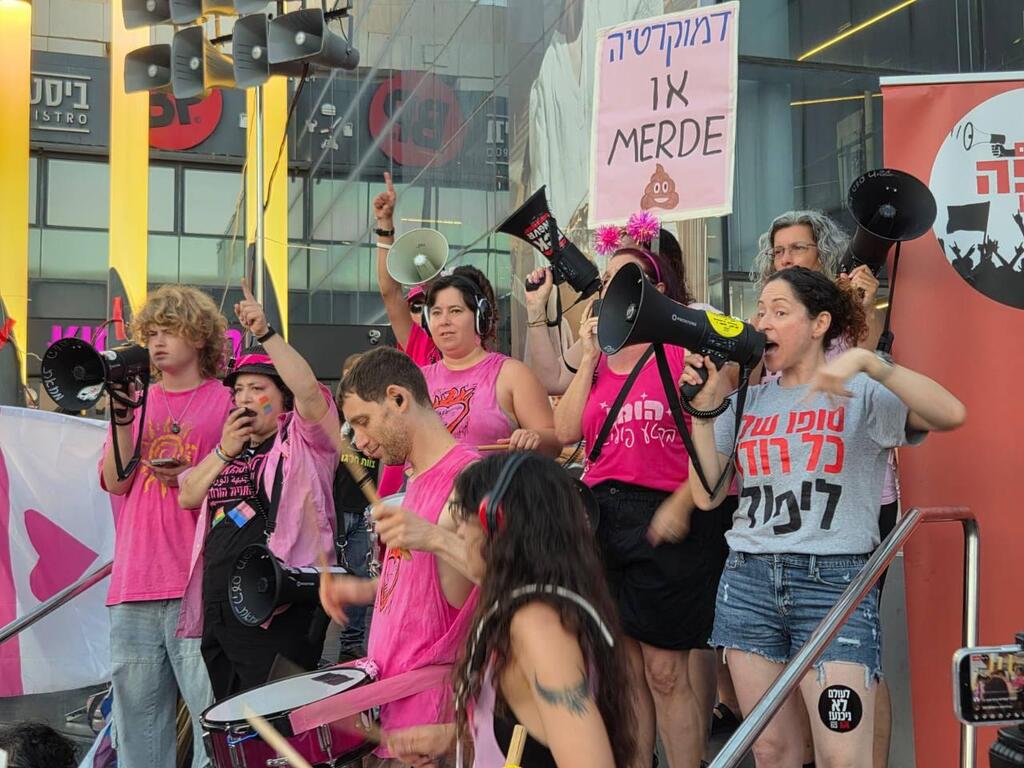
Anti-government protest in Haifa
(Photo: The People's Protest)
Among the speakers at the Tel Aviv rally was Gilad Golan, whose son, Maj. Sagi Golan, was killed during fighting against Hamas terrorists in Kibbutz Be'eri on Oct. 8, 2023.
"Like Sagi, many outstanding people were killed far too early, leaving behind a leadership vacuum whose absence we feel today," Golan said. "When the government refuses to take responsibility and does not establish a state commission of inquiry as required by law, there is no chance that anything will improve — not in the military and certainly not in political decision-making."
Brig. Gen. (ret.) Amal As'ad, a Druze former senior IDF officer, questioned the country's direction after nearly two years of war.
"I stand here on behalf of everyone who wore a uniform, answered reserve duty and now asks: What kind of country are we fighting for?" he said.
Referring to the legislation approved before the Knesset dissolved, As'ad said, "The great tragedy of the past week is not only that words have run out, but that life continues as if nothing happened and no one rises to shut the country down."
Attorney Tomer Naor, deputy director general for legal affairs and strategy at the Movement for Quality Government, accused coalition lawmakers of creating unequal treatment under the law.
"Fifty-eight coalition lawmakers voted for legislation that creates two classes before the law — those subject to the rule of law and those who are not," he said, referring to the draft-related legislation.
"We are not asking for a perfect democracy," Naor added. "We simply want a reasonable democracy — one in which debate is encouraged and the rule of law is respected."