

Yisrael Beytenu Chairman Avigdor Liberman accused the Palestinian Authority on Monday of interfering in the Knesset election, claiming it had sought to influence Arab political parties and contributed to political radicalization. He rejected allegations that the election had been stolen or that its results were compromised.
Speaking to reporters at his party's headquarters in Modi'in in his first public remarks since election night, Liberman also accused Shin Bet director David Zini of aligning the domestic security agency too closely with Prime Minister Benjamin Netanyahu's Likud party in its handling of allegations concerning the integrity of the vote.
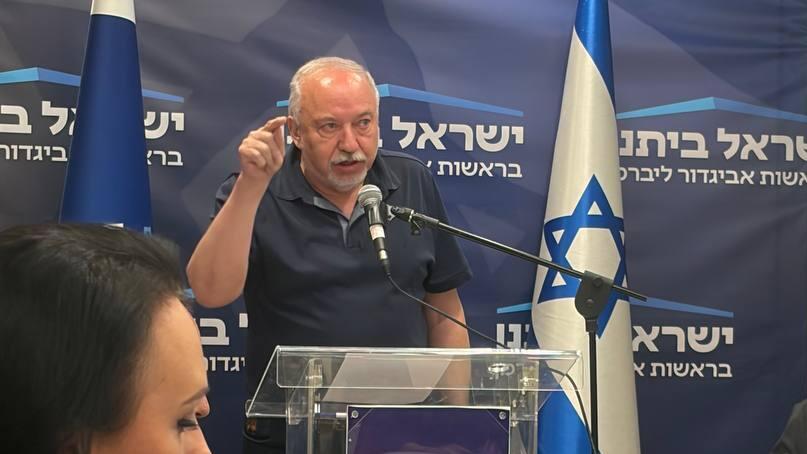
"The Palestinian Authority was very involved. They meddled in both Ra'am and the Joint List," Liberman said, referring to two Arab political factions.
"The Palestinian Authority caused radicalization, but the election was not stolen, and there is no concern about fraud or any need to review the election results."
Liberman did not present evidence to substantiate his allegations of Palestinian Authority involvement or specify how the alleged interference was carried out.
His comments came amid investigations into suspected election irregularities and a political dispute over their significance. Likud has described the allegations as evidence of a "stolen election," despite assessments by Zini and Central Elections Committee chairman Supreme Court Justice Noam Sohlberg that do not support that characterization.
"The Shin Bet's activity, and Zini's, is far too closely coordinated with Likud's narrative," Liberman said.
Asked about allegations involving Qatari money, he added: "As for the Qatari money, you can ask Yonatan Urich how Qatari money gets transferred."
Urich, a longtime Netanyahu aide, has been linked to investigations concerning alleged Qatari influence. Liberman did not elaborate on his accusation.
The Yisrael Beytenu leader's allegations come as Israel's political parties begin negotiations following an election that weakened Netanyahu's parliamentary bloc but failed to deliver a decisive victory for his opponents.
Liberman rules out Netanyahu, backs Eisenkot
Liberman reiterated that he would not join a government headed by Netanyahu under any circumstances and said he would recommend Yashar! party leader Gadi Eisenkot for prime minister.
"I don't think anyone was clearer than I was during the last election campaign. You can't be clearer than I was," he said.
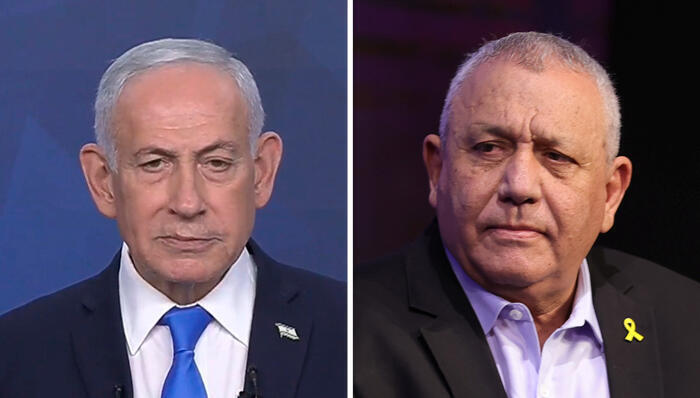
Prime Minister Benjamin Netanyahu, Yashar! party leader Gadi Eisenkot
(Photo: GPO, Oz Moalem)
"Even if the world turns upside down, I will not sit with Netanyahu. Even if he offers me a rotation agreement and I go first, it won't happen."
Liberman, one of Israel's most experienced political figures and a former defense and finance minister, said he had already informed Eisenkot privately that Yisrael Beytenu would support his candidacy.
"I was also clear about a minority government. That will not happen," he said. "I said before the election that we would not drag things out. I have many complaints about my partners regarding responsibility and fairness, but that has nothing to do with their complaints. I told Eisenkot privately that we would recommend him."
Liberman acknowledged that although Netanyahu's bloc had lost significant ground, the opposition had also fallen well short of expectations.
"Netanyahu and his partners weakened. In the previous election they won 64 seats, and now they have only 53. They lost 11 seats," he said. "The opposition also failed. Forty-eight seats is far fewer than we expected."
He blamed much of the opposition's disappointing performance on the campaign surrounding the possibility of forming a minority government.
"The minority government campaign caused us to bleed support," Liberman said. "In the final 10 days, we lost seven to eight seats because of all the talk about a minority government."
He claimed some traditional Likud voters who had considered supporting Yisrael Beytenu ultimately returned to Netanyahu's party because they opposed Eisenkot becoming prime minister.
"Likud voters told us they wanted to vote for Liberman, but in the end they didn't vote for us because they didn't want Gadi at the top," he said.
"Voters who crossed political lines and wanted to support us eventually went back home. This crazy situation hurt us."
Liberman also criticized Eisenkot's emphasis on who would lead the next government.
"Why was the question of 'who will be at the top?' so important to Gadi? It only hurt us. It cost us seats."
ynet reported Sunday that a meeting between Liberman and Eisenkot on Saturday night had been tense, with Liberman accusing Eisenkot of damaging the anti-Netanyahu bloc's electoral prospects through his campaign strategy and support for a possible minority government.
Opposition plans to replace Knesset speaker
Liberman said the opposition's first priority should be replacing Knesset Speaker Amir Ohana, a senior Likud figure.
"We have to replace him. We will do it immediately," he said.
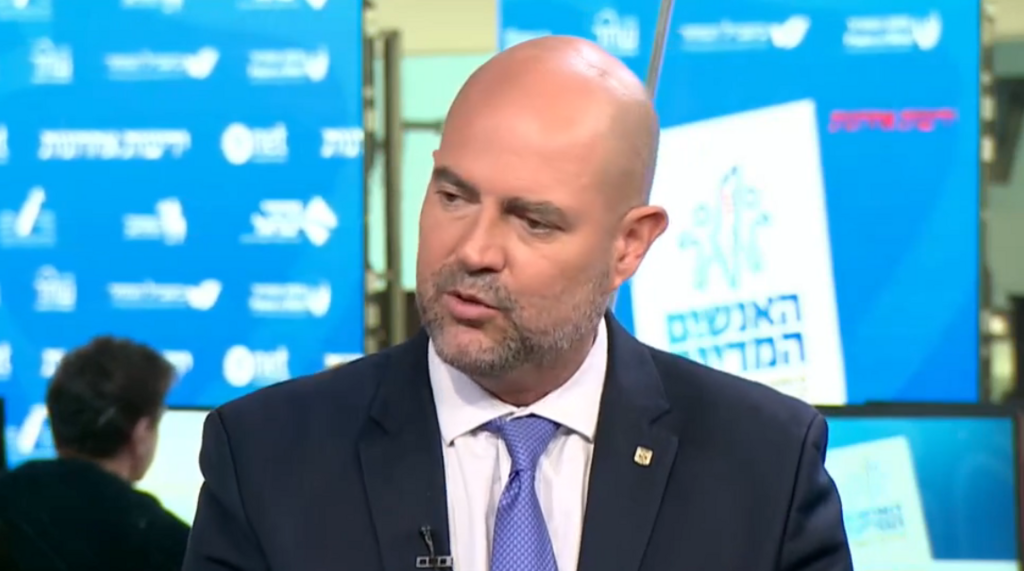
Knesset Speaker Amir Ohana
(Photo: Yaron Brener)
He expressed support for former prime minister Yair Lapid as the next speaker, although Lapid has not formally announced his candidacy.
Liberman said Lapid's party, Beyachad, had emerged as the second-largest faction and that Lapid's seniority and experience made him a suitable candidate.
"Because of his seniority and standing, Lapid is much more experienced and better suited to serve as Knesset speaker," he said.
"We will conduct ourselves fairly and honestly toward our partners in the bloc. That is why we did not demand the position for Oded Forer," he added, referring to a senior Yisrael Beytenu lawmaker.
Liberman said the leaders of all opposition factions would meet Tuesday to discuss their next steps.
"We have 28 days plus another 14 days, and that's a great deal of time. We're not rushing. Everyone agrees on Gadi Eisenkot," he said, referring to the time available under the coalition formation process.
He also outlined plans to establish an Arrangements Committee, which organizes the new parliament's work, as well as the Foreign Affairs and Defense Committee and the Finance Committee.
"In the circumstances that have developed, the Foreign Affairs and Defense Committee and the Finance Committee will have very heavy workloads," he said.
Liberman cautioned that passing complex legislation would be difficult while a caretaker government remained in office.
He also expressed doubt about the feasibility of establishing a state commission of inquiry into the failures that led to the October 7, 2023 attack during the transition period, saying the process would be complicated and could face legal obstacles.
Rejects minority government backed by Arab parties
Liberman also addressed proposals to establish a government with support from Arab political parties, an option that has become central to coalition discussions.
"We have no problem with Arabs," he said. "The problem is that in the previous election, fewer than 14% voted for Zionist parties."
"We don't want to encourage separatism. Israeli society is heading down the Lebanese path. Anyone encouraging separatism is making a huge mistake," he added, raising concerns about a political system divided along communal and sectarian lines.
Liberman reiterated his opposition to forming a minority government dependent on outside parliamentary support, including from Arab parties.
Asked by ynet how a government could be formed without such an arrangement, Liberman suggested that Eisenkot might persuade members of Likud to break away from Netanyahu.
"We will give Gadi the mandate. Maybe he'll manage to split Likud. Maybe half of Likud will come over to us," he said. "We have patience. Likud is hysterical because they are afraid a government could be formed without Netanyahu at its head."
Liberman also declined to explicitly rule out cooperation with ultra-Orthodox parties, despite longstanding disputes between Yisrael Beytenu and the ultra-Orthodox leadership over military conscription and religion-state issues.
"I'm enjoying what's happening over there," he said. "Aryeh Deri isn't answering Bibi, and United Torah Judaism isn't committed to Netanyahu, so let me enjoy it a little," he added, using the prime minister's nickname.
Pressed on whether such cooperation was possible, Liberman replied: "We have to see what happens."
He said he had not spoken with Deri, the chairman of the ultra-Orthodox Shas party.
'The ideal scenario is a Zionist coalition with Likud, without Netanyahu'
Liberman again identified two nonnegotiable conditions for joining a government: It must not be led by Netanyahu, and it must not be a minority government.
He also questioned Netanyahu's fitness to remain prime minister, including his physical health, without presenting medical evidence.
"Netanyahu is unfit for all kinds of reasons, including being physically unfit to serve in the position," Liberman said. "There is no obligation to publish a medical file, but to put it mildly, he does not appear fit for the job to me."
Liberman said his preferred outcome would be a coalition bringing together Zionist parties, including Likud, but excluding Netanyahu.
"The ideal world is to establish a Zionist coalition with Likud and without Netanyahu," he said. "I'm not rushing anywhere. We have time. In political life, the amount of time we have is an eternity."
He warned that a minority government led by Eisenkot would be short-lived and could ultimately strengthen Netanyahu.
"If Eisenkot presents a minority government, we will oppose it," he said. "A minority government would survive much less than a year, and then we would get Bibi back with 70 seats for another four years."
Liberman described another election as "the worst possible option."
When repeatedly asked how he intended to form a government given the restrictions he had imposed, he declined to provide a detailed strategy.
"Wait patiently. Leave me something for the next faction meeting, too," he said.
Despite the political deadlock, Liberman expressed confidence that a coalition could eventually be assembled.
"I'm optimistic that we'll be able to form a coalition," he said.