


One of the key issues expected to be discussed between President Donald Trump and Prime Minister Benjamin Netanyahu at their Oval Office meeting later Monday is Qatar’s role in Gaza’s reconstruction and administration. A few months ago Israel agreed that Qatar would be deeply involved and would provide funding for rebuilding, a decision that was reported by Ynet and Yedioth Ahronoth.
Qatar wants to be the dominant actor in the Strip, and its rivalry with Egypt over that role is playing out in the current talks. Israel, wary after the deterioration in ties with Qatar, Israeli airstrikes against Hamas leaders there and Doha’s international campaign against the Israeli government, wants to limit Qatar’s influence in a “day after” scenario as much as possible. That position is not acceptable to Washington. As of Sunday, negotiators had drafted a compromise formulation on the issue.
Another subject is Israel’s freedom of action should Hamas rearm, rebuild or otherwise regain strength. Israel has asked U.S. interlocutors to state explicitly that the Israel Defense Forces would retain freedom of action to remove terror threats from the Strip. Mediating countries have warned that such language could push Hamas away from any deal.
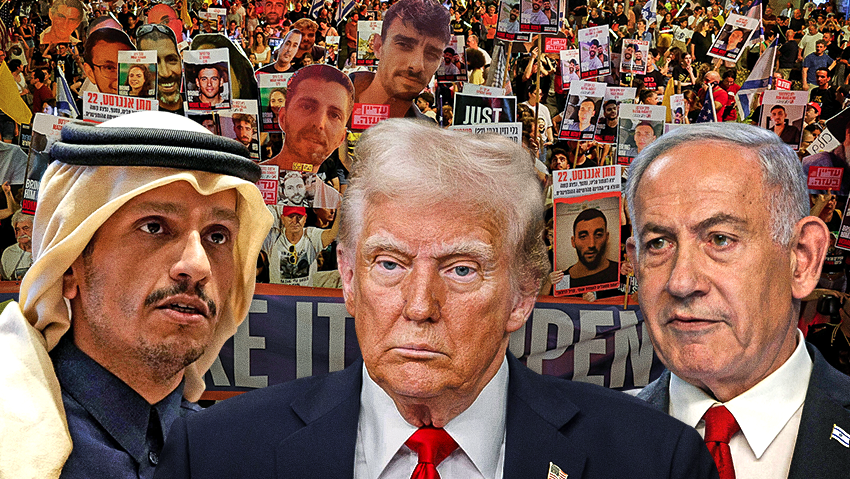
Netanyahu, Trump and the Emir of Qatar
(Photos: Ronen Zvulun/Reuters, Joshua Sukoff/Shutterstock, Ammar Awad/Reuters)
Israeli officials still judge the biggest challenge will be securing Hamas’ agreement to release all hostages in one sweep, thereby giving up what the group sees as both an asset and a human shield.
Overnight an Israeli official said there had been “substantial progress” in talks on President Trump’s 21-point plan. Trump’s son-in-law Jared Kushner and special envoy Steve Witkoff met for many hours with the prime minister at the New York hotel where he is staying, and the sides bridged most of the remaining gaps. The official expressed optimism about the chances of closing a deal, saying: “There is a good atmosphere toward a conclusion. There has been substantial progress toward agreements.”
Tonight at 6 p.m. Israel time Netanyahu and Trump will meet at the White House in Washington to discuss, among other things, the 21-point plan. They will have a private meeting, share lunch and then hold a joint news conference. “The best indication of any understanding will be the news conference,” an Israeli official said.
Despite Trump’s blunt public remarks opposing Israeli annexation of parts of the West Bank, a “large emergency delegation” from the Yesha Council flew to New York and met with the prime minister. The meeting between settlement leaders and Netanyahu lasted about two hours. Kushner and Witkoff passed by them as they left the prime minister’s meeting at the hotel. The Yesha delegation earlier met with New York Consul General Ophir Akunis. Among those at the meeting with the prime minister were Yesha Council chairman Israel Gantz and Samaria Regional Council head Yossi Dagan.
Netanyahu told the delegation he would “raise the issue of sovereignty with the president,” but stressed that “we must navigate a complex reality.” He told them: “There is a sympathetic president; remember the Obama era when he said we would not build even one brick.” Settlement leaders told Netanyahu the chance to apply sovereignty was a “one-time opportunity,” in part in response to French President Emmanuel Macron’s initiative on Palestinian state recognition and the support it has drawn. They also said some left-leaning municipal leaders privately told them they support “the Samaria envelop,” but would not speak publicly.
Sara Netanyahu, the prime minister’s wife, also attended the meeting. Yesha leaders asked Netanyahu to tell Trump that “sovereignty must be applied.” Netanyahu said he would find a way to express that “Judea and Samaria are part of the Land of Israel.” Participants said Yesha officials left “very disturbed” that Netanyahu did not set a timetable for when he would apply sovereignty.