

Eitan Davidi, chairman of the Margaliot moshav in the Galilee Panhandle, warned Monday about the implications of the framework agreement between Israel and Lebanon.
"We're in a kind of euphoria right now. I feel people are getting carried away and aren't reading the situation correctly," Davidi said in an interview with ynet. "I don't think this agreement brings any real breakthrough, and I don't know how it improves our security."
An explosion carried out by the IDF in Majdal Zoun
(Credit: IDF Spokesperson)


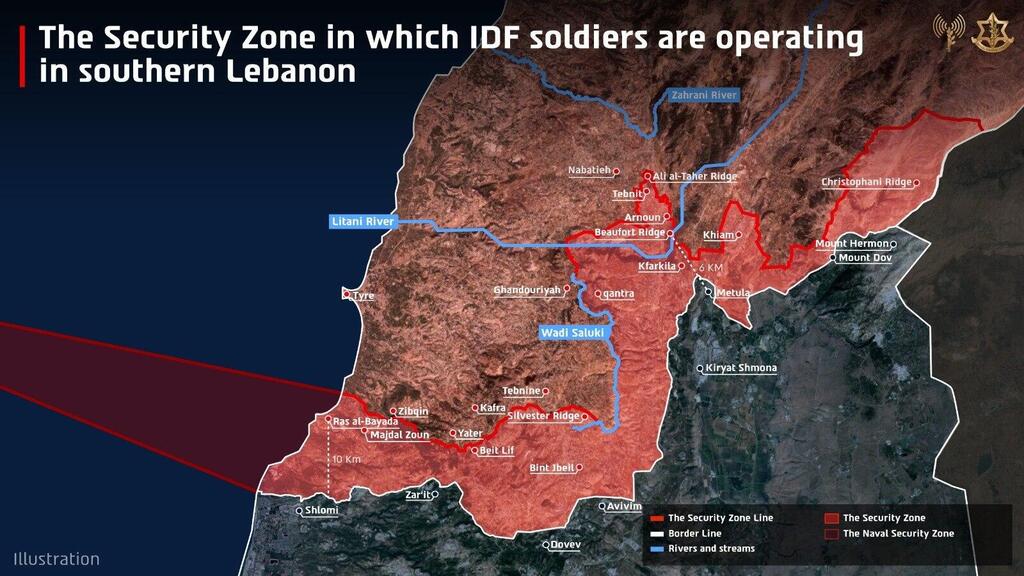
Under the agreement signed in Washington, Israel will continue to hold and secure its security zone along the boundaries of the "Yellow Line" inside Lebanese territory. The IDF presence will continue until Hezbollah and all other terrorist organizations are fully disarmed and the threat to Israeli civilians is removed.
The IDF will retain full freedom of operation throughout the security zone to eliminate immediate threats. As part of implementing the framework, two pilot areas will be established to test the gradual transfer of security responsibility from the IDF to the Lebanese army, alongside the rehabilitation of civilian infrastructure.
Davidi said: "It sounds good. It sounds appealing. It sounds great. The prime minister can boast about it and say it's a tremendous achievement for the State of Israel. But when you break it down into practical terms, we don't see any real progress or any improvement in the security situation for northern residents.
"The fact that we have legitimacy to remain up to the "Yellow Line" and that Lebanon recognizes Israel are the only two achievements I see. On the other hand, we didn't enter Lebanon to stay there for years or even many months. We entered Lebanon to do the job, do what needed to be done, finish the job against Hezbollah and then withdraw."
Asked about his main concern, Davidi said: "I understand very well what's happening here. This agreement was already made in November 2024. We signed an agreement with the Lebanese then under which Hezbollah would be disarmed south of the Litani River. We gave them until the end of 2025, and nothing came of that agreement.
(Photo: IDF Spokesperson)
"It's not that I don't believe the Lebanese don't want to do it. They very much want to, but they can't. In effect, we've signed an agreement with a government that's incapable of delivering results and cannot disarm Hezbollah."
He added: "From the Lebanese perspective, they'll do everything they can to exhaust the process, but they simply don't have the ability to carry out what they've signed. So we're back to the same point. We want quiet and security in the north so we can bring residents home and rebuild the area. How can we do that when we're being told, 'Ladies and gentlemen, Hezbollah is still in conflict with us and we're not finished with it'?
"We can't rebuild the region, and I don't understand all the excitement.
"They're trying to sell us a reality that isn't true. Even the Israeli government understands this agreement doesn't move us toward a safer security reality or anything that will provide better security for northern residents. I don't see any breakthrough here.
"From Margaliot, we can see Hezbollah raising its head again. I don't know whether anything will happen in the coming days, but I can say with complete certainty that we're heading toward another round of fighting. Ultimately, the Israeli government wants to sell something to the public, and maybe it'll bring political gains. It doesn't work on me."
As part of the IDF's operations in southern Lebanon, troops on Sunday destroyed the underground tunnel route uncovered in the village of Majdal Zoun, one of Hezbollah's main operational hubs in the western sector. The fortified underground complex was used by the terrorist organization to store weapons, including drones, warheads and explosives.
Footage of the destruction of a Hezbollah launcher
According to the IDF Spokesperson's Unit, "The underground complex was built using technology and expertise provided by the Iranian terrorist regime. The tunnel route stretched more than 200 meters (656 feet), reached a depth of more than 25 meters (82 feet), and contained hundreds of weapons as well as four launch shafts aimed toward Israeli territory. The IDF will continue operating in the security zone in southern Lebanon to eliminate any threat to our forces and will not allow Hezbollah to harm Israeli civilians or IDF troops."
Referring to the destruction of the tunnel, Davidi said: "I've always said Hezbollah was equipped with missiles in the Shiite villages near the border communities, and when we entered Lebanon we understood the true scale of the situation.
"No one wanted to tell us the truth. Everyone wanted to cover it up. They were afraid of getting dragged into the Lebanese quagmire. The IDF is doing an excellent job in Lebanon, as long as the State of Israel gives it the opportunity to do so. This is only the tip of the iceberg compared to what exists throughout Lebanon. Hezbollah is rebuilding its strength these days, and that should concern us greatly."
Meanwhile, the IDF said the Israeli Air Force struck three Hezbollah command centers Sunday night in the Nabatieh and Mefdoun areas of southern Lebanon.
"The strikes were carried out in response to Hezbollah's continued attacks on our forces operating in the security zone," the military said.
Earlier Sunday, troops from the IDF's Multidimensional Unit struck a Hezbollah launcher. The IDF said: "We will continue to act to remove any threat to our forces and will not allow the Hezbollah terrorist organization to harm Israeli civilians."