

Over the past year, the defense establishment developed a model for a moderate U.S.-Arab Sunni-led administration to govern Gaza through a local Palestinian leadership after Hamas’ fall. The plan’s goal was to exclude Qatar, the main sponsor of Hamas and a member of the Muslim Brotherhood camp, from any role in the enclave's postwar reconstruction.
According to the proposal, Gaza’s new governing council would comprise local Palestinian administrators under the oversight of representatives from Egypt, the United Arab Emirates, Jordan and the United States, possibly chaired by a mutually acceptable figure such as former British prime minister Tony Blair.
But the plan unraveled on Sept. 9, when Prime Minister Benjamin Netanyahu ordered an airstrike on senior Hamas leaders in Doha, contrary to the recommendations of defense chiefs. The strike failed, prompting Qatar to demand a public, supervised apology — and to reassert itself as a major player in Gaza once the war ends.
Israeli unease over Qatar’s growing influence
Throughout the war, Israel’s discomfort with Qatar’s influence was palpable. In December 2023, during the height of the ground offensive, IDF troops identified the lavish Qatari diplomatic compound in Gaza’s Sheikh Ajleen neighborhood as a “sensitive site.” Despite the caution, soldiers entered the building amid heavy fighting, damaging furniture and safes. They were reprimanded afterward, and the compound remains largely intact amid the surrounding ruins.
A more recent observation underscored Qatar’s lingering presence: the bright orange apartment blocks of the Hamad neighborhood in western Khan Younis, built with Qatari funds after the 2014 Gaza war, still stand almost untouched, even as most of the city lies in rubble.

Qatari Emir Tamim Al Thani
(Photo: Nathan Howard/Pool Photo via AP)
“Qatar and certainly Turkey must not regain any foothold in Gaza," a senior IDF officer told Ynet and its sister publication Yedioth Ahronoth. "The Emirates, Egypt and Jordan hate Hamas and genuinely care about the Palestinians. Qatar funded Hamas for years before Oct. 7 with those millions of dollars in cash Israel allowed into Gaza each month. There’s no guarantee that money won’t again fuel Hamas’ military wing rather than civilian recovery projects.”
U.S. coordination center takes shape
Adm. Brad Cooper, the new head of U.S. Central Command (CENTCOM), visited Gaza on Sunday to reassure Israeli officials. He said that while the U.S. will not deploy troops inside Gaza, it will establish a coordination center on Israeli soil staffed by about 200 personnel to oversee the new civilian administration — one explicitly intended to exclude Hamas.
Yet as Cooper toured the area, hundreds of Hamas terrorists surrounded a building in Gaza City’s Sabra neighborhood, where members of a militia recently allied with the IDF had taken refuge. Hamas demanded their surrender within 24 hours and later executed several alleged Israeli collaborators.
Israeli officials are calling for tighter supervision over the vast sums Qatar is expected to channel into Gaza’s reconstruction, noting that similar promises were made after previous conflicts, such as 2014's Operation Protective Edge. Many fear history will repeat itself — that reconstruction aid will again strengthen Hamas rather than weaken it.
The IDF’s postwar concerns
A senior IDF officer warned that the international community may soon lose momentum once the emotional high of the hostages’ release fades. “To truly weaken terrorist groups, you must cut them off from the population,” he said. “Hamas will resist any new governing force, because its power comes from the civilians who sustained its tunnel and weapons networks. It will start rebuilding the moment the ceasefire takes hold.”
He added that Israel cannot afford to wait for political decisions or for U.S. President Donald Trump’s next move: “We’ll have to strike any new rocket factories Hamas sets up, while allowing civilian rebuilding to continue. The government must make Washington understand the difference between the Arab guarantors: Qatar and Turkey are Muslim Brotherhood supporters of Hamas; Egypt and the Emirates despise it.”
Controlled withdrawal and fragile stability
The IDF completed its withdrawal from Gaza by midday Friday, having begun a day earlier to avoid delaying the hostage deal. Contrary to claims by the political echelon that Israel would maintain control over 53% of Gaza, the “yellow line” marking the initial pullback lies much closer to the border and remains fluid.
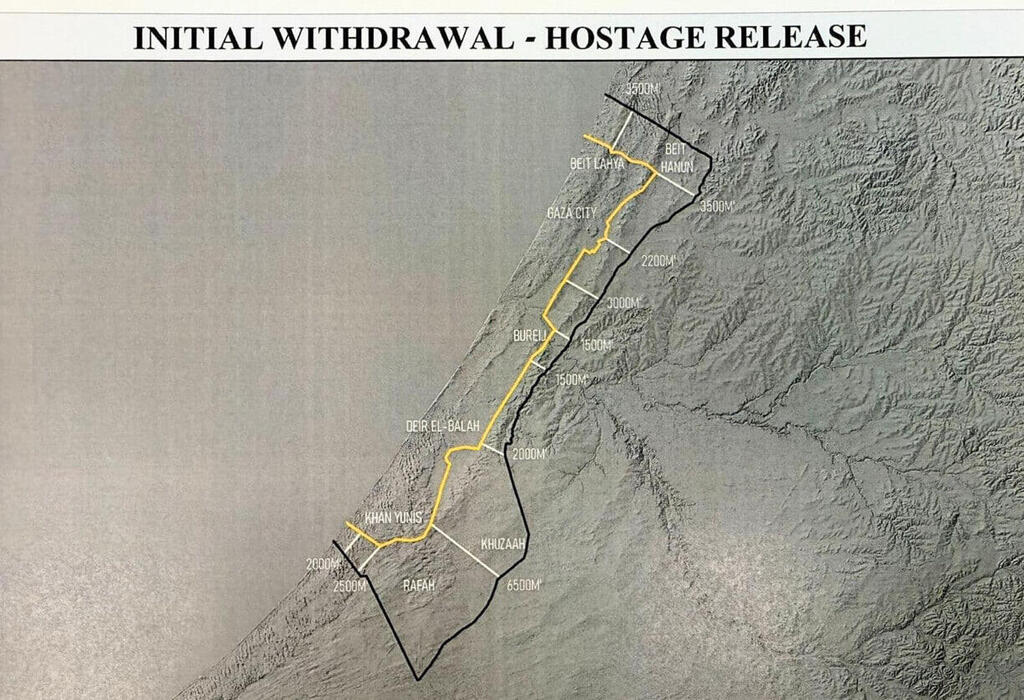
The initial IDF withdrawal map from Gaza presented by Trump
The areas now held by Israel form a deep buffer zone along the frontier — about three to six times wider than the defensive strip that had existed before the war. While the new positions reduce the threat to Israeli border communities, Hamas has regained access to most of Gaza’s urban areas, allowing it to regroup. Military officials concede the withdrawal line shown to the public was only illustrative. If negotiations on the next phase of the deal advance, the IDF will pull even closer to the border. But if talks stall, all sides may find reasons to be satisfied: the U.S. can claim an end to the war, Israelis can celebrate the hostages’ return and Hamas can begin rebuilding while still standing.
For now, Israel maintains control over the 70-meter ridge separating the western Negev from Gaza’s interior, a key defensive position, but the demilitarization of the enclave remains largely in theory. The IDF has destroyed Hamas’ heavy weapons and local arms industry and seized the smuggling routes under the Philadelphi Corridor along the Gaza-Egypt border, yet the future of Gaza’s governance — and Qatar’s role in it — remains uncertain.