

After nearly three years of negotiations and lengthy approval procedures, Israel and Greece signed the Achilles Shield deal Monday, worth about 3 billion euros, or more than 10 billion shekels. Under the deal, Rafael and Israel Aerospace Industries will build a multilayered air defense system for Greece.
It is the largest arms deal ever signed between Israel and Greece and is considered the second-largest in the history of Israel’s defense industry, after Israel Aerospace Industries’ (IAI) Arrow 3 deal with Germany, signed in 2023.
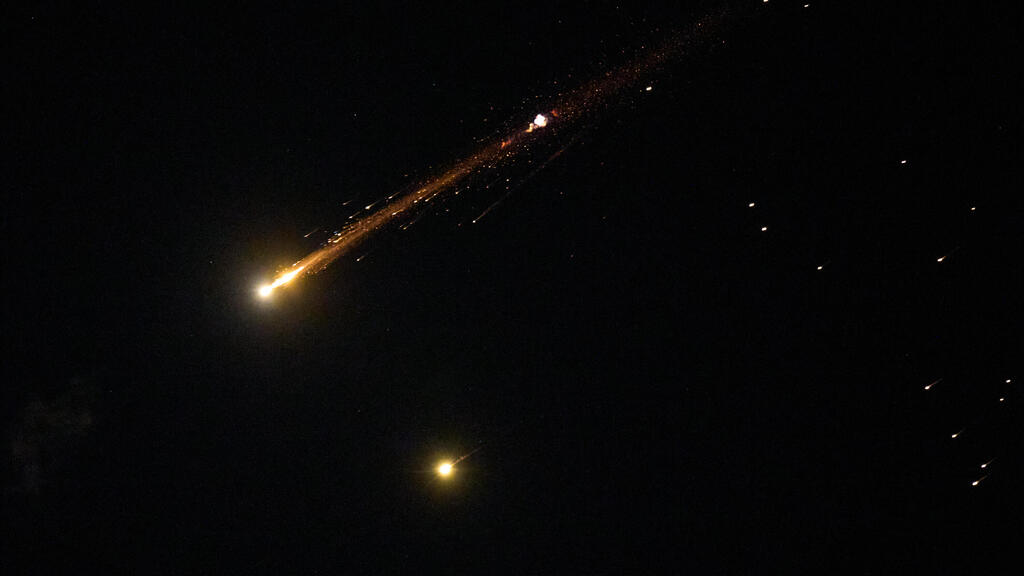
Interceptors chase an Iranian missile
(Photo: Ariel Schalit/AP)
The deal with Greece is considered unusual not only because of its financial scope. Unlike previous agreements in which Israeli companies supplied air defense systems abroad, under the new agreement Rafael and IAI will build Greece a multilayered air defense network designed to protect it against a broad range of threats, from drones and UAVs flying at low altitude to higher layers where fighter jets and ballistic missiles operate.
Over the next three years, Rafael and IAI will supply Greece with four different air defense systems that will operate in coordination. IAI’s share of the deal includes supplying the Barak MX system, which operates at ranges of up to about 150 kilometers, as well as radars developed and manufactured by Elta. The state-owned defense company Tomer may also benefit from the massive deal as the manufacturer of the engines used in Barak missiles.
Rafael will supply David’s Sling and Spyder air defense systems. This will be the second time Rafael has exported David’s Sling, which is designed to intercept cruise missiles, rockets and ballistic missiles. The first country to which it exported the system was Finland, under a deal signed in 2023 worth more than 300 million euros, as part of Helsinki’s efforts to upgrade its defense capabilities following Russia’s invasion of Ukraine.
In addition, Rafael will supply Greece with the Drone Dome system, designed to defend against drones and UAVs, in a deal worth 26 million euros. The systems are expected to protect strategic facilities across Greece and reinforce existing defense networks. All the systems supplied by the Israeli companies under the Achilles Shield program will be operated through a new command-and-control unit whose development will be led by Rafael.
A senior official involved in the details of the deal told ynet's sister publication Calcalist that its unique composition and the challenge of integrating the various defense systems were among the reasons the negotiations leading up to the signing took so long.
Shared tensions with Turkey
Greece’s extensive procurement of defensive missiles from IAI and Rafael continues a series of deals with Israeli defense companies that has intensified sharply since the beginning of the decade and is now worth an estimated cumulative 6 billion euros.
Last April, Greece ordered artillery rockets from Elbit Systems with ranges of up to 300 kilometers, along with launchers. Before that, it ordered Rafael Spike anti-tank missiles adapted for launch from air, sea and land platforms. Greece’s extensive defense procurement is part of its effort to upgrade its military units under a multiyear plan for the coming decade worth about 30 billion euros. The Greek buildup plan also includes the purchase of F-35 fighter jets from the United States and the upgrading of its existing F-16 fleet.
Yair Kulas, head of the International Defense Cooperation Directorate at the Defense Ministry, told Calcalist on Monday that the deal with Greece could ease some of Israel’s own rearmament challenges in air defense systems as part of the IDF’s preparations for future conflicts and efforts to replenish weapons stocks.
“Increased production allows for increased procurement of raw materials and expansion of production capabilities in a way that also benefits the IDF’s rearmament processes,” he said.
The Achilles Shield deal, like most recent deals with Greece, was concluded by Israel’s Defense Ministry with the Greek Defense Ministry, with the Israeli companies serving as subcontractors. Such agreements, known as G2G deals, or government-to-government agreements, are characterized by regulatory easements and government guarantees that the agreed terms will be fulfilled.
The Achilles Shield program includes understandings on cooperation between Israeli companies and the Greek defense industry, including transfers of knowledge and technology that will allow some components of the project to be manufactured in Greece. This reflects a broader trend in the European arms market in recent years, in which countries purchasing weapons increasingly demand that part of the production take place domestically in an effort to strengthen their own industrial capabilities.
The string of defense deals with Greece also comes against the backdrop of tensions that both countries share with Turkey. Greece and Turkey have long-standing territorial disputes and growing tensions in the Aegean Sea, while relations between Israel and Turkey are at a peak of tension because of Turkish efforts to establish new facts on the ground and entrench itself in Syria and Gaza, alongside harsh attacks on Israel by Turkish President Recep Tayyip Erdoğan.
All this comes as Turkey has spent the past decade significantly strengthening its military through extensive defense procurement, primarily from its own domestic defense industries. More recently, U.S. President Donald Trump promised to sell Turkey F-35 fighter jets, despite Israeli objections.
Officials in Israel’s defense establishment said Sunday that precisely at a time when “actors with hegemonic ambitions are seeking to expand their influence and undermine regional stability,” Israel and Greece would continue to deepen their defense and strategic cooperation based on shared interests.
According to Defense Ministry Director General Amir Baram: “The deal implements the Defense Ministry’s strategy of expanding defense exports as a central tool for ensuring the IDF’s force buildup and strengthening, influencing foreign policy and bolstering the defense industry and the national economy. Government-to-government agreements on this scale are not only a first-rate diplomatic and economic asset, but a direct engine for expanding domestic production lines in Israel, increasing inventories and establishing the State of Israel’s independence in armaments.”
His remarks come amid the extraordinary strain on Israel’s defense industries since the outbreak of the October 7 war. Increasing production for the IDF while simultaneously meeting growing export contracts requires Rafael and IAI to expand production lines, recruit workers and increase investment in infrastructure. From the Defense Ministry’s perspective, long-term export deals allow defense companies to justify expanding production capacity that, in an emergency, can also serve the IDF’s needs.
The massive debt owed to defense companies
In the background of the celebratory signing ceremony at the Defense Ministry is the heavy debt accumulated to Israel’s three largest defense companies — IAI, Elbit and Rafael — totaling about 15.5 billion shekels.
The growing debt stems from an ongoing dispute between the Finance Ministry and Defense Ministry over the size of the 2026 defense budget. The Defense Ministry’s debt to Rafael alone stands at about 7 billion shekels. Two days ago, Rafael CEO Yoav Turgeman sharply criticized the Finance Ministry for failing to transfer the funds needed to settle its debts and accused it of violating the law. The Finance Ministry did not respond.
Earlier, IAI moved into negative cash flow in the second quarter of the year because of a Defense Ministry debt of more than 5 billion shekels. The ministry’s debt to Elbit Systems is estimated at about 3 billion shekels.
Although the state is struggling to repay its debts to the defense companies, the Defense and Finance ministries also have failed to reach any agreement on compensating the firms for losses caused by financing the debt, estimated at about 1 billion shekels a year.
Although senior officials in both ministries have stressed in recent days to Calcalist that they recognize the debt owed to the companies, they said the firms’ strong financial positions allow them to soften the impact of the prolonged debt. According to one official, the defense companies benefit in any case from the state’s efforts to broker overseas deals for them, meaning they are capable of continuing to cope with the growing debt.
In 2025, Israel’s defense exports reached an all-time record of about $19 billion, a 30% increase over 2025. More than a third of the deals were made in Europe, and more than half of all deals worldwide were government-to-government agreements brokered by the Defense Ministry’s International Defense Cooperation Directorate, accounting for about $10 billion of total exports. That same year, about 30% of all Israeli defense exports consisted of air defense systems.
Aside from the deals with Greece, over the past two years Israeli defense companies have signed a series of additional air defense agreements around the world, including Slovakia’s purchase of a Barak MX system from IAI for more than 55 million euros, Germany’s purchase late last December of additional Arrow missiles from IAI and Thailand’s purchase of Barak MX missiles as well as launch and command-and-control systems.
At the heart of Europe’s arms race is Russia’s invasion of Ukraine in February 2022 and fears across the continent that the war could expand, including through attempts by Russia to invade additional countries or threaten them with drones and ballistic missiles.