


As time passes, the impression grows that even if a state commission of inquiry is established to investigate the failures of October 7, it will likely struggle to uncover the truth. This is not only because the passage of time blurs memories and facts while creating new ones, but also because the very concept of "truth" has ceased to exist in Israel.
In a properly functioning country, a commission of inquiry into such failures should be an existential imperative supported by a broad consensus. In Israel, however, the issue has become a source of deep divisions since October 7, inflicting severe internal damage. Driven by personal interests, the leadership under Prime Minister Benjamin Netanyahu has developed its own version of the truth about the roots of the failure. To strengthen the narrative's hold on the public, it has been elevated into a worldview, giving rise to a redefinition of the rules and language of Israeli public discourse.
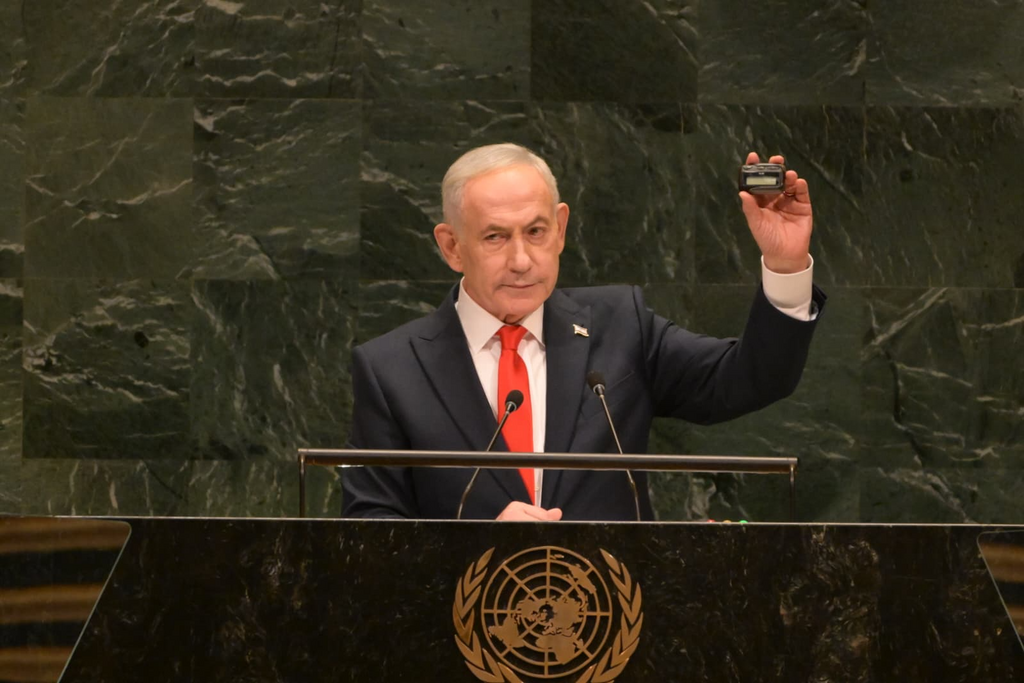
Prime Minister Benjamin Netanyahu addresses the United Nations
(Photo: Avi Ohayon, GPO)
This narrative draws a sharp distinction between those who are right and those who are wrong. It seeks to portray a leadership incapable of making mistakes — one that was supposedly "the victim of a security establishment that deliberately misled it" — while normalizing behavior once considered unacceptable, such as refusing to take responsibility and being unable to acknowledge failures, some of which are even presented as achievements.
The bewildered public has long deserved a rigorous and thorough investigation into the roots of the failure, one that would help prevent the repetition of mistakes that have, in fact, recurred since October 7. One example is the failed Gaza Humanitarian Foundation (GHF) initiative in Gaza, which contained the seeds of the same fundamental misconception that underlay the original failure.
Instead, the public is being inundated with selectively released document excerpts, fabrications and distorted notions that previously had no place in public discourse. Chief among them are conspiracy theories, including claims of a "generals' revolt" and even treason. These allegations are already fueling dangerous efforts to delegitimize domestic political actors and could ultimately undermine the democratic rules of the game, including respect for election results or a future government's right to change policy.
As a result, what should have been a substantive discussion has become a bitter and sinister struggle, with arguments that could lead to severe internal confrontation. Foremost among them is the claim that the same forces that sought to undermine the current leadership before Oct. 7 are now competing against it in elections, enjoy the support of Israel's enemies and would bring about the end of the state if they won.
The failure of truth
"Truth" has thus become one of the war's most prominent casualties. Its disappearance is turning Israel into a postmodern nation where facts no longer exist, falsehood has become routine and agreement on any issue is impossible.
Against the backdrop of such inflammatory domestic discourse, it is increasingly likely that even if a comprehensive investigation establishes the truth, its findings will be rejected. Critics will argue that the commission's composition is illegitimate, that its conclusions are biased and even that there is no reason to cooperate with it.
The debate over an investigation into October 7 has become a national wound that refuses to heal. It demands that lessons be drawn from history, particularly about how divisive collective memories are formed, weakening societies and tearing countries apart.
The trauma of three years ago could have become the crucible of a new Israeli identity, a defining generational experience through which Israelis, emerging from the horrors of war, would redefine themselves and formulate a shared vision and common goals.
Instead, efforts to shape public consciousness in pursuit of personal and political interests have turned the trauma into one of the deepest divisions in the country's history. The rift has prompted Israel's enemies to argue that, despite the devastating blows they have suffered since October 7, former Hamas leader Yahya Sinwar's prediction of Israel's eventual disintegration may yet come true.
October 7 is increasingly becoming a failure that appears destined to remain an orphan, with no one willing to claim responsibility.
A relatively small group of senior security officials has accepted personal responsibility, acknowledged blame and resigned. Others, by contrast, have sought to absolve themselves by claiming they were not part of the "collective failure of judgment."
Some security agencies have conducted internal investigations, although these were carried out by people within the system and still require external scrutiny. Meanwhile, journalists and academics have undertaken studies that effectively serve as substitutes for the investigation the government refuses to initiate.
Yet journalists and academics lack access to the full range of materials that should be available to a state commission of inquiry.
These shortcomings present a fundamental obstacle to understanding the causes of the failure, identifying the lessons that must be learned and determining how to avoid another disaster of this kind. After all, three years ago, the catastrophe befell people who had promised they had learned and internalized the lessons of the 1973 Yom Kippur War.
The aggressive effort to establish an "alternative truth" about past failures is producing a one-dimensional approach to policymaking. Under this approach, current decision-makers ostensibly seek to distinguish themselves from those who made mistakes — without confronting the fact that they themselves played a leading role in shaping the reality that existed before October 7 — while portraying themselves as clear-eyed leaders heralding a national renewal.
Even without a commission of inquiry, conclusions are already being drawn that portray the Oslo peace process and Israel's 2005 disengagement from Gaza as original historical sins, despite the fact that many of today's decision-makers previously embraced and supported them.
Driven by personal and political interests, it has become one of the deepest rifts in the country's history, prompting Israel's enemies to argue that despite the devastating blows they have suffered since October 7, Sinwar's prediction of Israel's eventual disintegration may yet come true.
This supposed "awakening" is manifested in the deliberate initiation of confrontations and a constant search for enemies, as reflected in Israel's approach toward the Palestinian Authority and Egypt.
It is also evident in an unprecedentedly abrasive attitude toward the international community, illustrated by the deepening crisis with Britain and the Arab world.
At the same time, concepts once considered beyond the pale are becoming normalized. These include "voluntary transfer" of Palestinians, which cannot be carried out without committing war crimes and turning Israel into an international pariah.
Another is the establishment of a single state between the Mediterranean Sea and the Jordan River that would deny citizenship to millions of Palestinians, yet supposedly remain an advanced and internationally accepted democracy, even while operating according to ancient biblical laws.
The Israeli public must recognize that a nation unwilling or unable to confront the truth, or to demand it from its leadership, is condemned to live in a perpetual state of falsehood, becoming addicted to fantasies while losing its capacity for critical thinking and its ability to assess reality accurately.
Such a nation is prone to repeat its mistakes, and the likelihood that it will stumble into historic disasters rises dramatically.
Dr. Michael Milshtein is a senior researcher at the Moshe Dayan Center for Middle Eastern and African Studies at Tel Aviv University.