


The political chaos resulting from the lack of a clear election outcome has left every branch of Israel's law enforcement system in a state of shock, confusion and, above all, apprehension. The turmoil has already sparked a fierce confrontation between two senior figures responsible for upholding the law: Shin Bet chief David Zini, who wields far-reaching governmental and operational powers, and Attorney General Gali Baharav-Miara, who is responsible for overseeing the domestic security agency to ensure it does not abuse its powers against Jewish and Arab citizens.
The fact that the Shin Bet chief has two "bosses" — the prime minister, his direct superior, and the rule of law, embodied in part by the attorney general's oversight and legal interpretations — further complicates matters. This is particularly true given the constitutional and political crisis that began with the launch of the judicial overhaul and continues to challenge the rules of the game on a daily basis.
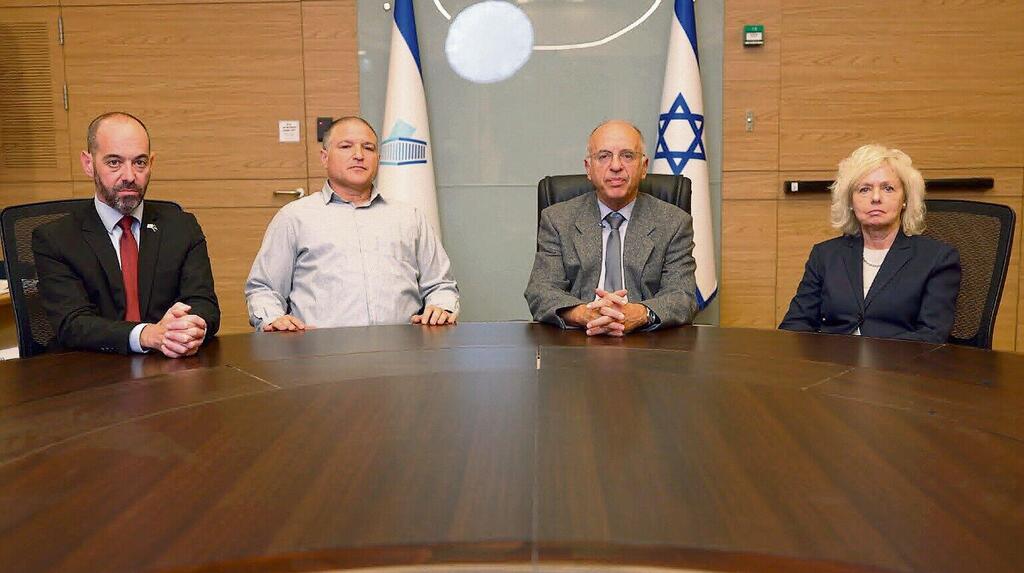
Attorney General Gali Baharav-Miara, Shin Bet chief David Zini, Supreme Court Justice Noam Sohlberg and Central Elections Committee acting director-general Dean Livne
"A battle is underway to prevent attempts to breach the boundaries of criminal law and use it for political purposes," a political source explained. "This is a threat that, if not stopped, could affect everyone. It will start with the Arab public, spread to opponents of the government, then to journalists and eventually to ordinary citizens."
"The severe crisis that has been unfolding since Tuesday should deeply concern anyone who values the rule of law," a senior law enforcement official said. "These are not isolated disagreements. The fact that the confrontation centers on the election results marks a significant escalation. Free elections and acceptance of their results are fundamental hallmarks of democracy, from which the supreme constitutional right to vote and be elected derives. These are signs of a regime coup. Israeli democracy will shift from a substantive liberal democracy to a merely formal one."
Central Elections Committee Chairman Justice Noam Sohlberg has also been drawn, reluctantly, into the severe crisis of confidence between Zini and Baharav-Miara. To his credit, he tried to contain the crisis and reassure the public that he was still awaiting the findings of the investigation. But the damage had already been done. By the time he delivered a televised statement alongside Zini and Baharav-Miara, the flood of poisonous accusations had already been unleashed and had taken hold among broad segments of the public.
A former senior public official expressed concern: "The conduct of the Shin Bet chief and the police commissioner has seriously undermined public confidence in the integrity of the elections and the legitimacy of Israel's Arab population. This conduct could, God forbid, have triggered an incident similar to what happened at the U.S. Capitol after the 2020 election, when Trump's defeat became clear."
The volatile situation also affects one of the central challenges facing the Change Bloc, whose leaders have repeatedly vowed to repeal the judicial overhaul laws set to take effect as early as January. These include the law dubbed the "gutting of the attorney general's powers," the law governing the Police Internal Investigations Department and the law changing the way judges are selected. The Change Bloc and senior judicial officials view these laws as measures that would politicize judges and institutional watchdogs, undermining their professionalism and independence.
The Change Bloc and senior figures in the judicial system view these laws as measures that would politicize judges and institutional watchdogs, replacing their professional independence with political loyalties.
Within the legal establishment, the effort to repeal these laws is known as "the undo." But officials familiar with the Knesset's legislative process say reversing them will be far from simple.
The first obstacle is time. The law changing the attorney general's powers, which also includes a provision allowing for Baharav-Miara's dismissal, is scheduled to take effect in January 2027. The same applies to the law governing the Department of Internal Police Investigations. Meanwhile, the law changing the judicial selection process automatically took effect when the newly elected Knesset was convened.
For now, the legal system remains protected by interim orders issued by the High Court of Justice, which have suspended the laws' implementation pending final rulings.
However, legal experts from across the political spectrum believe the High Court limited itself to suspending the laws because it wanted to avoid a confrontation with the political establishment. The hope was that the election results would allow the Knesset to reverse what had been done, eliminating the need for a ruling that could provoke a serious clash with lawmakers and supporters of the judicial overhaul.
Political sources on the right argue that setting a precedent for sweeping repeals of legislation immediately after a new Knesset takes office could prove to be a double-edged sword.
"A coalition today may find itself in the opposition tomorrow and risks having its own core legislation repealed when power changes hands," one lawmaker said. "We must not forget that these three laws were enacted after extensive deliberations, including testimony from experts. Repealing legislation with such profound constitutional and governmental implications in one fell swoop would set a dangerous precedent for future changes of government."
Constitutional law experts believe the Knesset's legal advisers could put obstacles in the way of repeal by raising procedural objections that could later form the basis of petitions to the High Court, arguing that the repealing laws were passed without serious deliberation.
Then, of course, there are the exhausting filibusters that opposition lawmakers, with plenty of time on their hands, are expected to stage in the Knesset plenum.
And if the repeal legislation passes, organizations affiliated with the right are expected to petition the High Court. The court would once again find itself compelled to intervene in controversial legislation.
The newly elected Knesset has a clear majority in favor of repealing these laws. The big question is whether the leaders of the Change Bloc will actually follow through. Amid the political turmoil, which promises fresh challenges almost daily — as demonstrated by the frenzy surrounding suspicions of foreign interference in Arab voting — will the leaders of the Change Bloc parties have the time and attention to deal with these laws?
The Change Bloc fears that if Israel heads into another election, the three laws, along with the conduct of the Shin Bet and police, could meanwhile entrench Prime Minister Benjamin Netanyahu and his allies' control on the ground, severely hampering the functioning of the law enforcement system.
The Change Bloc also fears that if Israel heads into another election, the three laws, together with the conduct of the Shin Bet and police, could meanwhile entrench Prime Minister Benjamin Netanyahu and his allies' control over the institutions on the ground, severely hampering the functioning of the law enforcement system.
Mediation and reconciliation efforts by President Isaac Herzog and Justice Sohlberg have lowered tensions but have not resolved the underlying conflict.
And that is without mentioning the prime minister's trial, which produces almost daily revelations about negligence by police investigators and prosecutors, lending support to those who believe the cases against Netanyahu were fabricated.
There are also the anticipated decisions in the "Qatargate" affair, in which indictments involving the Prime Minister's Office are expected, and the case involving the former military advocate general.
Attention is focused on the immediate crisis — the election results and the confrontation between Zini and Baharav-Miara. But all of this is taking place against the backdrop of the difficult reality facing Israeli democracy.
Israel in late 2026 is a country that does not arrest draft evaders, does not enforce the law against right-wing offenders and does not enforce the law in the Arab sector, yet incites against Arab citizens' participation in elections and their political influence.
Police summon journalists for questioning over leaks, turn a blind eye to violations of military censorship rules and fail to investigate government corruption.
"The political establishment is close to taking control of the law enforcement system," a constitutional law expert warned, recalling remarks by Supreme Court Justice Alex Stein, who cautioned that political control over law enforcement is a hallmark of authoritarian rule.
That is why the fear that a political actor is using the Shin Bet chief to undermine the legitimacy of the voters' decision is keeping defenders of the rule of law awake at night.