

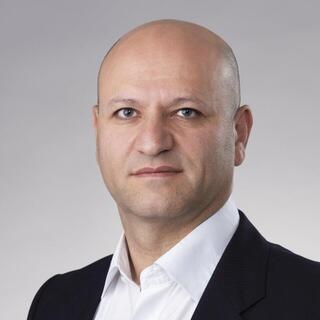
“Altogether, we lost 17 family members in wars, including four sons and five grandchildren. Praise be to God, who granted us the honor of their martyrdom. I am very proud that my sons became martyrs.” The words of Amal al-Hayya, wife of Hamas’ newly appointed political bureau chief Khalil, shortly after the killing of their fourth son last May, offer a glimpse into the fanatical world shaped by the family’s patriarch, who this week became the organization’s leader.
Al-Hayya’s selection is first and foremost a victory for Hamas’ leadership in Gaza, the place where the organization was founded and the only arena in which it controls territory (even if limited) and a population. Al-Hayya continues to carry the banner of Gazan leadership previously held by Yahya Sinwar and Ismail Haniyeh, even after nearly all of the region’s senior leaders were eliminated following October 7 and amid growing internal criticism over the decision-making that preceded the attack.
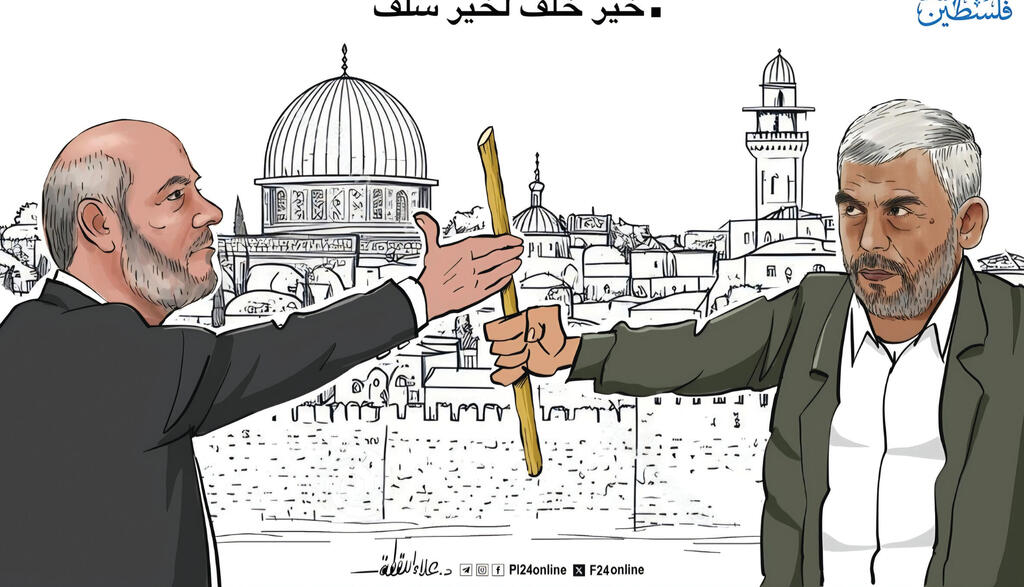
Al-Hayya takes over from Sinwar. He does not do Tehran’s bidding and is likely to make sure Hamas maintains its independence
Al-Hayya takes the baton from Sinwar. He is not beholden to Tehran and is likely to insist on preserving Hamas’ independence.
However, the path to victory was complicated, coming after a second round of elections (and possibly a third) in the Shura Council. In the first round, Al-Hayya and Khaled Mashaal, one of the movement’s founders who is from the West Bank and served as political bureau chief for 21 years (1995-2017), ended in a tie. At the initial stage, none of the candidates managed to secure the 36 votes required out of the council’s 69 members, as stipulated in Hamas’ bylaws. In the final round, Al-Hayya succeeded in adding the support of 23 representatives from Gaza along with representatives from the West Bank and abroad, enough to win.
The latest elections are another chapter in the long-running competition between Hamas’ leaderships in the West Bank and Gaza. There is no difference between Mashaal and Al-Hayya regarding the long-term vision of establishing a state throughout historic Palestine while eliminating Israel. The gap lies in their short-term goals and stems from the regional arenas each represents: Mashaal seeks to strengthen the West Bank leadership and may therefore be considering participating in general elections (expected to take place in November) or advancing reconciliation with the Palestinian Authority, while Al-Hayya is focused on rebuilding Gaza alongside preserving Hamas’ position in the area, including strengthening its military wing.
“Gaza’s suffering will be the first thing Al-Hayya addresses. He has a personal connection to the issue as someone from the area,” explains Iyad al-Aqra, a Gazan commentator identified with Hamas.
Al-Hayya did not rise through the military ranks like Sinwar, but through political activity, similar to Haniyeh and Mashaal. He was born in 1960 into a native Gazan family (unlike Sinwar and Haniyeh, who come from the refugee community), joined the Muslim Brotherhood before it became Hamas in 1987, spent about three years in Israeli prison in the early 1990s, earned degrees in Islamic law (including a doctorate from a university in Sudan), was elected as a Hamas lawmaker in the Palestinian Legislative Council elections in 2006 and served as chairman of the faction.
Since 2017, Al-Hayya served as Sinwar’s deputy in Hamas’ political bureau in Gaza. On the eve of October 7, he traveled abroad, apparently to manage political activity from there after Gaza was expected to be drawn into an “apocalyptic war.” Following Sinwar’s assassination in October 2024, Al-Hayya was appointed Hamas’ leader in Gaza.
Documents seized from an underground command compound in Khan Younis early in the war shed light on his central role in planning the October 7 attack. In July 2023, Sinwar sent him to Lebanon to meet with Saeed Izadi, a senior commander in Iran’s Quds Force, to request assistance in attacking sensitive sites in Israel at the start of the offensive. Izadi responded that Tehran and Hezbollah supported the plan in principle but needed additional time to prepare. Sinwar ultimately decided to carry out the attack even without guaranteed support from Iran’s allies, based on the assumption, which proved exaggerated in hindsight, that they would join the confrontation once it began.
Although he does not have a military background, Al-Hayya has acquired the image of someone standing at the forefront of the struggle against Israel. This image is reinforced by the fact that he lost four sons (all members of Hamas’ military wing) and that he himself was targeted in Israeli assassination attempts. The latest came in September 2025, when a building in Doha where Hamas’ leadership was meeting was attacked. Al-Hayya was wounded and his son was killed, and the strike later contributed to pressure from U.S. President Donald Trump to end the war in Gaza.
“Al-Hayya represents the hard-line and hawkish core of Hamas’ leadership, although he knows how to demonstrate pragmatism when required,” Adi Rotem, a former senior Shin Bet official who served on the hostage negotiations team and effectively operated in parallel to Al-Hayya, who headed Hamas’ team, said in a conversation. A senior security official added: “Al-Hayya is expected to maneuver between his desire on one hand to justify the militant image on which he was elected and, on the other, to show awareness of the distress among Gaza’s population, which has not erupted so far but remains at the center of Hamas’ concerns and monitoring, while also demonstrating relevance on the diplomatic level.”
Al-Hayya’s areas of focus are not expected to differ from those he handled until the moment he was elected political bureau chief. His main objective will likely be advancing the second phase of the Gaza arrangement.
As part of this, Hamas has already announced its willingness to relinquish governing authority in the Strip and accept a technocratic government, but has strongly opposed a complete and immediate disarmament. Against this backdrop, the three mediators — Qatar, Turkey and Egypt — have recently promoted a compromise proposal under which a technocratic government would begin operating in Gaza, the IDF would withdraw from most of the Strip and reconstruction would begin, even without Hamas fully disarming.
The proposal is being blocked by Maladnov, Trump’s envoy to Gaza, but the mediators continue trying to persuade him to adopt the initiative, mainly to prevent a scenario in which Israel returns to intense fighting.
Al-Hayya’s selection also carries regional and international significance. Like previous senior Gazan Hamas officials, he has warm ties with Tehran, unlike Khaled Mashaal, who is despised by the so-called resistance camp. However, Al-Hayya is not beholden to Tehran and is likely to insist on preserving Hamas’ independence.
He maintains close ties with Qatar, where he lives, as well as with Turkey and Egypt, whose intelligence chief was quick to congratulate him. Another notable phone call came from Hussein al-Sheikh, Mahmoud Abbas’ deputy, who also signaled a desire to develop stable ties with Al-Hayya while granting him legitimacy in the process.
Against this backdrop, Al-Hayya’s unique relationship with Steve Witkoff stands out. The relationship developed during negotiations to end the Gaza war and included, among other things, condolences expressed by the senior American official over the killing of the Hamas leader’s son in the Qatar strike. At the time, the relationship was explained by Witkoff as a bond forged by shared loss, since Witkoff also lost his son, who died of an opioid overdose.
Al-Hayya’s election was announced shortly before the “Returning to Gaza” festival, which reflected the messianic dreams held by some Israeli officials of conquering, settling and emptying Gaza. It would be better to distance ourselves from such fantasies, which cause serious damage domestically and abroad, and focus instead on sober plans for confronting a bitter enemy that is not about to disappear and which, from this week, is led by a man no less fanatical than his predecessors.
Dr. Milshtein is a senior researcher at the Moshe Dayan Center for Middle Eastern and African Studies at Tel Aviv University.