

The orange tree at the entrance to Kfar Aza’s Young Generation neighborhood is still bearing fruit. Heavy oranges fall to the ground and rot in silence, with no one left to pick them. Around it are burned homes, shattered windows and an overwhelming stillness. Time froze here on the morning of October 7, but the clock in the kibbutz keeps moving.
Unless a last-minute petition by bereaved families to the High Court of Justice changes the decision, bulldozers are expected to move in soon and clear the ruins of the neighborhood where 11 residents were murdered and seven were abducted to Gaza.
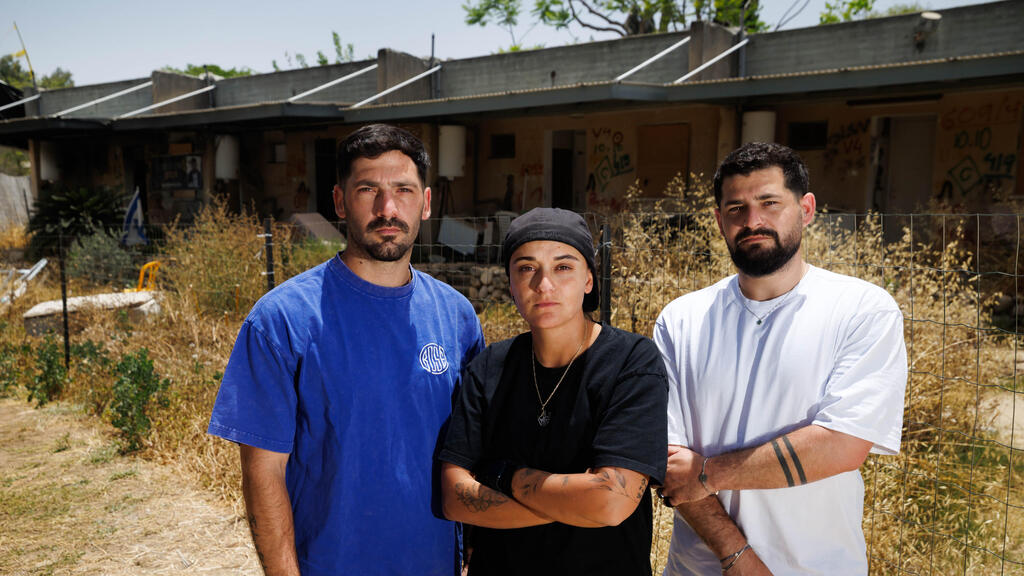
For former hostages Emily Damari and twins Gali and Ziv Berman, the place is far more than a devastated neighborhood. It is where they lived some of the happiest years of their lives, until they were taken from it into Gaza. Emily was released 18 months ago; the brothers returned a little more than seven months ago.
When the three stand together among the blackened homes, they are not only remembering the horror. They are also remembering the joy that filled the place before it was destroyed.
‘This is where we were kidnapped’
To reach his apartment, Ziv grabs a wire cutter and cuts through the fence blocking access. He looks up at a security camera now mounted above him and smiles bitterly. “Oh, now they remembered security cameras, after October 7, when we needed them.” After a few more jokes about the state of his completely burned apartment, he turns serious.
“When I come here, all the good memories come back,” he says. “What we see here now is the complete opposite, because this place was always happy. When I come here, I remember the beauty, the friendships. There is also a lot of anger over how they managed to do this to us and how something like this could have happened at all. But our approach is to keep going.”
He points to the apartment next door. “Right there, at my neighbor Yuval Solomon’s place, may his memory be a blessing, we spent all of COVID sitting together for coffee, the first at 10:30 a.m., the second at 4 p.m. We were family. This was a neighborhood full of life, with karaoke every weekend.”
Inside the ruins of Gali’s apartment, the television is smashed, clothes are scattered across the floor and bottles of alcohol remain on the counter, as if waiting for a party that will never happen. At Emily’s home, the window through which the terrorists entered is still broken, and bullet holes mark the walls.
For them, this place is a silent testimony to the massacre and the disaster. That is why, they say, it must remain for future generations to see. If it is destroyed, the memory will be erased.
“Before October 7, this whole neighborhood was alive,” Gali recalls with a small smile. “Every Thursday, people would gather here and stay late into the night.”
The strongest memory he and Ziv share is of the first sukkah they decided to build, just a week before the massacre. We decorated it with Israeli flags and told all our friends to come crash here. We sat there until nightfall, drinking and laughing. When I came back from captivity, I saw the terrorists had smashed it and burned the flags.”
Emily sits on the sofa that remains on the porch of her apartment. The bloodstained cushions have been removed, leaving only an uncomfortable wooden edge. “I would spend 16 hours on this sofa,” she says. “This is what I remember most about this place: coffee during the day, a shake in the afternoon and alcohol in the evening. Everything happened around this sitting area. Ziv called it “the hosting house.” You could open the cupboard and find disposable cups and plates for anyone who came by. When I come back here, I look for my things on the floor, my socks, my suitcase. I don’t pick them up. I leave them exactly where they are.”
“Seeing this place takes me back to October 7, to looking right and left and watching the apartments burn and the cars explode one after another,” she says. “But I choose to focus on the good memories I have from this neighborhood.”
“I also try to find the happy moments,” Gali says, sitting on the edge of the dusty sofa in his apartment. “There’s no point in going back to the pain I went through. Sinking into depression and misery won’t get me anywhere. I look ahead. It was awful, it was terrible, but we are alive. We survived. It is possible to keep living.”

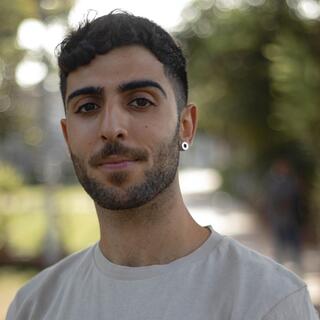
Emily Damari (right) in her apartment in the Young Generation neighborhood with Romi Gonen, April 2025
(Photo: Ziv Koren)
Still, he struggles with the idea that Kfar Aza plans to demolish the Young Generation neighborhood. “They’re telling us, ‘We’re going to take apart the place where you lived, where you spent the last years of your life,’ and those were years of joy and happiness,” he says. “Why would you take that away from me? I haven’t even processed the fact that my friends were murdered, and already you want to destroy it? I’ve been inside Yuval Solomon’s home twice, and I still haven’t really absorbed that he’s dead.
“People go back to life very quickly. The kibbutz wants to return to life too, but they’re not thinking about us. We still haven’t processed any of this. One day, I’ll have children, and I’ll want to show them where my brother and I were abducted from, and where Neta Epstein was murdered. This is our story, not yours. Ninety percent of the kibbutz never even came here.”
Nearly 300 kibbutz members voted to demolish the neighborhood: 70% supported moving some of the homes outside the kibbutz, 15% asked to leave the neighborhood as it is, and 15% supported partial preservation inside the kibbutz. Those who support demolition, themselves survivors of the massacre, say they do not want to live inside a memorial site.
Before the vote, Gali, Ziv and Emily came to the kibbutz assembly meeting in Ruhama, voiced their position and proposed ways to preserve the neighborhood without harming the fabric of daily life. They are not kibbutz members and therefore had no voting rights. Their view was rejected, and the issue is now pending before the High Court.
“We are working now to make sure this place is preserved in some form,” Ziv says. “Giving it up would mean erasing a piece of Israel’s history. This extermination camp called the 'Young Generation neighborhood', has to remain, and there are ways to make that happen. We come here every so often to look, to remember and to preserve one more moment, hoping that maybe something will change and it will stay.”
“This has been my biggest breaking point since I was released,” Emily says. “I spent so much time trying to convince my partner, Danielle, that this is where we would raise our children, live and build a home, and then came the decision to demolish the neighborhood. My dream was shattered.
“People don’t understand how important it is to leave this place standing. They tell me, ‘It’s only moving the neighborhood a little to the left, just outside the kibbutz.’ But by that logic, can you destroy the whole kibbutz? People were murdered everywhere here, not only in the Young Generation neighborhood. Should we tear up every access road where people were killed, or demolish the entire armory area too? Why my neighborhood?”
“Duvdevan fighters meet me and say, ‘Emily, what do we do?’ People came here and fought. There is a battle legacy here. So if it is unpleasant to look at, there are a thousand ways to solve that. This is not only a matter for the kibbutz. It is a matter for the world, the history of an entire people. This should be a decision by the state, not by the kibbutz. Even Romi Gonen, who did not live here, and whom I brought here a week after we returned from captivity, knows how important this place is.”
Hamas commander, Izz al-Din Haddad
On Saturday, the IDF killed Izz al-Din Haddad, who commanded Hamas’ Gaza City Brigade during the October 7 massacre and later climbed to the top of the terror group’s military wing as the war went on and senior Hamas commanders were killed one after another.
For Emily, Gali and Ziv, Haddad’s death resonates in a way few others can fully understand. They met his cruelty face-to-face in captivity. According to the IDF he was among the architects of the October 7 massacre, ran Hamas’ hostage-holding network in Gaza and surrounded himself with Israeli captives to make it harder to target him.
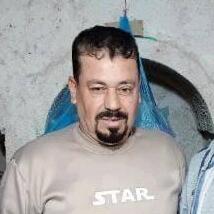
Izz al-Din Haddad
Ziv remembers one encounter clearly. “One day he came and said to me in Hebrew, ‘Nice to meet you. Do you know who I am? I am the Gaza Brigade commander.’ He did not say his name. He only said, ‘I am Hajj.’ He asked me if I knew where I was, and I told him Khan Younis. He laughed and said, ‘No, you are in Gaza.’”
“He was never with me for more than two or three hours at a time,” Ziv says. “He told us he often saw the female hostages, and that’s how we understood he was using them as human shields.”
Gali says he believes he met Haddad four times. “The first time was when I was in a house with Matan Angrest, and he and four other senior figures were sitting together,” he says. “They asked if we knew where we were, and also where we were from. A minute and a half had not passed before four houses next to us collapsed from airstrikes. Matan and I were frightened, so he told us, ‘Don’t worry, it is not you. They have been trying to take me down for years and have not succeeded.’ So now, finally, they succeeded.”
On another occasion, Gali says, Haddad came with a laptop and showed them pictures of all the hostages. “He told us things like, ‘This hostage, we don’t know if he’s dead or alive, and this one is being held here and here.’ He was trying to get information out of us because there were hostages they still could not identify.
“He also showed us a photo of Itay Chen’s body. Itay had been held with Matan. He showed us Hamas training footage from before October 7, including how they breached the fence. He said they would take over all of Israel. Every meeting with him was filmed and documented. We would sit with him, and he would bring us food and drinks.”
“But he is not a good person,” Gali stresses. “Everything simply went through him. If he wanted us to have food, we had food. If he wanted us not to shower for a month, we did not shower. I kept telling him to let me meet my brother, and when he wanted it, it happened. He made sure they filmed us meeting, a video that was ultimately not released. Emily also told me she asked him to do it.”
In one especially surreal episode, the Hamas commander took them to the beach. “It was me, Ziv, Matan Angrest, Eitan Mor and Omri Miran,” Gali recalls. “We came out of the tunnel straight there. You are walking in long clothes, in the peak of the heat, and suddenly there is sun and you cannot see anything because you had been in a tunnel for so long.
"We got into cars with cameras, and he filmed how we reacted. Everything was for consciousness, purely so it would look as if Hamas takes care of its hostages. So he can take me to the market, he can take me to the sea, but at the end of the day, this man is the one who sent all the terrorists to Kfar Aza.”
“Everyone called him Hajj,” Emily recalls. “He had visited Mecca, so he ‘earned’ that nickname. In my conversations with him, I called him that too. He was always bragging about what they did on October 7, saying, ‘You thought we would come from below, but we came from above.’
"He knew us inside out, and his Hebrew was extremely strong, despite his accent. He knew proverbs, slang and expressions. Every morning he would turn on Israeli radio in Hebrew, whatever he felt like that day, sometimes Reshet Bet, sometimes Galgalatz, sometimes Army Radio.”
“I was with him mostly in the tunnels,” she adds. “It started about two months after I was kidnapped and continued for a month and a half straight. After that, I met him in different places. He came to the apartments where I was being held above ground, and he made a point of saying that too, that he was moving around ‘upstairs.’ He was a huge braggart.
“In my final hours in Gaza, on the last day, he took me to the Red Cross vehicle, just before we moved between the cars. Do you understand what that means? It was a message: even on this day, I’m outside, making my presence show.”
“Thank you to the IDF for the precise operation that eliminated this horrifying man,” she says. “The moment I heard, I raised a shot and played a happy song. This is a man who murdered my friends and said, ‘We won’t stop here. We’ll come again.’”
Then she comes back to the planned demolition of the Young Generation neighborhood. “Izz al-Din Haddad reached into our guts, into our happy place,” she says. “Because of him, and because we must never forget what these people are capable of, I am standing here and fighting for my happy place - the place they turned into this horror - to remain exactly as it is. We must not forget the Holocaust they committed against us.”
October 7 and captivity
“The morning began with a barrage of rockets that did not end,” Ziv recalls. “I woke up and went back to sleep like I always did. I thought it was another normal day in the Gaza border area. A few rockets and it would calm down. But it did not stop. My mother called and told me, ‘This is a different event. Close everything. There are rumors of terrorists infiltrating.’
"Then I heard them here in the neighborhood, in the street. Shooting, shouting, burning and blowing things up. Terrifying fear. My apartment started to burn, smoke entered the room, I could not see anything and could barely breathe. The whole room was full of smoke, and I understood it was either choke to death or go outside. So I went out. In the living room, five terrorists were waiting for me with weapons drawn. They grabbed me, pressed my face against the closet, handcuffed my hands behind my back and tied my legs. The whole thing was accompanied by violence and beatings.
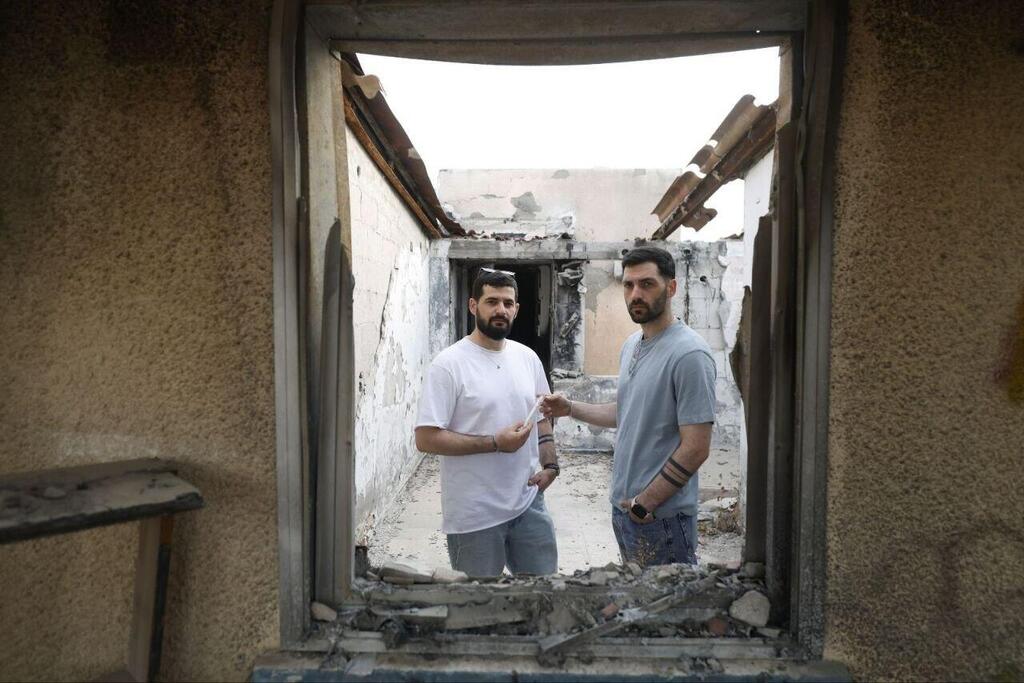
Gali and Ziv Berman in Kfar Aza, one month after their return
(Photo: Ziv Koren)
“They took me outside and put me on my knees between my apartment and Yuval’s. I could not understand what was happening at that moment. My eyes could not process what they were seeing. I saw that they had burned the sukkah, vandalized the neighborhood and burned Israeli flags. After a few minutes, they covered my eyes and put me in a car, and that was when I understood I was going to Gaza. Only later did I realize Gali and Emily had been in the car with me too. For the next 48 hours, I was handcuffed, tied up and blindfolded.
The twins speak with striking composure, considering what they endured. “At the end of the day, we’ve only been home for six months,” Gali says, before describing his October 7. “I took a knife and ran to Emily’s place to be with her. One moment we were in the safe room, and the next they threw in a grenade, broke inside, shot Emily and shot her dog, Chucha, who died. They dragged us out covered in blood, forced us to our knees, everything bleeding, everything burning.
“I was there, but I couldn’t really understand what I was seeing. Terrorists were running everywhere through the neighborhood, an insane number of them. They were shouting and shooting at anything that moved. There was no army, no one protecting you, after years of being told there was a wall keeping us safe.”
Emily describes the moment the terrorists got their hands on her and Gali. “I heard them breaking in through the window and I was sure my moment had come,” she says. “It is a fear that cannot be conveyed in words. Within a minute they opened the safe room door and shot me in the hand. I turned to Gali and told him, ‘They fucked up my hand,’ and then they shot my dog. Human scum. The bullet that killed my dog entered my leg. They sat us on the porch sofa that I love most in the world.
“We looked right and left and saw the neighborhood swarming with terrorists. They weren’t just happy about what was happening, they seemed almost euphoric, thrilled to kill, abduct, burn and abuse. I tried to negotiate with one of them. He told me, ‘Lady, I take you to hospital,’ and I said, ‘No, please, shoot me.’ They pressed a rifle to Gali’s head, and I begged them to take it off him. I would rather have died than be taken hostage in Gaza.”
“Only when we reached Gaza did I understand we had been kidnapped,” Gali says. “The terrorists kept saying it. ‘Welcome to Gaza,’ they told us. They took us down into a tunnel, where there were Israeli children and adults. I asked if they needed anything, and then I played some kind of game with the children, anything to make sure they were okay. What would happen to me mattered less at that moment.”
In captivity, there were small points of light. His first meeting with Matan Angrest is remembered as one of them, as are six days he spent in a tunnel with his brother Ziv, Matan and Eitan Mor. “We were awake all night, eating, playing, talking endlessly and singing songs,” he says.
During the three months he spent alone, he says, he tried to do what he was told. “If they tell you to go there, you go there. You don’t speak to them, and they don’t speak to you. There is no interaction. You are not allowed to have an opinion, and you have no rights. They would tell you: 'sit down, shut up, face the wall'.
“But eventually we understood that we were valuable bargaining chips and that they were not going to murder us, so a few times we pushed back. If they wouldn’t let me shower, I wouldn’t eat. I wanted to see if refusing food would get me a shower, and it worked. We weren’t eating much anyway.”
In the first days of captivity, Ziv and Emily were kept together. Ziv guessed that it would take the government no more than two weeks to bring them home. Emily guessed it would take no more than 24 days. That did not happen, and as the days passed, despair deepened.
“There were moments in captivity when I said maybe this is our last day here, and there were moments when I thought, 'here, a deal is coming and I will get out',” Ziv says. “Sometimes I thought, ‘Let me die with the Philistines,’ that we would all die together, meaning if I die, then the terrorists should die with me too. It all depended on the day and where we were. The terrorists celebrated that. Once they said, ‘There is a deal on the table,’ then they said, ‘Your government does not want a deal, we want one and you always ruin it.’ We did not let them influence us, but I broke down many times.”
Those were the hardest moments of his life. “I didn’t want them to see me break. I didn’t want to give them that satisfaction. But when I was alone, with too much time to think, I would say to myself, maybe this is the moment a missile falls on my head and ends it all. Why keep suffering? Why keep begging for food, water and a shower? Let it be over.”
Ziv says the fear shifted constantly between the terrorists’ cruelty and the possibility that the IDF could make a fatal mistake in the fighting. He points to the scar on his head, caused by an air force strike.
“When the IDF is close, there’s always the fear the terrorists will shoot you. The army was close to me several times, once even right above me,” he says. He later learned the IDF realized there were hostages in the tunnel and pulled back to avoid endangering them. “But in captivity, you live that fear every moment, around the clock.”
Emily says, “I won’t go into things that aren’t relevant here, but I will say that many times in captivity, I found ways to preserve my dignity.” She also describes the uncertainty, and the moment she saw her mother at a Knesset committee holding the last picture Emily had sent her from the safe room.
“That is how I found out she was alive,” Emily recalls. “For half a year you think your mother is dead, and suddenly you discover she is alive. It is impossible to convey that feeling. I cried, I was moved, I was happy but I was also hurt, because her daughter was abducted in Gaza and she had no information about her. I did not want her to experience all that pain.”
The physical toll is visible. Gali, for example, went from 72 kilograms to 57 while in captivity. He is only 28, but says he “can’t even run for five minutes without my knees hurting.”
“The body has to be rebuilt,” he says. “It is still weak after two years in which it was consuming itself because there was no real food and no real sleep. I was underground in unbearable humidity and did not shower. For a whole year, I didn’t even brush my teeth. We even barely manage to sleep at night, which is part of the recovery process."
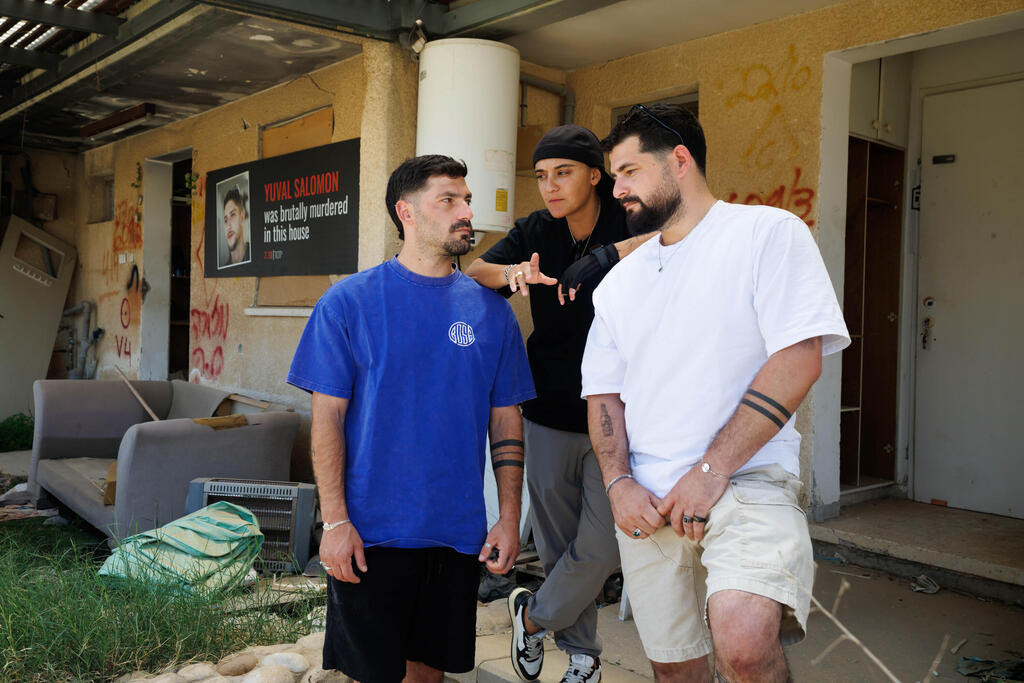
'People said, "This woman just came out of hell smiling, so lift your heads"': Ziv, Emily and Gali
(Photo: Ziv Koren)
The people they lost will accompany them forever. Still, after two horrific years in captivity, they are trying to live again. “Life keeps moving. The traffic jams are the same, the country goes on, and so do we,” they say. “We have a very large circle of friends, so we spend our days meeting people, and we go abroad when we can. Maybe later everything will surface, but right now we are not really crying or falling apart.”
Speaking Arabic
The twins speak to each other in Arabic with a Gazan accent. “Everyone in our country needs to learn this language,” Ziv says. “It is the only good thing I took from captivity.”
“There was no choice but to learn,” Gali says. “If you want to go to the bathroom, you have to know the word ‘hammam’ in Arabic. If you want to brush your teeth or take a shower, even the most basic things, you need to know how to say them. And you also want to understand what the terrorists are saying, what is happening inside Hamas and who is against whom in Gaza.”
Now they also use Arabic to gossip without others understanding. “This language is power,” Gali says. “Especially in our country.”
Emily, by contrast, tends to avoid speaking Arabic. Asked about the media image that cast her as a “gangster,” she says it all came down to one moment, the day she came out of Gaza smiling.
“People said, ‘Wow, this woman just came out of hell smiling, with her hand raised, so lift your heads.’ I feel we have many enemies, and we need to keep our heads held high. I feel I have a duty and a mission to speak about what happened to me, and that is my role. Gali, Ziv and I are telling the world, ‘We are here, we will remain here, we will continue to win,’ and that is what I believe.”
“What I work through with my psychologist is one thing,” she adds. “It doesn’t mean I can’t smile for the rest of the day, but it also doesn’t mean I don’t live with nightmares at night. Both things can be true.”