

President Donald Trump’s announcement of an operation to intensify Iran’s economic isolation signals a new phase in the campaign against the Islamic Republic. At this stage, it appears the U.S. president has become convinced that returning to a broad war does not guarantee the victory picture he seeks and could even complicate the situation, particularly given Iran’s ability to inflict significant damage on its neighbors and force the United States into a costly, protracted campaign amid growing constraints on troops and munitions.
Trump did not specify what the operation would entail but promised severe measures against any country that assists Iran. Meanwhile, Axios reported that the United States has secretly established a protected shipping route in the southern part of the Strait of Hormuz, allowing tankers escorted by convoys and covered by U.S. air power to transport about 10 million barrels of oil each night. Although this does not restore maritime traffic to its prewar level or provide a solution for other goods that passed through the strait, including gas, fertilizers and aluminum, its partial reopening at least makes it possible to slow the damage to the global economy compared with the deterioration of Iran’s economy.
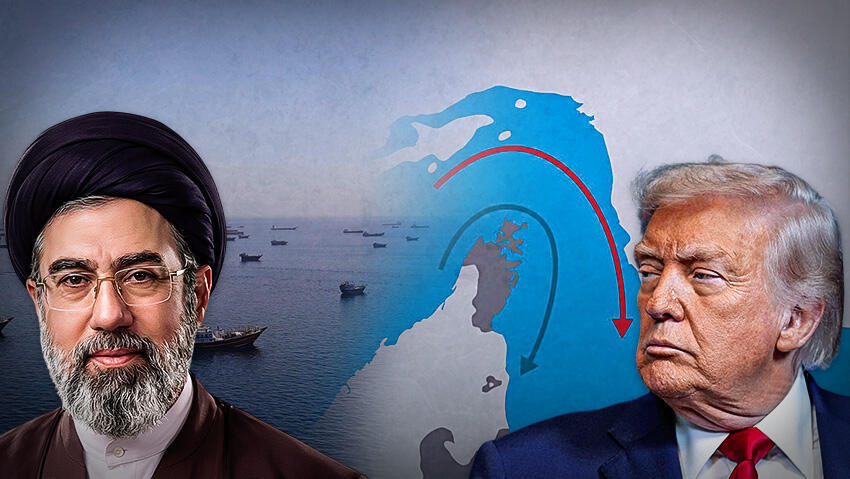
(Photo: shutterstock, AP/Alex Brandon, REUTERS/Stringer)
Trump’s preference for renewing and intensifying the economic campaign reflects a return to the policy of “maximum pressure” that he pursued during his first term after withdrawing from the nuclear deal in May 2018. The policy pushed Iran into a severe economic crisis, reflected in an unprecedented low in oil exports, a sharp budget deficit, inflation of more than 40% and an economic contraction of nearly 10%. The decline in government revenues forced the government to take drastic measures, including raising fuel prices and withdrawing tens of billions of dollars from its foreign currency reserves and the National Development Fund.
At this stage, it is unclear what steps the administration intends to take to effectively enforce the economic campaign. However, several factors that were absent in 2018 are working in its favor. First, the naval blockade is already having a significant impact on Iranian oil exports. Iran’s central bank governor, Abdolnaser Hemmati, acknowledged that oil exports have almost completely halted. Second, two of Iran’s major trading partners, the United Arab Emirates and Iraq, which previously played a key role in circumventing sanctions, have changed their approach.
The UAE announced this week that it was severing all commercial and financial ties with Iran, while tensions with Iraq over the Baghdad government’s intention to disarm Shiite militias are also affecting its willingness to assist Tehran. Recent visits to Iraq by Quds Force commander Esmail Ghaani, Parliament Speaker Mohammad Bagher Ghalibaf and the central bank governor failed to ease the tensions. This comes on top of the enormous damage already inflicted on Iran’s economy and industry during the war.
Iranian officials responded to Trump’s statement with predictable dismissal. Foreign Minister Abbas Araghchi argued that the threat of launching an economic campaign was intended to divert American public attention from domestic financial crises and that continuing a failed policy would lead to further failures and fuel Iranian hostility.
At the same time, reports of the worsening crisis are multiplying. The reformist Shargh newspaper described a severe crisis in the food market this week, after food prices rose by more than 128% in July 2026. The cost of a basic food basket more than doubled within a year, and the public is sharply reducing its consumption of staple goods. The newspaper warned that rising prices are already threatening food security, including children’s nutrition.
And yet economic pressure is a means of changing Iran’s policies — and some see it even as a tool for regime change — rather than an end in itself. At this stage, there is no evidence that Tehran is prepared to soften its positions. Moreover, it still has tools for escalation, including attacks on tankers and U.S. forces in the Strait of Hormuz, sabotage of ports and vessels belonging to its neighbors and increased use of regional proxies, chief among them the Houthis. Iran still appears to believe that by combining a “survival economy,” including cash payments to vulnerable groups, money printing and reduced investment, with a gradual escalation, it can force Trump to blink first.
In 2019, too, Iran responded to the maximum-pressure campaign with provocative military moves, culminating in attacks on tankers and an assault on Saudi oil facilities. From Tehran’s perspective, yielding to U.S. demands and unconditionally reopening the Strait of Hormuz in exchange for a cease-fire — one that does not guarantee the removal of the threat of war or provide economic and security assurances — is more dangerous than an escalation that could lead to another round of fighting.
Even if Iran ultimately decides to show greater flexibility, it is far from clear that Trump would be receptive. He may conclude that the United States’ ability to partially reopen the Strait of Hormuz gives him a way to defeat Iran after the military effort failed to do so. Therefore, there is no certainty that the current phase of the campaign will produce the outcome the United States seeks, and certainly not the outcome Israel seeks — whether through political or economic collapse in Iran or, at the very least, the neutralization of its remaining nuclear capabilities.
Dr. Raz Zimmt is Director of the Iran and the Shiite Axis research program at the Institute for National Security Studies (INSS).