


We are preoccupied with the entry into Gaza City—and rightly so. The issue is that the international arena is increasingly concerned about Israel. Last week, it was the U.S. Democratic Party convention, which backed away from a resolution supporting a two-state solution. Is this a punishment for the Palestinians? No. It turns out that even a decision against “two states,” in favor of one, is a reward for Hamas. This time it happened against the backdrop of the growing influence of progressive elements in the party, especially younger members, who oppose any solution that includes recognition of Israel.
It was obvious that the chants of “From the river to the sea” would reach politics. One might have thought it would take a few good years for the angry youth to recover from the anti-Israel indoctrination on campuses. We were wrong. The progressives are bringing into politics what they did to academia. Is anyone in Israel thinking about the long-term implications of this shift? What will happen when the Democrats return to the White House? What will happen if they hold a majority in Congress?

Jake Sullivan, who served as national security advisor, has long been considered a staunch friend of Israel in the Biden administration. Yet a few days ago, Sullivan stated that he supports an arms embargo on Israel.
Meanwhile, in the Likud, on the very same backdrop and at the same time, there was celebration last week with a festive meal marking the announcement of 17 new settlements in the West Bank. It doesn’t matter if all the decisions will actually be implemented, and it’s doubtful there are enough young people to populate 17 new communities. What is clear, however, is that there is no need to wait—Israel is already paying the political price for the announcements.
The bad news continues to arrive in bundles. The American public is undergoing increasing polarization—except when it comes to Israel. There, the gaps narrow. Sixty percent of Americans oppose sending additional military aid to Israel, while only 32% support it. By party, 37% of Republicans oppose sending aid, compared with 75% of Democrats. Pollsters note that this is “the highest level of opposition and lowest level of support for additional U.S. military aid to Israel since Quinnipiac University began tracking the issue on November 2, 2023.”
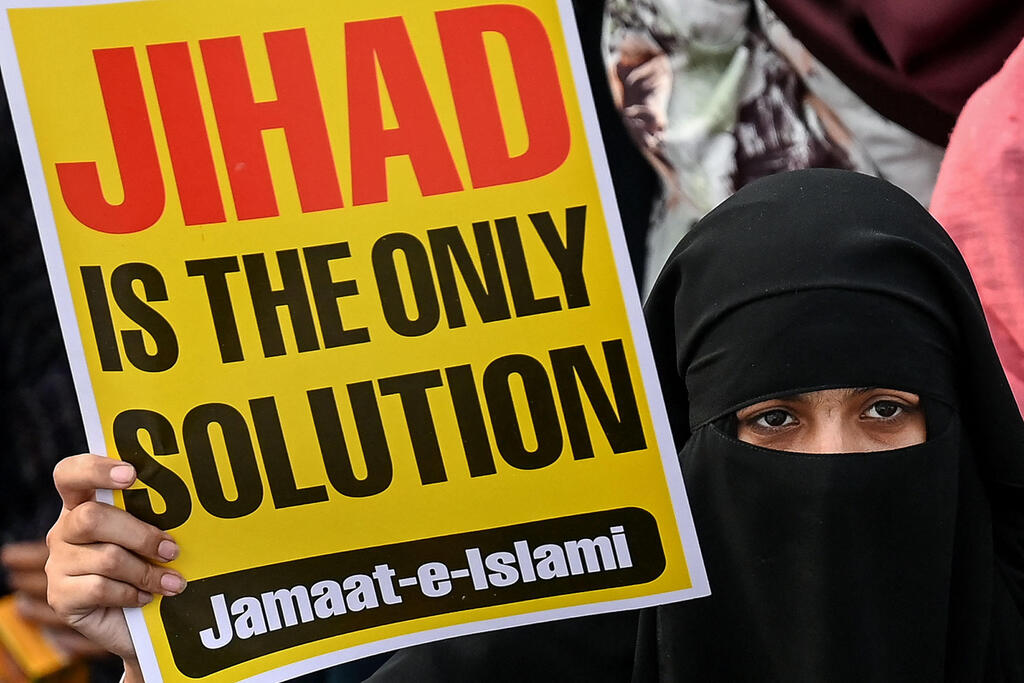
(Photo: Aamir Qureshi / AFP)
Other worrying data emerge: overall public support for Israel stands at 36%, compared with 37% for the Palestinians. Half believe Israel is committing genocide, while only 35% disagree. The trend is clear. This is no longer just the loud voices on campuses. It is the Democratic Party convention, essentially reflecting the voters’ positions. Even more than a third of Republicans are adopting the anti-Israel stance within their own party.
This is Israel’s lowest point in the U.S. We had hoped that Tucker Carlson, Candace Owens and Marjorie Taylor Greene—well-known Israel critics from the Republican Party—would remain marginal. We were wrong. Their influence is immense. How much more needs to happen for us to understand that this political collapse is not a forecast—it is a real danger?
Is the whole world against us? We have countless legitimate claims against Hamas’ propaganda campaigns. Yet it is worth noting that most free-world countries sided with Israel when it attacked Iran. Without any Israeli pressure, the E3 countries—Germany, France and the United Kingdom—recently threatened Iran that if it continues to violate the nuclear agreement and refuses to return to the diplomatic path, the “snapback” mechanism under the JCPOA would automatically reinstate all previous sanctions.
 Ben-Dror Yemini
They didn’t just threaten—they turned to the UN Security Council on Thursday, demanding sanctions. Iran has 30 days to demonstrate its return to a diplomatic track, including IAEA oversight of nuclear facilities. This is a particularly significant step, with no regard for Iran’s near-economic collapse.
Pressure on Iran is certainly encouraging. But it is frightening to think about the changes that will occur in Western public opinion in general—and in the U.S. in particular—following an entry into Gaza City, if it actually happens. We have already suffered far too many illusions. There is no need for the additional illusion that this public opinion will not affect Trump.