



The recent surge in Israeli aid to Gaza—implemented abruptly over the weekend—was crafted hastily and in secret, bypassing the security cabinet. These emergency initiatives were primarily aimed at halting growing international backlash against Israel, fueled by what has become a successful propaganda campaign by Hamas accusing Israel of engineering a famine. Yet an investigation by Ynet and Yedioth Ahronoth reveals that these steps are little more than temporary Band-Aids. Meanwhile, other more structured plans—such as the proposed "humanitarian city" in Rafah—have been frozen.
The conduct of Israel’s political leadership since March has laid bare the absence of clear strategic goals or long-term planning for the Gaza Strip. This mirrors the pattern seen in the first, fruitless cabinet debate on Gaza's post-Hamas future in November 2023—a discussion that led nowhere and was ultimately shelved.
Gazans arrive to grab sacks of flour from humanitarian aid distribution


One of the most controversial ideas, floated in recent weeks—the construction of a “humanitarian city” to house hundreds of thousands of Palestinians on the ruins of Rafah as a voluntary displacement measure—is also quietly being buried. After Prime Minister Benjamin Netanyahu, frustrated with the IDF’s slow progress, demanded a backup plan two weeks ago, even that alternative has not materialized.
“There’s no decision to move forward and no alternative plan,” a senior security official told Ynet. “The political echelon was convinced a hostage deal was imminent, which would have included an IDF pullback from southern Gaza, so it dropped the idea. It’s been set aside.”
In recent weeks, the IDF has been stunned to watch Western governments—including Israel’s traditional allies—place more trust in Hamas’ Health Ministry than in Israeli sources. “It no longer matters what’s true, only what narrative you tell and how the world perceives it,” a source said. “We’ve taken a huge hit. The problem is that most of our decisions are made at the last minute, under pressure, instead of being proactively planned and diplomatically prepared to avoid these crises.”
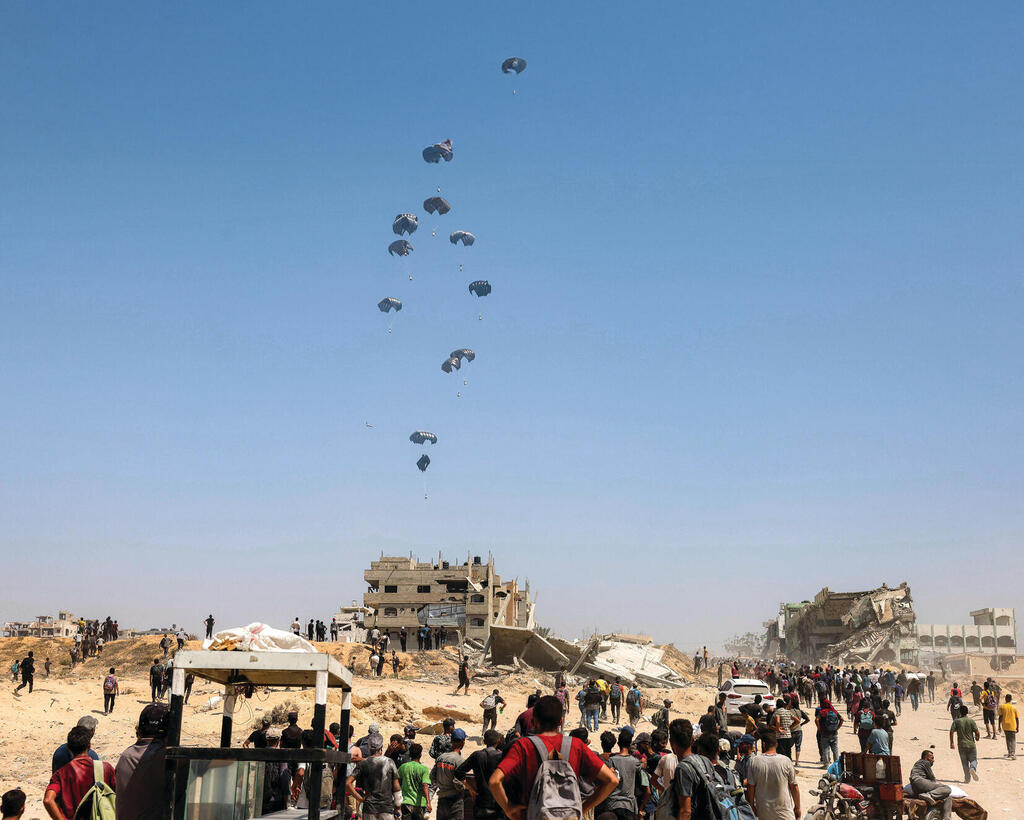
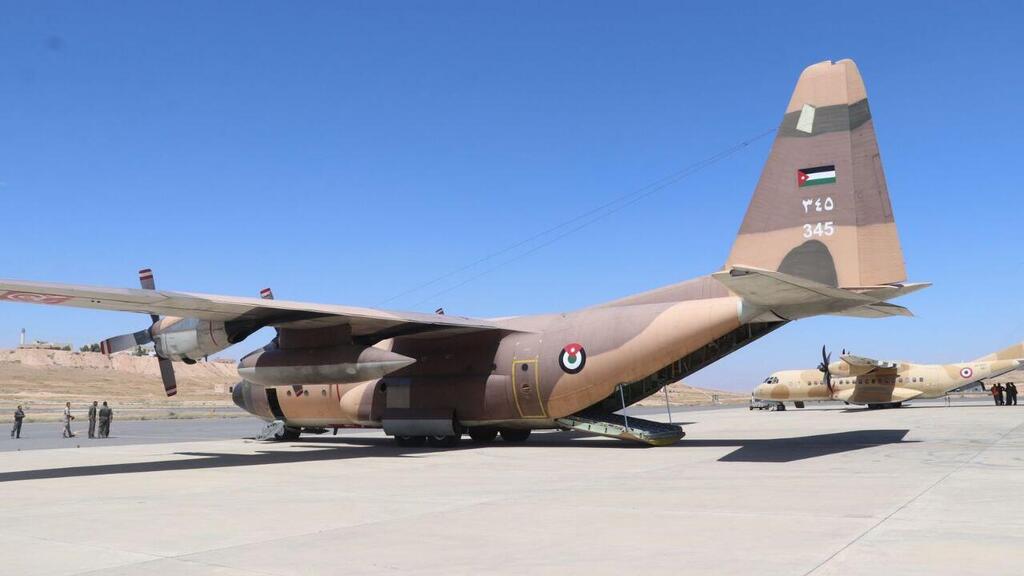
Jordanian plane prepares to drop humanitarian aid into the Gaza Strip
According to the IDF, the grim scenes in Gaza and Hamas’ false claims could have been avoided if Israel hadn’t blocked aid shipments in March for political reasons—mainly due to threats by certain ministers to collapse the coalition—and if the government had successfully coordinated food distribution with the UN. Back in early April, Ynet and Yedioth Ahronoth revealed that the IDF high command had urged political leaders to resume aid flows urgently to avert the kind of international crisis that could compromise the war effort.
The government dismissed those warnings. Finance Minister Bezalel Smotrich even vowed at the time: “Not a single grain of wheat will enter Gaza if it reaches Hamas. Read my lips.”
Within weeks, Smotrich was forced to reverse course. Dozens of aid trucks began entering Gaza—belatedly—through the Zikim crossing into the north, where they were promptly looted in the town of Al-Atatra. Meanwhile, the four food distribution centers that had been set up in the center and south of Gaza—once hailed by Smotrich as a “historic achievement to remember”—have become a tragic farce from every angle.
Despite this, the defense establishment still believes in these centers and maintains that, in areas around Khan Younis, Hamas has lost economic control because it can’t seize the incoming aid. Israel is expected to further invest in those locations. However, Ynet has learned that plans to double their number and establish four similar centers in northern Gaza have been frozen and are now at risk of cancellation. The reason: an impending hostage deal with Hamas, which opposes the distribution centers, could torpedo the initiative.
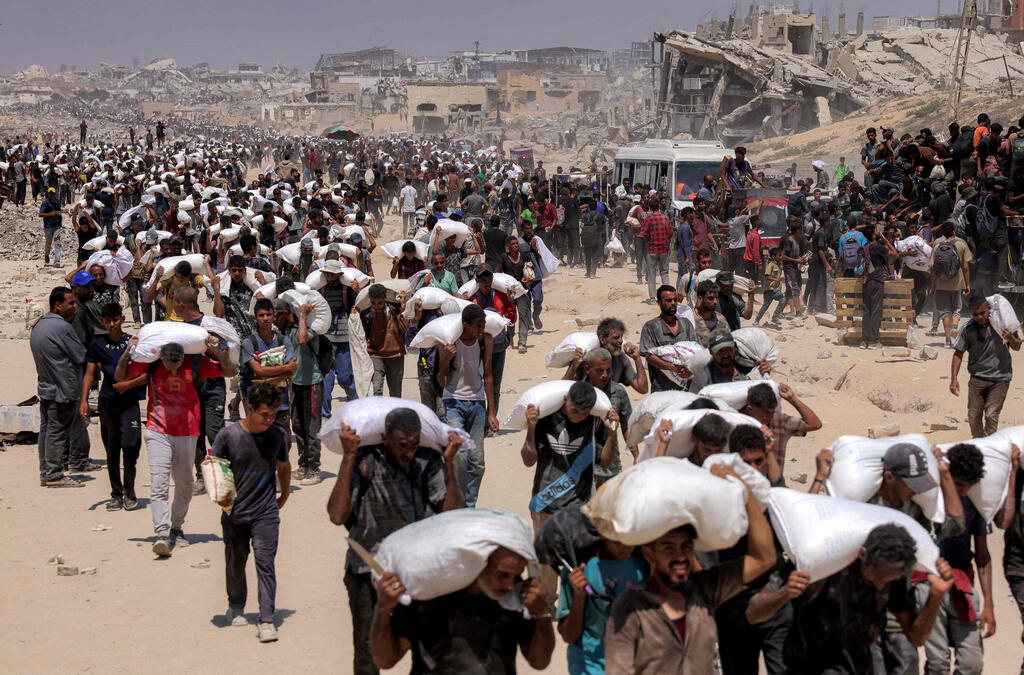
Distribution of humanitarian aid in the Gaza Strip
(Photo: Bashar Taleb / AFP )
The result is that in northern Gaza—home to nearly one million residents—a return to standard truck-based aid delivery continues, without the more structured, secure distribution Israel had been attempting to establish.
A humanitarian cease-fire like the one held yesterday in the Gaza Strip remains a controversial move, as it is unilateral and does not bind Hamas. The pause is intended to encourage civilians to move and collect the large quantities of food to be airdropped or delivered overland—though, once again, no Israeli authority is guaranteeing that Hamas will not seize the supplies. The terror group reportedly warned its operatives on Saturday to be wary of the Israeli “gift,” avoid using smartphones, and remain alert to surveillance, noting that the Israeli Air Force would continue tracking movements of operatives and commanders during the pause.
“The humanitarian cease-fires apply only in non-combat zones, and we have not opened the separation corridors for general movement,” explained Israeli defense officials. “Civilians may only move within unpartitioned areas (which include most of Gaza) to receive medical treatment and collect food. This is another declarative move to convince the world that there is no famine in the Strip. We’ve done it before, at the start of the war.” Security sources estimate that such humanitarian pauses will continue for at least the coming week, though they could be halted in the event of a major security incident or reassessment.
Get the Ynetnews app on your smartphone: Google Play: https://bit.ly/4eJ37pE | Apple App Store: https://bit.ly/3ZL7iNv
Israel’s historic airdrop of aid to an enemy during wartime—carried out by the air force’s Hercules squadron on Saturday—was followed on Sunday by five Arab aircraft: three from the UAE and two from Jordan. As during the early stages of the ground maneuver over a year ago, the aid was dropped from the air without any assurance it wouldn’t fall into Hamas’ hands. These airdrops are expected to continue in the coming days. The difference is that today, the IDF maintains only a few thousand troops in Gaza, in a scaled-down ground operation, which was reduced further last week in Khan Younis. At the height of the war, some 30,000 troops were operating across most of the territory.
These new aid channels are also intended to align with potential broader ground operations. The IDF has authorized the UAE to move forward with a plan to build a new water line from an Egyptian desalination plant in Sinai to the displacement camp in Al-Mawasi. Construction is expected to begin soon along the Khan Younis coastal route. The significance: this infrastructure could allow the IDF to take control of Hamas' stronghold in Al-Mawasi in the future without destroying critical systems, unlike many essential facilities damaged during months of heavy fighting.
The military continues to propose tactical solutions for Gaza, but they remain ad hoc and local, rather than the product of a centralized political decision about Gaza’s long-term future. As a result, the strategic achievements of the ground campaign—dubbed Operation Gideon’s Chariots—are gradually eroding. One recent measure aimed at reducing chaos is designating one day a week when only Gazan women are allowed to collect food at distribution centers, significantly decreasing shooting incidents at those sites. Israel has also pledged to the UN to increase IDF protection along the main aid routes: from the Kerem Shalom crossing northward, and from the Erez and Zikim crossings southward.
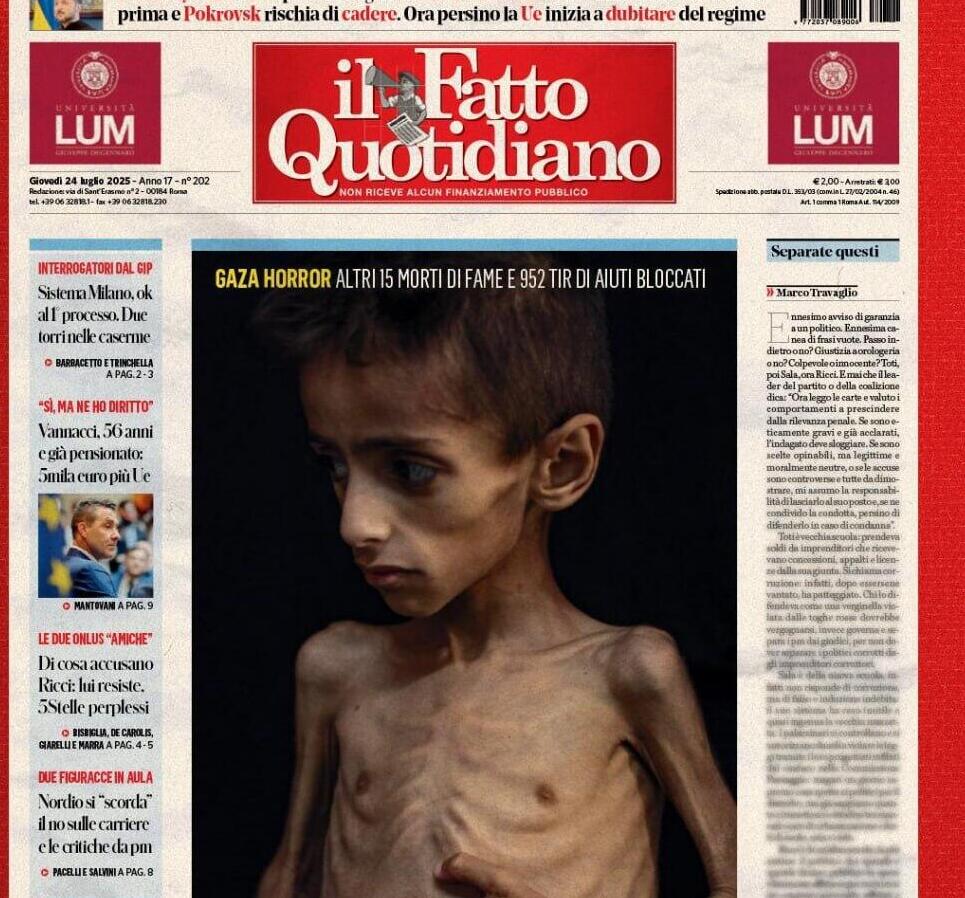
Cover of the newspaper Il Fatto Quotidiano showing a sick Gazan boy named Osama al-Raqab suffering from malnutrition
The IDF on Sunday revealed the goals behind Israel’s expanded aid effort: to more than double the number of trucks entering Gaza daily, targeting about 150 per day. “There are nearly 800 aid trucks waiting at the Kerem Shalom crossing. They’re proof of the world’s hypocrisy and the UN’s behavior—just 12 hours after resisting entry, they were fully cooperating after we dropped aid from the air,” said IDF sources.
The scale of this new Israeli move is such that, over the weekend, Prime Minister Benjamin Netanyahu approved the resumption of electricity supply to the southern desalination plant in Deir al-Balah. The plant is expected to deliver roughly 200,000 cubic meters of water per day to residents, mostly in central Gaza.
Israel also plans to increase fuel shipments to Gaza to about 400,000 liters per week and aims to deliver an unprecedented tonnage of food—unilaterally and without any deal with Hamas. According to the IDF, around 100,000 tons of food were delivered to Gaza over the past two months. Since Israel’s recent decision, spurred by mounting global pressure, that number has jumped to roughly 20,000 tons per week.
The challenge, however, is that such sweeping concessions were originally intended as bargaining chips in a hostage release deal—much like the arrangement at the beginning of the year.